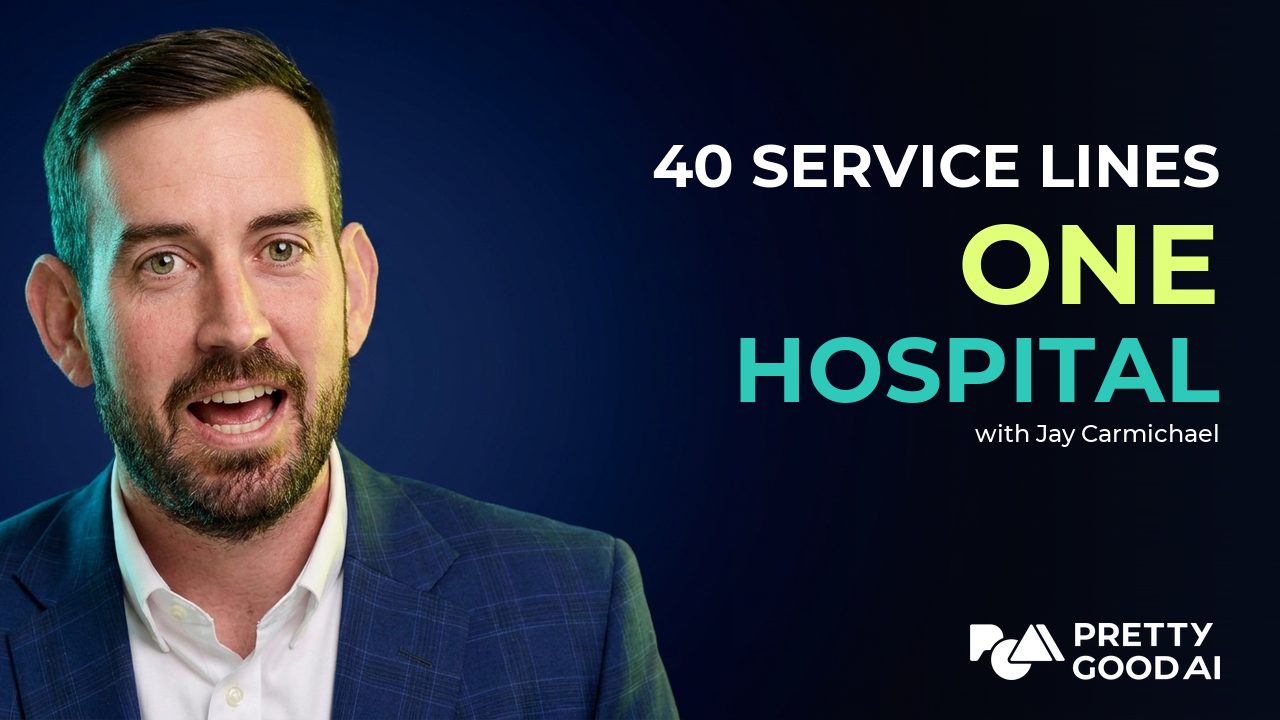
40 Service Lines, One Hospital
Jay Carmichael, CEO and President of Horizon Health, on growing a rural Illinois critical access hospital from 200 employees to more than 900, running 40 service lines most critical access hospitals never attempt, and where AI actually fits.
Key takeaways
- Horizon Health has gone from roughly 200 full-time employees to more than 900 in five years, pushing toward $150 million in net revenue across 40 service lines.
- Overstaff through a technology transition rather than understaff it. The savings from running lean during a go-live are never worth what breaks.
- Complementary beats competitive: Horizon partners with larger tertiary hospitals on service lines like urology and cardiology instead of going head-on against them.
- As the second largest employer in its county, a rural hospital is an economic engine first and a care provider second, the reinvestment stays local.
- The first AI wins are unglamorous: an ambient listening tool already surfacing social determinants of health that were being missed, and cutting hours of manual work out of building quality dashboards.
- Rural health transformation funding is welcome and nowhere near the scale rural hospitals actually need.
Most conversations about rural healthcare start from scarcity: what the hospital cannot offer, which patients have to drive two hours, which service line closed last year. Jay Carmichael runs the counterexample.
He is CEO and President of Horizon Health, a critical access hospital in rural Illinois that has grown from roughly 200 full-time employees to more than 900 in about five years and is pushing toward $150 million in net revenue. It offers 40 different service lines, a number most critical access hospitals would never attempt to staff in house.
His path there did not start in hospital administration. Jay sold technology at Cerner before moving into hospital operations, then into Horizon’s strategy seat. Coming from the vendor side of the table shaped how he now buys, deploys, and staffs technology.
What selling technology taught him about buying it
The lesson he carried over is about implementation, not procurement. Technology transitions fail on staffing, and the instinct to run lean through a go-live is exactly backwards. Jay’s approach now is to deliberately overstaff during a transition, extra hands on the floor, extra coverage at the desk, so the people doing the work have room to learn a new system without the schedule collapsing around them.
It is a more expensive plan on paper and a cheaper one in practice.
The shift from COO thinking to CEO thinking
Year one in the CEO seat is not a bigger version of the COO job. The operating role rewards a bias toward fixing what is in front of you today; the chief executive role forces the question of what the hospital should look like in five years and which of today’s decisions foreclose that.
The move Jay describes is from solving problems to choosing which problems are worth the organization’s attention.
Growing without losing the know-your-neighbor part
Quadrupling headcount is the fastest way to lose the thing that makes a community hospital work. Patients in a small county are not anonymous; the person at registration knows the person walking in.
Holding that while hiring hundreds of people is a culture problem, not an operational one, and Jay treats it as the real constraint on growth. Every new service line has to arrive without turning the hospital into somewhere that feels like a system.
The hospital as economic engine
Horizon is the second largest employer in Edgar County. That reframes the strategy entirely: adding a service line is not only a clinical decision, it is a local employment and reinvestment decision. Money that would otherwise follow patients out of the county to a larger metro stays in it.
This is also why the partnership posture matters. Rather than compete head-on with larger tertiary hospitals, Horizon looks for complementary service lines, urology, cardiology, where a partnership brings specialty care into the county instead of asking patients to drive to it.
Where AI fits today
Jay is neither dismissive nor breathless about AI, and the two places Horizon has started are both concrete.
The first is ambient listening in the exam room. Beyond saving documentation time, the tool is already surfacing social determinants of health that were previously getting missed, details a patient mentions in passing that never made it into the note.
The second is quality reporting. Building quality dashboards is hours of manual assembly, and an early effort at pointing AI at that work is aimed squarely at giving those hours back to the people responsible for the measures rather than the spreadsheet.
Neither is a moonshot. Both are the kind of thing that compounds.
Checked in before you walk through the door
Asked where this is all going, Jay’s answer is about accountable care and chronic disease management, a hospital paid to keep a county healthy rather than to see it in an exam room. The experience layer he describes to get there is borrowed from outside healthcare entirely: a visit that feels like a mobile order at a drive-through, where the check-in already happened on your phone and walking through the door is the last step, not the first.
The part he is skeptical about
He closes on funding. Rural health transformation programs are real money and, in his read, nowhere near the scale of the gap they are meant to close. A critical access hospital cannot build 40 service lines on grant cycles. It builds them by running the operations well enough to reinvest, which is the whole story of the last five years at Horizon.