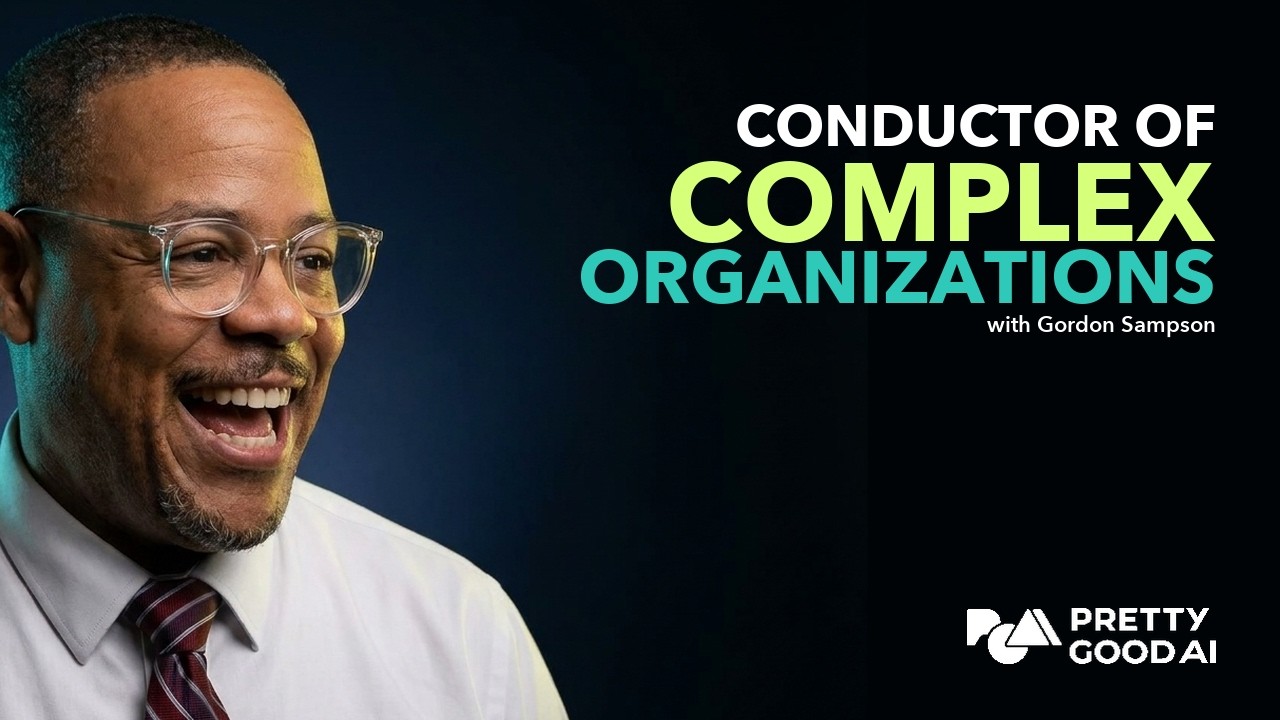
Conductor Of Complex Organizations
Gordon Sampson, VP of IT infrastructure and operations at Planned Parenthood Federation of America, on running technology for a federated organization he does not fully own, why the biggest surprise was getting back to basics, and why building your own AI may be the only way to keep control of your data.
With Gordon Sampson, VP of IT Infrastructure and Operations at Planned Parenthood Federation of America
Key takeaways
- Running IT for a federated organization means standards and security travel through dozens of semi-independent affiliates rather than a single mandate.
- The biggest surprise in his first 90 to 100 days was not technical debt but how much ground gets lost just getting back to the basics.
- A conductor can fully control only his own attitude and approach; beyond the team, leadership is concentric circles of influence.
- Shadow IT and AI adoption come back to the same work: identify your customer and get to one source of truth before any tool goes on top.
- Silicon Valley now asks Washington to slow AI down instead of asking it to get out of the way.
- More organizations may need to build their own AI just to keep control of their data instead of losing it to the cloud.
Most IT leaders run technology for an organization they control. Gordon Sampson runs it for one he does not fully own. Three months into the role of VP of IT infrastructure and operations at Planned Parenthood Federation of America, he joins Kevin to talk about what it means to set standards and keep systems secure across a federated organization of semi-independent affiliates.
Ninety days in, back to basics
Gordon walks through his first 90 to 100 days on the job and the biggest surprise he found. It was not technical debt. It was how much ground gets lost just getting back to the basics: the fundamentals of running infrastructure and operations that have to be re-established before anything more ambitious can happen on top of them.
A career that travels well
Gordon traces his own path into healthcare IT, from a National Institutes of Health internship to a converted morgue at Georgetown’s cancer center. It is a career he describes as one that travels well: infrastructure and operations skills that transfer across organizations, even when the organizations themselves could not be more different.
The conductor and the concentric circles
Gordon describes himself as a conductor. A conductor can fully control his own attitude and approach, and everything beyond that is influence: concentric circles that start with his own team and extend outward to the rest of the organization and the affiliates beyond it. It is a framing for leadership in a system where nobody can simply mandate compliance.
Shadow IT and one source of truth
He applies the same framing to shadow IT and AI. When teams adopt tools the central organization did not choose, the answer is not only enforcement. The work is identifying your customer and getting to one source of truth, because any AI tool added on top of fragmented data inherits the fragmentation.
When Silicon Valley asks for brakes
Gordon also shares a striking read on Washington, where the posture has flipped: Silicon Valley now asks the government to slow AI down instead of getting out of the way. And he closes on a point about control that every healthcare IT leader is quietly circling: more organizations may need to build their own AI just to keep control of their data, rather than losing it to the cloud.
Transcript
Read the full transcript
Who's your customer first?
Who's your customer? Identify your customer. If you got a whole bunch of different customers, all right, where do these overlap functionally? Forget your org chart. Functionally, what are the teams? And you start holistically there, then you add in your data, you add in your tools, and you try to get to it some sort of source of truth.
You're listening to the Pretty Good AI podcast. Today's episode is about running IT for a system you don't fully own. Standards, security, from the center, execution spread across dozens of independent operators. Every healthcare organization wants to modernize. Fewer of them are honest about what it actually takes when you can't just mandate the change. And we've seen this across organizations we work with, but Gordon's had a front row seat working in university healthcare systems and now.
As the VP of IT and Infrastructure and Operations for Planned Parenthood Federation of America, trying to standardize and wrangle a system he doesn't fully own. But I think the most amazing part of our conversation today is the process and the way that he thinks in terms of how to step into a new organization. And so we get to see both his thinking of how to come into an organization and then his thoughts on AI and where that's going. Let's jump into it.
Thanks for having me. I'm really looking forward to the conversation.
So you're about what, say, three months into this new sort of role at VP of IT infrastructure and operations. So it's a it's a mouthful. Maybe why don't we start with that? Like what is that sort of encompass and and what has that been so far?
Well, it has been everything the title kind of would lead you to believe that it is. it's a big role.
And I've started asking people what it means to them, first and foremost, and just listening so I can get kind of a little bit more of the ethos in the culture of what
Yeah.
I'm kind of walking into. but there's some universal truths. And I think that those are the things when you talk about customer experience, you talk about operations, you talk Infrastructure, you're talking overall service delivery. And I think that that's the game that we're in. And it's evolving, obviously. But I think those are sort of the building bricks and cornerstones that I kind of walked in here with and been trying to kind of use that as a conversation piece this first 90 to 100 days because you never get this time back. So yeah.
Yeah. What's been your biggest surprise kind of in these first ninety or hundred days? Technical debt, undocumented integrations, like shadow vendors, you know, something in the org chart. Is there anything that's like, wow, I didn't expect that?
Yes. So like it's been it's been a bunch. I think the biggest maybe not unexpected, but just you know, how to move forward from it. You've we've gotten a lot of consensus and this isn't the first time this has happened where it's just People who are very aligned and groups that are very aligned can sometimes still be fragmented.
The conversation about how to close those gaps is where the the the the magic is made I think it's meeting organizations where they are in that journey and then starting from there. And sometimes I think the biggest surprise has been all the tools, all the processes, all the things, getting back to basics has been the biggest surprise for me in this sort of era where we're pushing forward. Everybody wants to be leading edge, bleeding edge. You don't hear people really talking about the building blocks that are the basics of you being able to even be any of those things. So I think that that's been the the the the the I would say most ver most surprising but most energizing and exciting thing so far.
I think going back in time, I mean, you started your career kind of in the university system or education system, but but actually the healthcare part of that, right? It's it was actually the you've actually been in healthcare a long time. walk me yak to that first job and like what was that like? And what was healthcare IT kind of what did that look like back, you know, in the early days?
Well, the the the fascinating part about all of this is again thinking and and we had talked and my my first kind of step into this was in the early two well late nineties, early two thousands. not trade secrets or anything, Georgetown University, right? I was working in the university's medical center, and I was a university employee, but it was my first exposure to a managed services company that was working shoulder to shoulder with us. And as we j shuffled things Around my assignment booking in the Lombardi Cancer Center.
Some of my colleagues from back then will remember we we sat in a re fabricated morgue. They
Yeah.
they moved most of the material things in the morgue out, not much else and just put some desks in there for us and you
Yeah.
shouldn't be behind your desk anyway, you should be out here closing tickets.
Right.
Yeah.
That was a fascinating experience. But I actually even thought, even before that, my actual first internship that I got, and it was I was a high school student, and it was at the National Institute of Health. And I forgot that in my own story, right? I had started
That's wild.
out at a science and technology high school, and I was on a biology path. And I thought that I was gonna be a biomedical engineer for a second, and I mean a quick second, because I got
Yeah.
in and it was like, this is a lot.
But I was able to get an internship at the National Institute of Health, and I just worked in the lab. Again, wasn't so much connected to the science, was more on the tech, just viewing the tech and how the microscopes engage with the instruments and all the things. But then, and you know, as you're in these environments, and this would be some advice I would give to all young people, the beauty about the industry we're in is it travels well. You always get paired with other industries, and if you get your Open and your hands on, you're gonna absorb some of these things. So I've become unbeknownst to me a healthcare sort of mission-driven service provider. And it it I will not say that it is something I set out to do. I let the technology and the path of my career follow me there and That's sort of, you know, the early beginnings of me sort of getting involved with the healthcare sort of in help the health healthcare tech.
Yeah, I I love the travels well. pivoting a little bit, you you kind of frame yourself as the conductor, right? A lot of moving parts, like one person sort of arranging them. You know, where do you draw the line between like what you can control and what you influence?
Ooh, that's a great question. may not be a great answer, but it's it's sort of my answer. That tends to happen organically, right? I think it really is about meeting the org and meeting your team where they are. Right? You can be more the the controlling part is.
Functional, right? Anything that we know are these truths that we hold on to. The ideation part and in in conducting that is aspirational. So if you can work yourself backwards from where you want to be and bridge the gap between where you are, where you are today, you can control, right? You can control your path on where you want to be.
But the things that you can control, your approach to work, your personal ethos, your commitment to service delivery and overall sort of operational efficiencies and excellence. Back to that point about a traveling well.
You get in these new roles, you're like, all right, let me do a bunch of research, let me do all the things. Do what you've already always done to be successful.
And I think that that's the part you can control. You can control you, you can control your attitude, you can control your energy, you can can you always have a choice in controlling that. Everything else, falls out on that. But I do think that there's certain things, once you get things nailed down, you get your metrics in place, you get your internal sort of workflows, you start thinking about those circles of influence, right? You start with you as the individual, something it builds out to your immediate team, gets to your division. gets to the org, it gets outside of the org.
A lot of other things, I can't control that unless I'm given the authorization, as a lot of other people in my role are, including me, to sign off on things, right? Like I can't sign off on something I didn't sign on for, all all the things in the middle. So I think that that's where I get the the difference between, you know, what you can control and and what you can influence.
I love that thinking of like these concentric circles. And I'd love to like get your thoughts on how that applies to the technology layer. Like we think of like identity, network, endpoint logging. Like you really get nerdy on that stuff. But I'm curious, and we've had this like in my past life, like shadow IT, right? Like, you know, all the consumerization of IT, like I just go download, you know, Dropbox or an email app and I just connect it to the IT system and start using it. And obviously today, the AI is Obviously, the one that everybody's talking about of like how are people using AI both in the workplace? What if that is sanctioned by IT? What if that is sort of just, hey, they open up their phone or they take a picture of something or they type in something and they sort of get it?
Cause I think with shadow IT, it was always like, well, we could lock the password down, or you know, you how you could lock this thing down or that thing down. They couldn't log into this system with that set of data. But I'm with I with AI, it's a little trickier, right? Because it it is a little more, you know, ubiquitous in terms of how it works.
What have you seen? And then and then what is your sort of thinking of where that goes?
Well, I th I love this topic and I love this question.
And you talk about the fragmentation, right? So if if we just use that as an analogy and we talk, and I can tell you we go back twenty-five, thirty years, and you step in and you say, all right, we have consensus that, for lack of a better phrase, thought leadership maybe, fragmented. We have shadow this, and we have internal that, fragmented. You've got internal groups that You know, are you apps? Are you infrastructure? Are you support? Are you these things? A little bit fragmented. You have all of that. How do you how do you without identif addressing that come up with one size that fits all? Before you even get to the tech, right? So you're right here in this part. So what else do you have to do? Okay, everybody as the facilitator in the middle.
What do you need, right? What do you what do you need to to do the thing that you do? Is it a tool? Is it data? You have to start very holistically, in my opinion, humble opinion, with those conversations first. And I again back to this first sort of 90, 200 days here, back to some of the universal truths.
Who's your customer first?
Who's your customer? Identify your customer. If you got a whole bunch of different customers, all right, where do these overlap functionally? Forget your org chart. Functionally, what are the teams? And you start holistically there, then you add in your data, you add in your tools, and you try to get to it some sort of source of truth.
And if you can get to your source of truth and you can govern the inputs around, everybody's heard this phrase junk in, junk out, right? If you can get to where you are providing a good clearinghouse for all of that, then it makes the conversations a little bit easier it's not rocket science, but it's very interesting how it can be undervalued these days, I think.
And then you know, you hear high level, you know, I I attend a lot of sort of think tank things with other leaders and what are your top three things? Like AI, security, data. Whatever order, right? Most people pick the same order. And then when you start with the data, right? So before AI, before before AI security, w what's your data set? And then you start to dig in there and I think that that's where, you know, you you start, that's your input.
I mean, for an organization like yours, you sort of have this affiliate model, right? Where you've got like semi-independently run and as an IT sort of, you know, sort of orchestrator across all of this, like I'm sure there's been different choices made for both good and bad reasons as that has grown and organically. How much of that do you try to template out and say, Hey, this is the, you know, the stack that we like or prefer versus, you know, hey, they're running their own patient portals and then because of that, now they have their own.
EHR CRM looking thing. So patient access now becomes, well, now I've got to integrate with many different things. Like how much of that has been a challenge for you versus you're able to sort of like send out a template and say, hey, this is the kind of tech stack that we want. And then maybe that doesn't all evolve over time, but is the goal to eventually sort of try to like harmonize that?
I think it is. but even if if we're talking, like you said, I would call it a federated model, right? Where
Okay.
you've got, you know I won't even call I if you you've got a bunch of entities, right, that loosely, maybe not directly, that loosely roll up that in into that relationship where you want those individual pods that are out there to have their autonomy and you want to be an advisory board. That the challenge in being an advisory or consultancy is you wanna know that you have the consultant who's advising you, that they're kind of living by their own best practices. practices too. And so that's where it gets tricky, right? So I think that even if you look at the university system, right? You've got a university, but you've got respective colleges, right, who bring in their own funds that may or may not map to an initiative particularly re related to IT. So they're running in tandem and you do get the shadow. That's where you do get a little bit of fragmentation. The Nirvana of it all.
Is to be able to allow that, not govern that part of it. Doesn't matter what you use. You can use some of the tools, all of the tools, or none of the tools in the seat as you're as you're governing this sort of decentralized sort of landscape. What you have to do again, back to that: what is the source of truth and how do you synthesize all of those different sort of work products, outcomes?
Synthesize it to be able to report on a in a cohesive way that includes everything. That's the that's the challenge. That's the challenge. But it goes back to if you provide the autonomy and the sandbox, have the right thought leadership with the right connected conversations, you'll be able to meet, I hate to say it, you'll be able to meet in the middle somewhere. And that's
Yeah.
what the that's what the goal is.
Man, in healthcare, it's wild. Like the chatbot can do one functionality, like the form sitting right next to it that for a web form can do another. And then when you call, you get a completely different experience. And then if you text, you get another experience and it's like different numbers. And it's it's amazing. Like today, that what we've seen is that you know, over these last 30 years, like tech has been built in such this fragmented way for healthcare because it was so challenging. And now with AI, it's like we're sort of in 30 days or 30 weeks. many times rebuilding 30 years of sort of legacy. but it it that's challenging, right? For someone in your shoes to say, hey, like, which one do I pick? And to you said everybody's an AI company now, right? You know, your phone vendor's an AI company, your operating system's an AI company, right? Like, you know, the the the door locks that are running at the building's an AI comp everybody's got, you know, I'm an AI company.
What what if we zoom way out and say, let's just look like three years from now? And I that's you know, a many lifetimes in today's speed. What is the infrastructure and what is in good shape look like to you?
Yeah, I think that what you're gonna continue to see is the persona is the sort of out emoted outwardly result of these conversations now. Because it's it's started. It was it was we kind of backed our way into these talks about governance. I mean look in the look in the news, now now everybody's saying, Hey, government, get involved, please. We went when when does that ever happen?
Yeah. Right.
Right? All right. So they're saying somebody needs to get involved to
Yeah.
regulate us, because this is a lot. So I think that the now that that is in the forefront where where it has been a trailing sort of thing, we were able to well, I could say maybe in some other industries, you're able to slow it down by saying, Okay, wait, we wanna do the thought leadership.
I think now that we've gotten on the the the thought leadership trail it will be the or the organizations that are able to accept everything synthesize it in the middle, which I think is coming because now you're getting a lot of folks saying, raising their hands and saying, I'm maybe we can develop this ourselves. Then do we need 10 AIs or do we develop our own for one? So then we now have control on the back end on what inputs we bring in. the the thought leadership conversation is gonna be okay. We know we can't have fragmented data, the data we have it has to be secure, we've got to get to a source of truth so we can get the output that we want and not be held liable for our AI telling it somebody somebody something that isn't inaccurate, right? And then you've got now we we know that we'll have all of the security around that as well. So I think in the next three to five years the conversation will evolve. I do. I I think that the governance part Of it would be all right, we kind of have heard that now. And it's it's it's fascinating to me because I was talking governance around AI when machine learning was a thing and they were calling it that, and you're dumping
Yeah.
stuff into Watson, right? It was the same thing back then. I'm like, guys, same deal. Junk in, junk out. Eventually,
Yep.
we'll get to where we're not talking about that anymore. And you don't hear a lot of that anymore. And again, it evolves. I think we've we've gotten to a place where now this is so buzzy. Thought leadership, governance, truth.
Transformation, centralization. They're now they're in the zeitgeist now as universal truce. So now the race is on to who's gonna be the the group or groups that galvanize all of that the best and the quickest. And I also think the groups that are mature enough, if they're on the front edge of this stuff and they start building it themselves, what does that look like? So I think that that's the that's what's probably coming next. And it's probably already here in a lot of ways.
I love it. I think one thing we didn't say at the top show, like you're in DC and you've been in DC for a long time. So I you're, you know, when we talk government,
Yeah.
I mean you're you're across the street or down the road from it. and and I would love your perspective. So I'm Silicon Valley, been in the Bay Area, you know, for most of these 30 years. And for us, you know, government was always this thing that slowed tech down that got in the way. You know, like that was kind of the the Silicon Valley mindset. I'm curious from your perspective, kind of being in technology and IT.
But around, you know, kind of the DC, you know, your sort of local news and your local circles, I'm sure have been talking about this more. How has that changed like over the last couple of decades? Right? Cause my senses it's been a lot different.
I love that question. So you kinda answer what we just talked about when we said s slowing things down back in the day. Who slows it down is the government.
Yeah. Right.
The evolution is now Silicon Valley AI is is groups are asking for the government to slow things down.
Yeah, yeah. Right.
Fascinating, right? So that you kind of backed into everything we're talking about. So that is the government, right? That is governance. Slow down. Let's get put some thought behind this. I'm sure you can do all the things we know, but we need to put some guardrails around this. That's literally what is happening in front of our faces right now. However, the thing that I am most fascinated by is this.
Inverse paradigm shift where the government is actually leading some of these things now. Where the government are ahead of the private entities, and that has been the biggest change. Typically, you're going get private entity from government to come in and push you fast. Now it's like the private entities are saying, slow us down. And while you're at it, here's some tech. You guys go out and do it first. Let us know how that goes.
Right. Trial balloon model. Yeah.
That's the biggest change I've seen. Yeah, that's the biggest thing I've seen. over the last thirty years, the biggest change I
Cool.
would say.
I love it. Last question. In your opinion, what's the biggest opportunity kind of in AI kind of healthcare operations like that you see as like that nobody's really talking about yet?
he the the tough one with that is that there is really no stone that's been unturned at this point. I think that the the biggest thing that I could see is the build it yourself model, right? And I think there are a lot of thoughts around the escalating cost.
Of it all. And if you escalate those costs and you lose more and more control in your mind, right? And it feels that way, where does that really leave you? Like, what does that really get you? Right? Somebody gives you a call and they ask you about your business. You're like, I don't know. Let me type in, let me type in and ask. That gotta be unsettling. That would be unsettling for me, right? So I think that that's the part where it's like, you know, what what nobody's talking about. I don't think anybody's the the the people aren't talking about that. But I think that that's something that should be sort of considered. And I think based on that consideration, it's like how do we get back control of the robot a little bit, right? Do we build it ourselves? Do we buy it? Not sure, but at least we're having that talk now.
It's cra it's crazy we ended there as I think about this. Like one of the things that we've always said is we don't sell AI, we build yours. Cause our view is that like to your point, the the end game is pretty clear, right? If we all have the same tech and the tech becomes very cheap, like organizations, the value is in the data, the security, like you really want to own that, right? Like you don't want that sitting in somebody else's cloud or in you, you wanna be able to have like that sort of thing be yours because it it is your business, just like you would never You know, Coke would never share the the recipe. Like there's that's kind of the recipe of a lot of these organizations is that context and data. And so, really interesting way to think about it. but yeah, awesome. Gordon, this has been amazing. Like, where can listeners connect with you? where where would we best find you?
you can find me on LinkedIn. I'm pretty easy to find.
I love it.
Thank you so much for spending time with me and I'm excited to to share this with folks.
This is fantastic. Thanks for having me.
That was Gordon Sampson. Just an absolute masterclass and a discussion about how to run large, complex IT organizations, but also really that sort of grassroots understanding of what does it really take to see technology transforming at the speed of AI? And then some really cool insights around him being in DC for so long and understanding and seeing how the government and that tech relationship has changed over the past few decades.
Top five takeaways.
First, the role. Gordon spent those first 90 days at Planned Parenthood reinforcing the success that starts with the basics. What do you do? What's your title? What do people do? And really just understanding and listening. Two, Tech travels well. I've seen this in my own career. But his path in high school, working for the National Institute of Health.
Then Georgetown's Cancer Center through other universities, and now at Planned Parenthood. Control versus influence. You can control your attitude, your approach, and your influence grows outward from there. AI starts with the data. Clean, secure data in a single source of truth have to come before any AI tool is gonna see success. And finally, The big shift. Tech is now asking the government to slow down and help them sort of set up what are the guardrails that we should use. And really, that building your own AI may be the best way to keep control.
And that's what we do at Pretty Good AI. We build AI systems for athenahealth practices, help them with front desk operations, answer phones, texts, faxes, video, and then also on the back. Insurance, prior auth, billing, really sort of allowing the staff to get back to what they do well, which is caring for patients, and make sure that patient access is never down.
If you're running athenahealth and are looking for help with strategy around your AI, drop us a note, prettygoodai.com. And if you're operating IT inside of a federation like Gordon, a franchise, or any multi-state model where you don't control the front line, share this episode with someone on your team living that exact tension. And make sure you're subscribed to the Pretty Good AI podcast. We'll keep bringing conversations with operators building in the future of healthcare.
That's the show. And if you got something you could use, share it with another operator that could also learn something. I'm Kevin Henriksen from Pretty Good AI. We'll see you next time.
Transcribed from the episode recording, with names and spellings corrected.