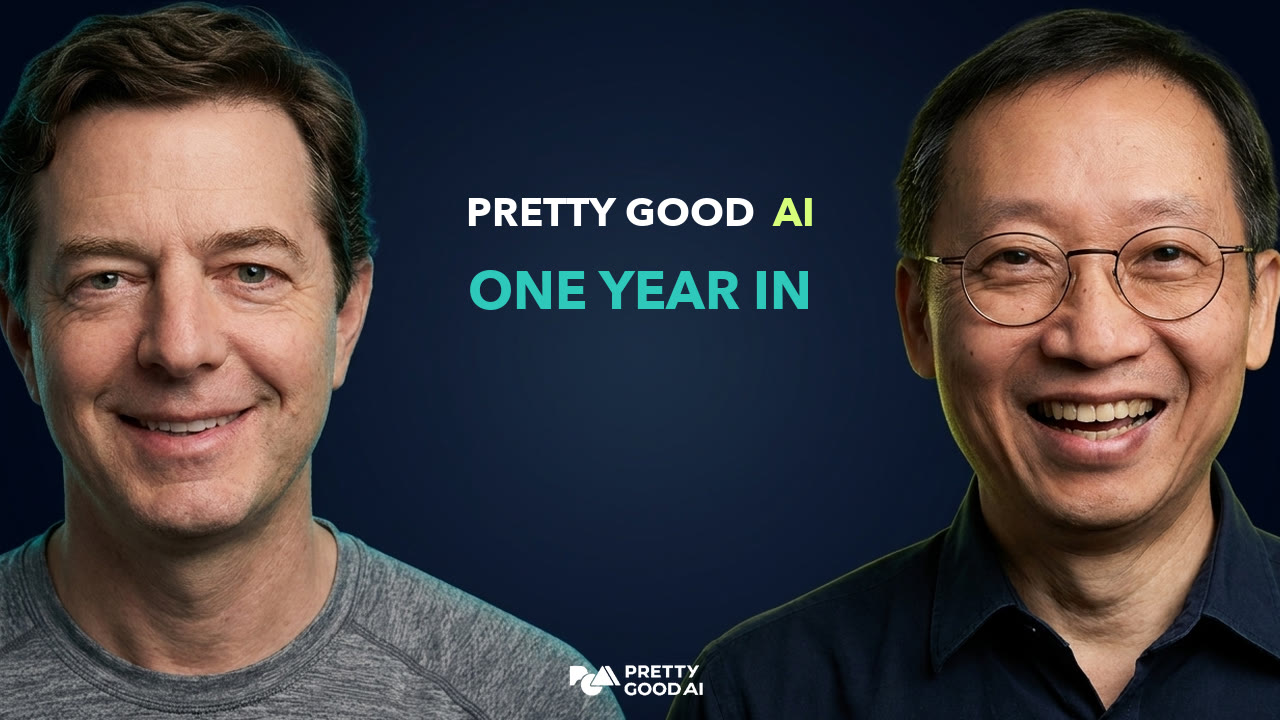
Pretty Good AI, One Year In by JJ Zhuang and Kevin Henrikson
Pretty Good AI co-founders JJ Zhuang and Kevin Henrikson reflect on a year serving athenaOne practices: why they started with the phones, what practices want from an AI team, and how they build around each customer.
Key takeaways
- Personal experiences navigating healthcare led both founders to focus on making it easier for patients to reach a practice and get care.
- They started with phone calls because patients still call their doctors, and voice had become a problem AI could meaningfully help solve.
- Practices want a trusted AI team to help them adopt the technology, not just another piece of software.
- Usage-based, month-to-month pricing without implementation fees gives practices room to try a new approach without a long commitment.
- Small teams of generalists and compliance built into the engineering process let the company adapt its work to each practice.
One year into selling Pretty Good AI to athenaOne practices, co-founders JJ Zhuang and Kevin Henrikson sit down together to look back at what brought them to healthcare, what they learned from practices, and where they want to go next.
Why healthcare became personal
JJ grew up surrounded by physicians, but his own experience navigating care after a ski accident made the gaps in the system tangible. His doctors helped him recover; getting through the surrounding process was much harder. Kevin shares how his father’s health complications and his wife’s cancer journey showed him the same struggle from the patient’s side: coordinating appointments, surgeries, and providers takes more effort than it should.
After talking with practice staff and administrators, they saw the other side of that experience. People dedicated to caring for patients were working with disconnected tools that made simple tasks difficult.
Starting with the phone
Patients still call their doctor’s office even when other channels are available. Answering those calls is hard for practices, and voice technology had reached a point where JJ and Kevin felt they could help. They chose that problem as their starting point rather than looking for an easier task. Early work with their first customer gave them confidence that the approach could work, even as they continued to improve it.
From software to an AI team
Both founders came from building software, so their first instinct was to make the best product they could. Conversations with practices changed that picture. JJ says the teams they met needed people who could help them figure out how to adopt AI across the practice, and many could not build that team themselves.
That realization shaped how they work with customers. Kevin and JJ discuss a usage-based, month-to-month model without upfront implementation fees or a long-term lock-in. The goal is to build something a practice can actually use before asking it to commit.
Building for each practice
The conversation turns to the people and processes behind the work: small teams of generalists, curiosity in hiring, and making compliance part of engineering from the beginning. They also discuss patient referrals, the challenge of deduplicating requests across channels, and the opportunities ahead in prior authorization.
JJ sums up the approach with a line he has been refining throughout the year: “We do not sell AI, we build yours.” His advice to healthcare founders is to stay open to the scale of problems AI can now help address, while paying attention to the small changes that matter in a practice every day.
Transcript
Read the full transcript
as product and engineering folks, right, very often we get upset that our salespeople overpromised, right? because they they were trying to sell things that we didn't have or you know missing features or whatever.
But today it's almost like I'm begging you to oversell because it just becomes like a completely different mindset, right? We're we're living in an age that anything is possible as long as we have the right ideas.
We're now about a year into sort of selling Pretty Good AI to athenaOne practices. And, you know, I think it's a good time to kind of reflect, but also take a step back of like how did we get where we are today and then where are we going? So excited to just have me and you today.
Yeah, that's great. Let's get into it.
Awesome man. So you and I have worked together a long time now. I think we're coming up twenty seven years, twenty six years. And twenty six.
Twenty seven twenty six so far, because you know, it's very easy. We s we met in the year two thousand and we started working together since then.
I like it. Yeah. So the zero zero. you grew up in a medical family and parents, uncles, physicians. how did that shape kind of the idea when we first started thinking about, you know, both AI and then healthcare?
Yeah, I think you know, coming from this kind of family background, you know, medicine is always a familiar topic, right? You know, at dinner tables the conversation is all about like, you know, what kind of patient everyone saw that day and the challenges and so on. So it's a always very familiar topic. But I think that even though I always thought about okay, you know, we're in healthcare related things in my future as as I think what really made it close to to to me personally is this topic many years ago I had a ski accident and then it just shattered my leg one of the legs and navigating the healthcare system to get you know fully fixed and you know There were some incredible doctors, right? They they it really fixed me up so that I can walk again and just like as if nothing happened. It's it was a miracle, but at the same time, while you know, the doctors are great, navigating the healthcare system was difficult, right?
Getting things done was difficult. And considering like a you know, someone like me who already ha probably have better than average access to to healthcare, it's already so difficult to me. I can imagine that it must be very difficult for many people. So, you know, when Kevin, you and I thought about what we should do next, This topic came up and so we looked into it and you know turns out that there's just so many challenges in in healthcare system. And we now also feel AI is a get a good point that it is capable enough to finally be able to do something about it, right? So you know you and I are both engineers, we came from that background. It's all about solving problems. First is like we want to establish there's a problem to solve, and then also, you know, can we do something about it?
In this case, both checked out.
Yeah. And and for my side, I think my father had a lot of health complications before he passed and sort of seeing how he worked with the healthcare system. And honestly, that was, you know, a lot of the way he spent the last sort of ten years of his life interacting in and out of the healthcare system. And then I think my wife's journey with cancer now and seeing like that sort of journey and like the stress of like how that's happened both a couple of times over, but just this sort of Being on the patient access side of how do you get things scheduled? How do you figure out how to weave together the right set of surgeries and providers to be together? at the time I didn't realize like how much technology made that hard for the people on the other end. Right. And I think as increasingly we've learned together going into and, you know, sort of sitting with these healthcare providers and their staff and administrators, like how difficult it is to do things that.
We as technology would just think is simple, like, this would be like a two-click thing or a very simple progress to move something through the system. But for them, it's very challenging because the tools they have are so antiquated and so disconnected. And historically the vendors haven't been able to approach that from a way that we're able to approach it today. And so I mean, healthcare is a big space, but maybe you can pinpoint that moment where.
We sort of decided like this was the thing we should go after and and then sort of what were the next steps that we took to kind of move through that?
Yeah, I mean, you know, there's challenges everywhere in healthcare. Once we sort of like peel the onion, right? And also Kevin, you know, when you mentioned your your dad and your wife, I remember so many calls we had you were calling from hospital, right? Like a lot of meetings you were taking from hospital. and also you know, once we started talking to you know potential customers, providers and the staff.
It just feels like, you know, these people they're literally they're dedicating their life to provide care to people, right? They really, really deeply care about what they do.
And you know, it's just like you can't help admire these people, right? But at the same time, as you said that the tools are always getting in the way. Wherever they are using is antiquated because you know, in the last twenty plus years a lot of legacy software got built up, you know, and people have to live with them, right? So you know we both feel that there's something we can do, we can do better. And then in terms of where we want to start, if it turns out to like, you know, not just our own experience, but when we talk to provider groups, it's easy to see that answering phone is always a a a you know a problem.
Because a lot of calls every day. Most patients still call, even though they may provide web and mobile access, most people still call. Some folks they just associate a phone call with healthcare, right? Like you call a doctor's office. So we kind of feel that let's start there because Voice is hard. It's hard enough so that it's not a trivial problem to solve. But at the same time, now AI and the voice tech has become good enough, we can make it work. So we we want we don't want to pick a problem that is just too easy. We want to pick a problem that has you know that that's challenging enough so that we can spend a lot of time on it and do it right. So we start there and that you know the early test with our very first customer gave us a lot. of confidence. We feel that yeah we can do this. There's a lot of things that is maybe not perfect, but you know we're engineers. Those are the things we can deal with, right?
Yeah, I mean, we've been actively selling now to athenaOne practices for about a year. What's the biggest thing that surprised you on how healthcare practices actually buy?
Yeah. so you know, because both of us came from just a technology background, we've been building software and you know selling software for a while now. compared to when last time when we did for example accompli, when we were building a mobile app for email and a calendar, right? That eventually became Outlook. that was fun. but you know at that time it was about hey let's build the best software so that a lot of people love and want to use. probably approach the AI initially with that kind of mindset. Let's build the best AI software so that it's not only reliable, it's great, it's also, you know, easy to customize, easy to learn. But once we start to talk to customers, right, what we realize is yes, they need AI, but what they really, really need is somebody who can Hold their hands and learn like how to adopt AI in general, right? So what we really need is an AI team. But most of these practices, they are not at scale to afford their own AI team. So when they find somebody like us, right, they really want us to be their AI team. But at the same time, they don't want to use these words, right? Because it kind of sounds presumptuous to say, hey, why don't you guys be our AI team? But you can sort of read between Between the lines, that's what they're looking for. And you know, we you know obviously didn't come from this kind of consulting background, right? And we always see ourselves as product people, we want to build the best products, but with AI now we are in a very magical time because yeah, we build products, but why shouldn't we be able to build products differently for each customer. Because AI now gave us so much leverage, right? We can effectively do that. So we kind of like took on that challenge to basically see why shouldn't we be everyone's AI team? So that's how we start to operate and that's how we kind of engage customers. And then that message, once they understand it, they then see that totally this is exactly what we So I just say that that mindset change was very, very interesting for us.
Yeah, I remember in one of our earlier meetings, we were meet meeting with CEO and their board, and you and I were sitting across the table and they were like, Man, this sounds amazing, but how can I afford you? Like, how can I pay for this? And, you know, in the end, we ended up, you know, sort of designing a system or a pricing model that's usage-based pricing. There's no per seat fees to use the, you know, the phone system. We do have, you know, provider-based fees that map to sort of how providers grow. But I think a key part of that was it's month to month. There's no lock-in. We don't charge huge upfront implementation fees. We sort of show up with our tools and we get to work and we build something that the practice can actually use and deploy before we even start the pilot or sort of charging. in your opinion, like would we make that same call again? Or is that still the way if you had a clean sheet, you'd start over, was that the way you'd design it?
As a startup, we do want to have some predictability of our revenue, right? but you know, at the same time, after thinking about you know, I remember that you tried to convince me that this is the way to do it, right? And I was a little bit hesitant, but eventually I realized you know you're right, because If we have so much confidence in ourselves, right, then why shouldn't we have the confidence that we'll always do the right thing? We'll always build the right product for our customers. So there's absolutely no reason we shouldn't have the confidence that we'll earn their business every month, right? And you know, what if we just give everything that a customer can imagine they want?
At the same time, also take all their risks away so that they can make a zero-risk decision. I remember some of the calls you and I were on. Some customers, after the initial conversation, they basically tell us, this sounds just too good to be true. Right? And our mindset is: why shouldn't we? you know, make an offer to our customers that is too good to be true normally, but now it is actually possible because we leverage so much AI. Right? Look at you know, two years ago it wasn't just never possible to be able to do what we do. But today it's possible.
I think it's a big part of like how do we take the technology and tools that we have today and almost use that as a gift back to the customers and back to the organizations we work with. And I think to me, it is pretty insane. Like the hit, the typical way that software's been sold in healthcare, where it's two, three-year contracts, huge upfront fees. And as I've interviewed salespeople, they've even said like the implementation fees and a lot of those upfront fees.
Or almost like 50-50 split with the salesperson. Like they take half the commission in some sense. And so there's, you know, incent a bad person, you know, incentive for them to sort of charge high implementation fees. and healthcare providers are used to paying it or healthcare systems are used to paying it. And so for us, I think we've been fortunate, right? As you know, that you know, a hundred percent of the pilots that we've engaged in where the practice is engaged in that pilot is converted to live.
100% of those have converted to paying customers, and we've never lost a paying customer. And I think that track record, you know, is incredible, but a testament to this both the approach that we're taking, but also the care that we take to make sure that these kind of get through there. And I think part of this is this you you've talked about this, these tiny AI superpowered teams, right? I think those were the, you know, just a bunch of really weird words put together. But I I would love to know how you think about.
The type of teams we've hired and the team that we've built that allows us to sort of deliver this.
Yeah, you know, so Kevin, you and I have been working together for how long? Like you know, we said like 26 years, right? We built so many different companies, big and small, together. And every stage when we were building team, right? always feels, this time is so different. but like you know, when using accomplish again as an example, when we were building the mobile email app that eventually became Outlook, day one.
I remember we said, okay, we need to find the best iOS engineer, the best Android engineer, the best backend engineer, the best DevOps, right? So every role is a specialized role. It's an expert in this particular thing. Because it used to be that gaining experience in a specific space takes enormous amount of time and effort.
So you can't just say, I'm good at I don't know, like a database is I should be able to learn mobile and just pick up very quickly, right? It's it was very hard. But now that we are in the age of AI, the specialization becomes it's it's somewhat commoditized. It's not a fully commodized special ty specialization, special knowledge still you know makes some difference, right? But It the scale of that, it just changes it it tipped over so much, right? It just favors journalists so much. So that you know, day one of Pretty Good AI, we basically already recognized that we say, let's go find the best journalists from our past life that we want to work with again, right? So we put up put together the team that way. And it turns out that was the right bet because they can do anything now.
Right. So you know the team members who are taking on all the DevOps work, right? They used to have to we used to have the best DevOps person, right? But now engineers are doing that on their own. And same thing with web or mobile, anything, right? So so that's one difference. the other is it's also you know in terms of numbers of of people, right? you and I we had a you know how big was our team like a thousand engineer size team at Instacart, right? And it was a big team, it's like so many people to manage, right? at the same time, you know, the velocity, certainly everyone worked really, really hard, right? But when you have such a huge machine. there's a you know it creates like a own its own sort of like organizational burden as well, right? So we always love y small teams with a lot to do because that's very clarifying. We know exactly where the priorities are and we will not be able to do anything that is not the most urgent, the most critical thing today, right? So we always favor having small teams, but in the age of AI, small team also has now has the superpower because we can leverage so much AI and deliver a lot more.
So if we look at the throughput every week, right, even though the number of people didn't change, because the the technology, the underlying model got smarter. week by week and month by month, the throughput just keeps going up, right? So if we draw the the chart of like number of merges and so certainly number of mergers is not the only measurement of productivity, but it it's sort of like you know one of the proxies, right? And we can see that it just keeps growing, right?
Yeah, I think it's amazing, right? This this this notion of like ruthless prioritization because of the size of the team combined with this sort of approach that you you came up with, which was like, hey, if we hire, you know, we started with interns, right? We were hiring sort of an intern type model to expand the team and then realized that sort of new college grads or those with actually less work experience potentially may be a better fit for the model of what we're trying to build. Tell me a little bit about that and what you've seen.
In terms of how hiring changed. Cause like you said, I mean, at Microsoft and Instacart, we had thousands of people. And, you know, to interview that many people, and you're kind of searching for that five to 10 year experience range, typically, where you're doing a bulk of your hiring. But today we're searching and and working with team members that in many cases have this is their first like actual job.
Mm. Yeah, a hundred percent You know, I remember when I was hiring, I was focusing on okay, how much experience do you have? How what have you done? Right? Like, you know, and tell me all the details of what you have done and why y you know, I can see that this is a a great talent, right? Certainly, you know, a lot of we we we hired a lot of great people. But today, taking that generalist sort of mindset approach to the extreme, which is Yeah, generalists can figure out everything, right? But now, what if it's a generalist with zero experience? It turns out that AI can also do a lot, right, to really support these folks to learn really fast. So now the you know certainly we have some of the folks on the team who have like a you know 10-20 years of experience with really amazing people from our past lives to anchor the team but at the same time we also have brought a lot of new blood that is yeah like you said a fresh out of college with no experience but now the measurement is very different it's all about you know we want to I want to find the most curious person Who can just keep pushing to learn more, right? Because if you think about you and I, we use a lot of AI in almost everything every day ourselves, right? What makes us slightly better than average, let's say, average sort of like ChatGPT user, right? Is you know, we just ask better questions because we have years of training of like a keep asking questions, right? When we led teams, how do we understand what's going on with the team, who's actually who has the right ideas, right?
It's all about asking the right questions. So we had that kind of training. And now if we look at these new folks with very little experience, right, it's all about can they learn to ask the right questions? Can they learn to push the AI to do the right things and how fast they can learn? So that's the only measurement now. So all our challenges, our interviews is set up to select the very few people who has that kind of mindset and has has that kind of you know personality.
we started with patient access. I think our first customer was, you know, tens of thousands or hundred thousand voice calls a month. we started with that and now, you know, looking at tech, scheduling, referrals, and then kind of this broader sort of RCM revenue protection and Really just the outcomes across the sort of practice. in your side, like in your world, what are the layers we're building and and and why that one next?
Yeah. but Kevin, let me ask you this first, right? First of all, you we started v from voice and and then we keep you know growing the the stack, right? And but in your mind what are the you know most interesting things that we built that really resonates with customers because you know you do a lot of the frontline, you know, talking to just tons of customers every day, right? You know, what have you learned? Who what what really resonates?
Yeah, it's a good question. I think it's actually a meta thing. The thing that resonates the most is that we can say yes to almost anything. Is that when customers ask, hey, can you do this thing? Can you text? Can you process a fax? Can you process an email? Can you deal with three back to back appointments and an ultrasound that's required? And if we move those two appointments, can you move that? and what I gather, and again, Not a healthcare person, right? I'm sort of now I would say I am after a year and a half of two years of this, but it's that rigidness that customers have sort of been trained to expect from vendors of like, you say you can answer phone calls, but can you answer a phone call that also is calling from a pharmacy, or can you answer a phone call that has two patients that they're discussing on the line? Cause they have two child children that they're talking about at a pediatric clinic. And it's what I find is that customers are in Incr increasingly impressed by the ability to say yes to things that they implicitly thought was an absolute no, because not only have they been trained like that vendors can only offer these narrow, sort of like somewhat rigid product solutions, but also that there's boundaries between what you do. And in, you know, sort of to this roadmap thing, it's like, hey, you guys are the voice guys. can you do text? And then you say yes. can you do voice? Yes. Can you work on video? Yes. Like The fact that we can go do all these modalities at the same time from the same company, and then from a single AI brain, to me, that's the most differentiating thing that I think partly because of our size, that that we're still, you know, super nimble and quick, but also the vision that we picked of like saying, Hey, we're we're not here to solve a specific customer narrow issue. We're here to provide like a sort of a platform or sort of be like the true AI partner, just like if we were the AI team for this company, nobody would come to us and say, hey, can we do that? We'd say no. Like and you and I
Yeah.
grew up this way at all these engineering teams. If the product team asked us to build something for Instacart or asked us to add something, we would reason over it, but we would we could say yes. And I think the magic of being able to say yes in so many different conditions blows away the customers that I talk to every day.
Yeah. It it's funny because you know years ago when you and I were working at Zimbra, we actually very often were, you know, as as product and engineering folks, right, very often we get upset that our salespeople overpromised, right? because they they were trying to sell things that we didn't have or you know missing features or whatever.
But today it's almost like I'm begging you to oversell because it just becomes like a completely different mindset, right? We're we're living in an age that anything is possible as long as we have the right ideas.
So our customers can feed us the right ideas because they live these problems every day. They inherently appreciate and understand it deeply. So, you know, a lot of you know, we're gonna talk about what we Want to build next because that you were asking about roadmap. But to be honest, our roadmap are they all came from our customers. They tell us what is important to them. And when we hear enough of these feedbacks from enough customers, right, it starts to you know resonate. So that's how we develop our roadmap. But at the same time, the things that we built in the last six months.
What do you think is a surprise to you that you thought you know, you never thought that was a big deal, but turns out like it you know, everyone wants something.
I think a lot of a lot of the stuff around referrals and sort of managing the workflow of something that for specialty clinics is their lifeblood, right? How
No.
do new you know, and this is like the front door, how do new patients come in? And I think that has been a really rich kind of area that we've been mining for ideas, but also solutions that increasingly they're very similar to what other what customers want, right?
It's like Referrals can come in from many places. It can come from a phone call, a fax, in some cases, text messages to a provider, an email. And then being able to rationalize over those, deduple them, understand the source, the quality, and then correctly get them into athena so that they can move to the next stage.
And so I think that's been a, to me, a surprising area of like, it almost makes sense. It's like, how do, you know, new patients get into the practice and it's the ultimate access. sort of definition, right? It's like, you know, a lot of people say, patient access is like, do you answer the phone or do you get back to portal messages? But, you know, actually allowing new patients to get into a practice in the most efficient way and the correct way and making sure that they're gonna be a good fit for the practice is actually incredibly critical.
Yeah, I mean, you know, we started from Funko thinking that this is to lower the cost of providing great access to patients, right? So so you know, we came from this kind of like a cost-saving mindset, but I think you know referral as you mentioned it's just so important to every practice because especially with specialties, right?
Because that's how they grow their business and they'll provide more care to more people, right? And so now we're working on the V two of our referral management that you know further just like make every link we we want to have that doesn't matter which channel it came from you know we want to dedupe all these channels make sure that everything is tied to a single page in chart At the same time, we always want to provide the highest visibility to not only the patient, but also the referring doctor. So everyone knows where the case is, right? So that any intervention needed is always timely. Like for example, if we know that we're missing the medical records from the referring doctor, the doctor will immediately know that is missing, and that's how he can help the patient to move to the next step.
Step And then the other thing is once we start to build a referral, and also you know, we have our reputation management and you know sort of like outcome follow-up type of product line as well, right?
So If you think about it, EMR is really about you know getting all the right records in a single place, right? But today EMR is built in a way that does not really have a focus on the patient relationship. How can we have a very close and strong relationship between the patient and practice, right? So that's why.
The next stage, the things we focus on so much are is, you know, quote unquote is the the the CRM, right? But in the patient cases, maybe we can call it the PRM. The patient to relationship is a big piece of where we want to go. you know, but certainly beyond that, there's a lot of other things on our roadmap, right? Like w what is the what is your favorite thing on the roadmap?
I think it's prior auth and and all the things around that. I think to me it's something that comes up in almost every conversation.
It's like, even though most of them get approved, there's still a lot of work to go do that. And it's incredibly manual. And I think, as we all know in healthcare, that particular area is not really well defined from an API perspective. It's there's not a lot of sort of consistency in terms of how that works. And it's an evolving space. I think, you know, famously, sort of a lot of payers.
Or adding AI to sort of reject or sort of scrub claims that they're coming through and check those. And so I think for us, you know, helping practices sort of navigate those changes in real time is something that's both, you know, today indeterministic. It's not clear exactly how those are going to happen, but also just an imassive opportunity for them to both, you know, become more efficient in that space.
Yeah, on that front, you know, we also have our sort of like a V0 prior support, right? Not only like we strictly follow priorith you know private compliance, right? When we book appointments and so on, make sure in fact our compliance violation is almost like I I think it's literally zero, right? Like once we once AI start to you know book appointments for for different customers, right? The what you know AI is good at is it never forgets right this is the rule to follow.
But I think there's a lot, as you c you said there's a lot we need to do in the private space because if you look at where people spend the most of their money, the staff members, right? It this is a big time sink. So yeah, just just a very exciting space.
You you mentioned compliance and it sort of takes me to a place where obviously we've done a bunch of work. I think it was interesting in the early days. I think we only had four or five engineers and we started working on high trust. we now have high trust I one, soc two, and then ISO. I'm curious, how was it for you, sort of in the engineering team, thinking about compliance when we were such a small team? when a lot of startups don't get to that in their first, you know, few months of building.
Yeah, The the engineering side of the mindset is always like you know, compliance is is only an outcome, right? Because when we're dealing with important data and the private data, especially you know patient data, because all our customers trust their patient data to us, you know, we really want to guard it as this is the mission critical data, right? So Our system from day one was set up that way. And it's just not our production system, certainly end-to-end, and need to protect the data every every stage of the way, right? So it's basically sort of like every systems need to know. There's not really any sort of like an overly generous permission from one place to another, right? even our development process.
Because you know these days everyone uses AI in their development, right? We need to guard against any sort of like potential leakage of patient data through some development tooling, right? To like you know, models we don't trust and so on. So we already do these things inherently as a process anyway, including our internal process, like the communication process, which channel cannot have any sort of patient data. so you know the whether it's soft true or or high trust this kind of like external validation, that's just a natural outcome. it you know, but when you do everything the right way the first time, it a lot of these things become easier.
so JJ, you know.
You're sort of famously got the taglines. You know, you've been working on it's funny as the engineering sort of historical sort of chief architect type role, to be sort of chief tagline officer, I think should be, you
Okay.
know, rather than CTO, it should be CTO for chief taglines. And I'm curious, like the latest one that that we've now is like we don't sell AI, we build yours. Tell me a little bit about what that means and you know, how does that really differentiate from, you know, everybody's pitching AI these days?
Yeah, I mean, you know, AI is so different from all the type of software we use to build it before, right?
AI, in order to make AI truly useful for our customers.
It has to be built specifically for them. And what we learned is, you know, we kind of like had this mindset when we start, but now our customers have really validated this because you know, among all the things we have built for different customers, they look almost like completely different products. so you know, saying that we are AI software company, we sell AI software.
It just doesn't sound true at all. Instead, it's like you know, we treat every customer, every launch as a new build.
And this is why our forward deployment team and you know when they engage customers right we have these squads who are really you know it's effectively customers' own AI team right their job is to build AI for each customer and that's how we see it ourselves and that over time that's how customers recognize it as well.
I think one thing that's unique about the team that we've built, and unlike any team that I've at least managed or built with you in the last 26 years, is that a hundred percent of the team members are customer facing. Like every single person on the team, from the most senior engineer to the most junior engineer, every single person has been on customer calls, has actually been part of building things for customers, not just behind the scenes, but actually engaging with customers and sort of, you know, that that ethos of forward deployed engineer is like.
I would challenge any other company, right, that I've ever seen
Yeah.
to saying how you know, can you can you sort of have a hundred percent of your, you know, team members actually lead or be part of customer conversations and and bringing things forward? I think that's a you know, s well at least one different drif differentiation. I think I'm curious from others on your side, what other things would you say differentiates the approach that we take? Cause I think a lot of companies are out there saying, Hey, it's custom AI, it's built for you, it's customer centric. what else would you say that we're different in terms of what people have realized or sort of seen and what we've done?
Yeah, I mean, you know, just to talk about this point a little more, right? Like, you know, we really give our customers access to not just you know our customer engagement team, right? But directly to the engineers who work on their projects and Engineers are there answering customer emails directly at night, right? Like you know, all the places we worked at before, we've never done that before. and there's always some kind of barrier. But I think you know, if we say we are gonna enable our customers to provide more access.
To their patients, right? Why shouldn't we provide it back best access to our customers? So that that's you know one of the differentiation I see. The other is just that, you know, we kind of touched on this a little before, right? We don't really have a boundary in terms of like a where we cannot go. As long as it is a pain point to our customers, if they tell us, hey, if you can solve this problem. it will s add so much value and make our business and our practice so much more efficient. We will listen carefully and we will do our best to to give them what what they want.
It's fast forward if we're sitting here a year from now, like where do you think the the roadmap in terms of what worked and what will that actually look like in terms of customer product and then in terms of our team?
Yeah, I think certainly hopefully more of everything, we'll have a much more complete product line that addresses all these different pain points, the common pain points across these customers, but also you know more customers certainly. but probably the thing that is most exciting to me. is still our learning. I talked about what I look for in a candidate just joining the team. I want to find the people who learn the you know the most curious, learn the fastest. Same thing to us.
Because we didn't come from a healthcare background. We never worked in healthcare before, right? So compared to last year, in a year of time, Kevin, how much have we learned, right? You know, certainly we can always do more, but we now understand so much more. Like it, you know, makes me feel that last year this time, the two of us we just didn't do know anything, right? And I hope next year this time, when we look back, I will see myself today sitting here talking about health care. right?
Yeah, it's a good point.
Final question, what do you think?
Listeners, potential customers and other healthcare founders need to take away from where we are right now with, you know, everything you're seeing.
Yeah. I think a few things, right? One is honestly, this is the best time to build.
We can do almost anything, right? And this is just like no I It's almost like I want to say there's no problem too big. And also at the same time, there are a lot of customers who keep asking us, hey, can you change this? So because AI actually can do so much, can you but can you do this thing as well, right? There's also no change too small.
So we live in this kind of world that AI is enabling to run our technology startup in a way that we couldn't have imagined before, right? And then the other thing I want to add is anytime you feel that, this seems to be a very hard problem. Can we solve it? Can we use more AI? I think the answer is always yes. You just need to find a way.
And these days there's this word that everyone uses is called the overhand, whereas you know people call it technology overhand, model overhand or or capability overhand, right? It means that the resource that has at your disposal, which is AI in general, is more capable than what you have tried to use it for. So You know, we should all challenge ourselves to say, why shouldn't we able to be able to do more? Right? Let's let's find a harder problem to solve.
I love it, dude. Well, thanks, brother. I appreciate you spending the time with me. And it's always good to see you. Obviously, we talk every day. but I think, you know, if for folks that are listening, if you got something out of this, please subscribe to the Pretty Good AI podcast so you can catch the next one and links to JJ and I's information and obviously Pretty Good AI will be in the show notes. And so that's the show. I'm Kevin Henrikson. This is Pretty Good AI. See you next time.
See you next time. Thank you, Kevin.
Transcribed from the episode recording, with names and spellings corrected.