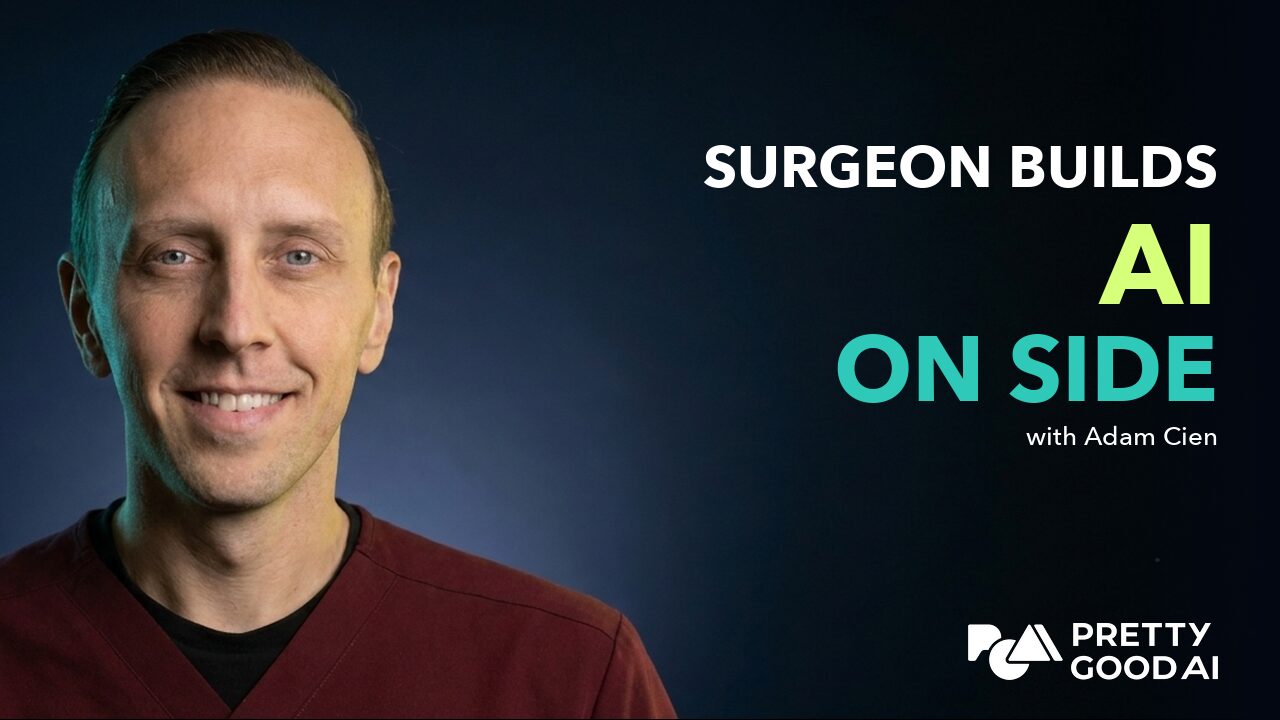
Surgeon Builds AI On Side
Dr. Adam Cien, a fellowship-trained orthopedic surgeon at South Bend Orthopaedics and co-founder of TriageAI, on building a software company alongside a full-time surgical practice, why the product stays out of the EMR and deletes patient data within an hour, and what physicians should ask before buying any AI tool.
With Dr. Adam Cien, Orthopedic Surgeon and Co-founder of TriageAI at South Bend Orthopaedics
Key takeaways
- TriageAI was built by three orthopedic surgeons with full-time practices and one developer, after Adam watched his own staff working through a pile of unanswered voicemails at 4:35 p.m. every clinic day.
- Staffing solves capacity, not priority. A post-op patient with a fever and a draining wound should never sit at voicemail number 45 behind a routine reschedule.
- Keep operational AI and clinical AI separate. Sorting, summarizing, and ordering is one category; the moment a tool tells a clinician what something is, the regulatory posture and liability profile change.
- Before buying any AI tool, ask whether the vendor retains PHI, whether they train on your data, and how long the integration will actually take.
- Integrations are where projects die. TriageAI stays out of the EMR by design: forwarding a phone line takes seconds, is reversible in minutes, and trials launch within 24 hours.
- Deletion is the default, not a feature. Everything is wiped within an hour of delivering a structured case summary, so there is nothing to breach.
- The next generation of surgeons still has to learn the fundamentals without the robot or the AI, because one day the system goes down.
Most healthcare AI stories come from one side of the wall or the other: the technology founder who has never run a clinic, or the practicing physician who waits for a vendor to solve the problem. Dr. Adam Cien is both at once.
He is a board-certified, fellowship-trained orthopedic surgeon at South Bend Orthopaedics in Indiana, specializing in hip and knee replacement, and he sits on his partnership’s executive committee. He is also the co-founder of TriageAI, a tool he built with two fellow orthopedic surgeons and a single developer to sort and summarize the voicemails that pile up in a busy clinic.
From tech-curious kid to surgeon-founder
Adam grew up building computers with his dad and tinkering with whatever technology came into the house. Medicine won the career, but the instinct never left. As AI started showing up in his practice over the last five years, he kept seeing problems he felt he could solve himself. Eventually the light bulb clicked: get two co-founders, find a developer, and build it.
The sales side has been the bigger education. After a career of implant reps calling him, he is now the one making the call, and he has a newfound respect for the people on the other end. His advantage is that he is not really pitching. He is describing a problem he had.
The robot is not doing the surgery
Adam started training in 2012, before robotic hip and knee replacement or the minimally invasive techniques that are now standard. The robots he uses today are not autonomous and are not making decisions. They add precision and reproducibility, and their real value is narrowing the outliers rather than improving the average case. AI-assisted planning is plausible in the next few years; AI performing the surgery is a five-to-fifteen-year question at best.
Patients regret waiting, and so do practices
The most common thing Adam hears after a joint replacement is some version of “I wish I did this five or ten years ago.” Not because earlier is always right, but because arthritis creeps in over a decade and patients gradually give up on tennis, golf, or the grandchildren without noticing. Elective surgery means the timing is theirs, so his advice is to name the things you want to keep doing and act when you cannot do them anymore.
Kevin draws the parallel to administrative pain. A couple of voicemails become a couple more, the admin tax quietly grows, and practices adapt around it for years before someone finally decides to fix it.
The 4:35 p.m. voicemail pile
TriageAI came from a specific scene. Clinic is finishing up, Adam is getting ready to go home, and his staff are still on the phone frantically working through voicemails that have piled up while the practice saw 30, 40, or 50 patients. Hiring more staff would add capacity, but capacity was never the problem. Priority was.
The examples are night and day. A patient a few days out from surgery reporting a fever or a draining wound should go to the top of the list because the practice probably wants to see them today. A patient who needs to move an appointment from two weeks out to a month out can wait for tomorrow’s admin block. TriageAI’s job is to make that distinction and to take the listening burden off the staff.
Operational AI versus clinical AI
Adam’s view is that the administrative layer is where AI actually works well right now: the phones, the fax, the inbox, where most of the wasted hours go. Everything TriageAI does is operational, sorting, summarizing, and ordering. The moment a tool starts telling a clinician what something is or what to do, it crosses into a different category with a different regulatory posture and a different liability profile. He wants clinicians making the clinical call, not the tool.
Where AI vendors get it wrong
Two patterns. First, blurring that operational and clinical line to make a bigger promise. Second, piloting with the most enthusiastic person in the practice rather than the busiest one, then blaming staff when adoption stalls because the tool required everyone to change how they work.
His advice to physicians and administrators evaluating vendors is to look inward first, find the biggest pain point, and solve it incrementally instead of changing seven things at once. Then ask the questions that matter in healthcare: do you retain PHI, do you train on our data, and how long will this IT project actually take, months or years?
Fundamentals without the robot
Asked what he hopes the next generation of surgeons keeps, Adam turns the question toward industry. Who teaches young surgeons to operate without the robot or the AI system, for the day it stops working? Residency exists to learn the fundamentals, and technology should be layered on top of them, not substituted for them. He also sees an upside for the generalist in a small town: robotics and AI narrow the standard deviation enough that a one- or two-surgeon practice can perform like a fifteen-person group of subspecialists.
Staying out of the EMR, deleting within an hour
The software was maybe a third of the work. The harder decisions came after: how to raise the confidence and precision of the AI, and what to integrate with. TriageAI deliberately stays out of the EMR because integration is where projects stop. Every integration is a dependency, a security review, a vendor conversation, a BAA, and a round of lawyers. Forwarding a phone line is a three-second change that can be undone ten minutes later, so trials launch in about 24 hours.
The same thinking drove data handling. Most vendors treat retention as the default and deletion as a feature. TriageAI ingests the voicemails, delivers a structured case summary and the audio to the practice’s secured email, and deletes everything on its end within an hour. You cannot breach what you do not hold, and that keeps the compliance conversation short for practices with one person running IT.
Selling software as a surgeon
Adam’s go-to-market is colleague to colleague: a short text or LinkedIn message saying he is an orthopedic surgeon, not venture-backed, who solved a problem the recipient probably has too, and asking for five minutes. Kevin’s experience selling into healthcare matches. Buyers are not sitting at a computer waiting for the next email. They are between cases and between patients, so persistence and in-person conferences do a lot of the work, and happy customers telling other customers builds the flywheel over time.
Kevin’s three takeaways to close: the “I wish I did this five years ago” regret applies to admin workload as much as to joints, the best origin stories start with a founder watching their own team struggle, and integrations are where projects die. Pretty good, shipped in front of the staff who need it, wins.
Transcript
Read the full transcript
staffing can solve capacity. Hey, we hire more staff, we can answer more phone calls, but it really doesn't solve the priority. And so that's what triage AI is, is that it's not, it's basically helping not only prioritize the most important voicemails, but also taking that burden from sitting there and listening to them.
You're listening to the Pretty Good AI podcast. Today's episode is one of my favorite kinds. It's healthcare innovation, where clinicians solve the problems they experience every day instead of waiting for someone else to do it. healthcare has no shortage of AI tools, but the best ones, you know, don't try to replace clinicians.
It's really that removing the friction so doctors and staff can spend more time with patients. And that's exactly what this conversation's about.
Dr. Adam Cien's a board-certified fellowship-trained orthopedic surgeon specializing in hip and knee replacement.
But is also the co-founder of TriageAI, a platform built to eliminate one of healthcare's most overlooked administrative burdens, while keeping this kind of clinical judgment exactly where it belongs with the providers.
Let's get into it.
Well thanks for having me, Kevin. Really appreciate it the time.
Awesome man. So I'd love to kind of start with your journey, right? I mean, we had talked before the show, you know, kind of this tech guy at heart, but you know, what was it that sort of clicked, you know, for you, you know, sort of coming up through medical school, you know, becoming a surgeon and and doing, you know, now it's sitting on your the executive committee of your partnership and what was that moment you sort of decided like, hey, you know, other than medicine, I'm also gonna go be a tech entrepreneur?
You know, it's I think probably started with a kind of some baseline, you know, growing up. I was always that kind of nerdy kid, you know, playing video games, tinkering with my k with computers. my dad, you know, always helped, you know, he was kind of in the computer space, but we built computers from, you know, from the start. So I was always tinkering with technology. I felt like we always had kind of the latest and greatest and some of the things at home like you know first cell phones or walkie-talkies.
And then you know as AI has started to you know involve our world over last you know five you know plus years, you know we started seeing things in our practice or you know in my practice that you know are like man I feel like I can solve some of this stuff. And you know, so a light bulg just clicked like, you know what, I'm gonna do it. Let's let's get it done. you know, got my two co-founders and said, Hey, you know, do we want to build this thing and see where it goes? And here we are.
So so we're talking about triage AI, like which is this software that you two you're you know, and they're both your two co founders are also surgeons, right? Like they're not technology guys. It's not like you've got software partners here.
No, you know, it is three orthopedic surgeons with full-time practices. and, you know, a developer that we found who's a very great developer. And you know, we came to him with an idea, said, Hey, can you do this? And he said, Yeah, let's get it done and you know off we went.
Tell about how that's been, you know, from like a sales perspective. I think like in the medical world, you know, I mean, there's not really sales, right? You know, people come to you with a problem and you're sort of there to solve it. Like, how has that, you know, aligned or not aligned with, you know, sort of taking software and now selling that or sort of presenting it to others?
I've spent my whole career on the other side of that. I've had implant reps calling me, you know, now I'm the one making the call and I have a lot more respect for that. you know, I guess I my advantage is you I'm an orthopedic surgeon, you know. I'm pitching a little, but I'm really describing a problem that we had, that I had. and you know, developing that to others. So definitely have a newfound respect for those individuals.
I like it. and then thinking a bit like into your day job, like you know, in a practice, you've kind of seen that also kind of evolve with technology, right? I mean, like this kind of change from minimally invasive robotics, like I'm guessing your first surgery looked very different than the one you did most recently.
Yeah, I mean, I started practicing orthopedics and training in 2012. we weren't doing, you know, robotic surgery. we weren't doing more minimally invasive techniques and, you know. over the past fifteen years, those evolve and you adapt and and yeah, you gotta keep up because you know what we want for patients is, you know, the best. We want patients to, you know, recover faster, have a safer surgery. We want them to be outside doing things they love, you know, faster than, you know, 15 years ago. And that's where we are today.
I love it. let's nerd out for a minute because I'm I'm actually like interested. Like I've never personally had a robotic surgery. My wife had one, but I'm curious from your perspective, like, you know, like I sit in Claude Code all day or in Chat GPT and I ask it to build stuff and it kind of goes cr you know, and like the robots, you know, write code for me. I'm guessing the robotics in surgery are very different. Like How much of that is like AI or even computer assisted versus it's really just giving you sort of more dexterous hands and sort of accurate things? Like, can you walk us through like a little bit for like people that are sitting out there that are writing computers? You know, the medical people may get bored for a minute or two here, but I'm curious like if you could maybe describe that, just educate us.
Yeah, so you know, I do hip and knee replacements and the robots we use today are not autonomous, they're not making decisions. They give you more precision and reproducibility, but the sur the surgeon, you know, is still doing all the driving. what the robots are really good at is, you know, narrowing those outliers. and that matters more, you know, than the average case. but You know, as technology develops, you know, we're thinking about hopefully, you know, AI assisted planning tools, you know, probably not AI performing surgery, you know, in the next couple of years, but you know, maybe on the roadmap in five, ten, fifteen years, that might be that might be a possibility. But you know, it's really about hey, how can we leverage AI and technology to help Surgeons make better informed decisions, you know, helping thinking through, you know, problems on the fly, pulling, you know, new literature, you know, or faster capturing data from across the world. So I think that's where we're heading. but yeah, today I'm still controlling the robot. It's not doing your surgery. I'm I'm I'm right there. You know, maybe one day I'll be sitting in the couch, you know, far away.
And then how do you, I mean, like a lot of patients, I'd love to draw this parallel. Like patients, especially like hip and knee, like older patients, like live with this pain for a while, right? Like it kind of sits there where, like, man, it's nagging, and then finally kind of reach that point where it's like, you know, okay, now it's time to do it or not. Like, what conversations do you find yourself having with your patients, kind of deciding like when's the right time?
I had a buddy of mine that, I mean, he was like a star tennis player in college, and then Literally he said for 15 years he always had this hip issue and he finally retired and was like, man, I should go look at it. And they're like, we can just replace that.
And it worked. And it was like he walked out of there the same day. what are the conversations that frequently come up and how do you guys address that?
Yeah, so you know, I think one of the most common things you hear afterwards of, you know, a hip and knee replacement is some version of a regret about waiting. You know, that's the most common complaint. I wish I did this five or ten years ago. I don't know why I waited. not because earlier is always right, but because they've adapted gradually. You know, arthritis, you know, in hip and knees gradually forms over five, ten, fifteen years, and you just learn to adapt.
To the challenges of your arthritis, you may start limiting yourself and doing things. but you know, a lot of patients don't really notice that they've given up on those things. But you know, one day something clicks and they're like, you know what? Yeah, I can't, you know, play with my grandchildren or more, I can't play tennis or golf. And so, you know, they come in, we have a conversation, and really for elective hip and knee replacements, it's all about it's elective, the timing is theirs.
So I always tell patients, you know, you know when the timer's right. You gotta decide, hey, I wanna do A, B, and C. And if I can't do those anymore, well then it's time to discuss, you know, next options, which can include surgery.
Draw me a parallel into the technology world, like back to Triage A with voicemail, where like, you know, at what point do you kind of like, hey, it's a couple voicemails, it's a couple more, you know, you're you're sort of reaching that same sort of operational sort of admin tax. Like, how did that sort of like crop up and like be like, wow, that's the point where I need to go and, you know, go fix this?
Yeah, so you know, TriageAI came about by, you know, me realizing that there is an issue in my clinic, and I know that others feel the same pain point. It was, it's 4:35 p.m., clinic is finishing up, and my staff are sitting there on the phone, you know, frantically calling the voicemail line and listening to voicemails that have piled up. throughout the day. You know, we're seeing 30, 40, 50 patients a day sometimes in clinic, and those voicemails that are piling up sometimes don't get answered in a timely manner. And so, you know, here I am getting ready to go home and my staff is sitting on, you know, the computer and the phone lines trying to Hey, listen to all these different voicemails. And so, you know, staffing can solve capacity. Hey, we hire more staff, we can answer more phone calls, but it really doesn't solve the priority. And so that's what triage AI is, is that it's not, it's basically helping not only prioritize the most important voicemails, but also taking that burden from sitting there and listening to them.
What is like some of the things that in your world are important and what is that sort of triage protocol or what are the kind of things that like, wow, this should bubble to the top and then the things that like, hey, these are gonna be lower priority?
Yeah, so a great example. Patient calls in after surgery, it's been a few days, I'm running a fever or my wound is draining. you know, that's probably a priority that, you know, it shouldn't sit in a call cue of, you know, number sixty or number forty-five voicemail. It should be to the top of the list because we probably want to see that patient. We want to probably bring them into the clinic or the walking clinic. Versus, hey, I'm calling because I want to reschedule my appointment. It's in two weeks, but I can't make it, I need to make it a month from now.
Like That's not a top priority. so that can get you know pushed down to the bottom of the pile where hey, now I finally have some time tomorrow on my admin day, I can make a few phone calls and adjust schedules. So those are the kind of you know night and day examples of kind of a high priority versus low priority.
Other things outside of the phones and voicemail, like, and again, would love to parallel like when you first started practicing versus today, because I mean so many things have changed in, you know, payers and care and patient expectations. Like what are other sort of administrative things or sort of non, you know, sort of clinical things that have sort of impacted, you know, both how patients are sort of served, but also just the workday of you and your team?
Yeah, you know, everything in medicine is converging to, you know, we live in a day of age that, you know, we can get on our phones and get anything we want. And so it's kind of come over to healthcare. Patients want to get in faster. They want their surgery sooner. You know, patients don't want to wait on hold. They want, you know, it's it's become more of a you know almost like a hospitality, you know, industry where we're trying to not only treat patients, but we're treating them as customers and we're trying to, you know, the patient's always right kind of attitude that, hey, we need to kind of be that more concierge type of practice and make sure everyone feels like they're very you know, that they're the most important thing, you know, at that time. And, you know, independent practices, you know, we're really under pressure to, you know, consolidate, to stay ahead, try to stay independent. And there's just a lot of pressures from the government and payers and insurance companies and, you know, patients and all that's kind of converging right now.
what would you say is like operational AI and like clinical AI, right? Like we're all using ChatGPT. it used to be always like Dr. Google, but today it's you know Dr. ChatGPT or Dr. Claude. in in your sort of experience, what are you seeing in terms of like that sort of blurred line between what you know people are using to operate, you know? admin type stuff versus like the clinical things where you're sort of making decisions
Yeah, you know, I I think that the administrative layer is where a lot of this AI actually works really well right now. and so I think practices need to focus on the here now. And that's what we kind of do with triage is that hey, the phone, the fax, the inbox are where a lot of those hours are going. you know, as we, you know, get further away, you know, AI, more assistance planning, more clinical decision making, you know, can be you know helpful. but you know, now we're kind of starting to blur the line, like you said, between you know administrative task and clinical decision making.
And you know, every AI company Like, what do you think they're getting wrong? Like, where do you think they're making mistakes?
you know, I I think that you know, a few things. You know, everything we're doing is operational. We're, you know, sorting, summarized, ordering. The moment the tool starts to tell clinician you know, what something is or you should do, well, now we're crossing into that different category. And that comes up with a different, you know, regulatory posture and a different liability profile. and you know, we've kind of tried to stay away from that because we don't want to do the clinical decision making. We want to make sure that clinicians and medical professionals are making it rather than you know an AI assitter tool. But you know, practices want to try to pilot these AI tools or different things, sometimes with the most enthusiastic person instead of maybe one of the busiest ones. And then you know if it works you know beautifully for someone with, you know, hey, this is their workflow, you know, and hey, it's you know, for us, hey, this person's using it, they don't have a lot of voicemails, it works perfectly. But you know, if you're trying to buy in a tool for that staff, you have to change how they work. and then sometimes, you know, that blaming staff when adoption, you know, stalls, you know, I think that can be a problem with you know, with industry gets it wrong.
What would advice would you give, you know, to a physician or leaders that are sort of evaluating AI vendors today? Like, how do you think about like what's important, you know, and what are the factors that w should go into a decision like that? I think it's great because you have this sort of experience of being on now both sides of that wall.
Yeah. I think genuinely need to look, you know, internally at your practice and see where are the biggest pain points and what can be solved incrementally in small chunks. I feel like sometimes administrators or practices bite off more than they can chew. They are trying to change seven things at once rather than focusing on one thing and doing it well. and then when you're trying to change too many things or trying to change how your practice performs, how staff interact with different tools, you know, I think that's where you know integrations fail. I think that's where you know things saw. But you know, you know, big questions typically in the healthcare field is, hey, do are you retaining PHI? Can you know this, how long is this IT project going to take? You know, is it, you know, months, is it years? Do you train on the data? Do you retain our data? So I think those are all different things that you know practices need to ask the vendors.
really good. if you could eliminate like one sort of administrative task forever, is there one thing that you like see or your staff sees that are like, Man, we really wish this thing would go away?
I don't know if there's one specific thing, but you know, like I alluded to, I think the low administrative type tasks are where AI is gonna really transform medical practices. That's you know, patient intake forms, you know, voicemails, consolidating patient records, you know, things that just take hours and many different systems. And you know, we don't have a centralized EMR in this country where, you know, I can just log on and be like, hey Kevin, I'm gonna you're coming in today, I'm gonna look up Kevin's profile. I see all your medicines, I see all your surgeries. No, you've been to a PCP office, a dermatologist, you know, two different hospitals, you've lived in seven different cities.
That's 30 different, you know, EMRs or different systems that don't talk to each other. So, you know, I think if we can just solve the administrative burden of, you know, aggregating information and knocking all those simple steps, you know, we will be able to you know, really accelerate healthcare and do what's best. It's what's focused on patients and talking to patients rather than spending hours and hours doing prior offs or pulling information or chart prep.
What would you hope for like the next generation of orthopaedic surgeons, what if you imagined out, you know, a decade from now, like what are the things where you're like, Man, I really hope they keep this, but then what are the things that maybe you're like, Well, I hope they, you know, can skip?
You know, as we're starting to do robotic surgery, I've always talked to industry about who teaches the next generations on you know, next generation of surgeons on how to do the surgery without robots and without AI. Because what happens the robot stops working one day, or what happens the AI system goes down? Can you go back and understand the fundamentals of things? So I I think that's the you know, crux of the issue in medicine is you can't, you know, accelerate so far to the future that you forget the basics because, you know, maybe one day the future doesn't work properly that day. and so I think it's bright, AI's here to stay, robots are here to stay. But we just need to figure out how to incorporate all that without losing some of the fundamental skills for young surgeons.
Yeah, and that's a good one. I think like one thing that I've had, you know, deeply kind of underappreciated is how much like AI's like sped up my education on things that I had no idea about.
Do you think like the specialty market in healthcare in general?
Will start to widen because today there's like so many different specialties. And then even inside of specialties, like you know, you just said, and like we work some other orthopedics where like, no, I'm the shoulder guy, I don't do need a hip.
Do you think that may change with the ability of you know, even just AI and education to kind of change and shape that?
Well, you know, in orthopedics, you learn all the fundamentals. You know, that's why you spend five years in in residency training and you learn everything in orthopedics. And then you start to subspecialize and then you continue to kind of hone your, you know, skill down to something that you're passionate about in orthopedics. and as technology advances with AI, robotics, everything, I'm not sure if, you know, you're gonna take that Generalist, or you that specialist and making more of a generalist again. I think he's gonna continue to just be, hey, I'm very specialized in X, Y, and Z, and I use all this technology to completely increase your odds of success and everything like that. especially in maybe bigger cities and bigger markets. Now, if you're in a small town, middle of nowhere, you know, North Dakota, well, that you know, general orthopedic surgeon who takes care of the whole town.
I think that's a big advantage for him. All of a sudden he's a generalist, but now with the AI and robotic advancement of all the specialties. So, you know, again, we're trying to narrow that standard deviation down to a little. And all of a sudden, that, you know, one or two surgeon practice is, you know, they have all the specialists there. They're they're as good as a 15-man group with all the subspecialists.
Yeah, one of the things I you know, I've sort of grown to appreciate in technology is similar, where a lot of the same tools or a lot of the same problems we approach, but then how you solve those for different customers or how you solve those for different sort of constituents ends up changing. Looking at your sort of work with TriageAI, like what have you sort of learned on the software side or sort of like product side where you're like, man, I thought this is I'd solve this problem and then realized like there was just so much more to it.
you know, there's you know, the software and development side is that I feel like maybe a third or thirty percent of the project, you know, that we, you know, thought was gonna be hard and and do it. But you know, that was Pretty straightforward. We built it and it worked. But then it was the, hey, how do you increase the confidence level of the AI? How do you make sure it's more precise and accurate? you know, how do we, you know, we had to make some decisions. You know, we decided to stay out of the EMR. How do you, you know, get fewer dependencies, you know, within TriageAI. So we're not on this big roadmap or release cycle. so there's a lot of decisions that have to be made. after you develop the product and how you launch it and you know, what do you wanna integrate with?
Yeah, it's a good one. Like for us, we we made the choice to only integrate with one EMR. So we've really focus on athena and we spend all our time there. I'm curious for you with voicemail, and we still run into a lot of phone systems. I'm curious, like phone system wise, have you chosen like which phone systems you work with or found a way that you can say, Hey, like as long as you can get us the voicemail files, we'll look at them and that sort of is the integration is like put the data in our box.
Hundred percent. so you know, we can work with basically anyone and anything, and that is by design. You know, so we stayed outside of the EMR because, you know, integration is where projects die. You know, every integration is a dependency, a security review, a vendor conversation, a BAA, lawyers reviewing everything. You know, for us, forwarding a line to our system, I mean, that's a simple three second thing in your phone system. You know, you could undo it ten minutes later.
So, you know, the reversibility of our trial is great. We're not doing a big project. We can launch trials within, you know, 24 hours. again, you know, we don't retain data. You know, I think a lot of companies want to keep data and they have PHI. and so I think a lot of people assume that retention is default and you know, that deletion is a feature. You know, we treated the opposite. It's designed not to, you know, contain all that stuff.
Got it. And so then you basically th your your kind of integration model is hey, forward the phones to us, we'll collect the voicemails, we'll delete them right away, and then just give you back a summary or sort of some kind of a result of that, you know, sort of order of operation.
Yeah, so yeah, you know, the sh basically we ingest the voicemails, we you know run them through triage AI, it delivers a structured case summary to their, you know, secured email, along with a voicemail file as well. And then basically within an hour, everything on our end is deleted. You know, we don't want to, you know, hold the PHI, we don't want to you know, have that liability. you can't, you know, you can't breach something that we don't hold. So it makes our compliance conversation, you know, really short. And that, you know, I think that's you know really matters when you're selling to practices with small, you know, IT staff or you know, there's one guy running IT. So, you know, we wanted to make it very simple for practices to get involved with AI, since that's what's you know really hot right now. And not how to, you know, not have to change the entire way you do your practice and you know a big project.
How how have you sort of found is the best way to sort of find customers for this or sort of discover? Is it just talking to your friends and and sort of reaching out to other orthopedics or is there any sort of particular technique that's worked better than others?
well, if you have some good pointers, I would love to hear them. But you know, for me right now, you know, this comes back to, I think we talked about it little in the in the past, but you know, I feel like almost like a used car salesman at this point. You know, I'm I used to be on the other side where people were pitching me and selling me, and now I'm I'm reaching out. I'm you know, I'm basically just reaching out to colleagues on LinkedIn via text message and saying, you know, my pitch is hey, I'm just an orthopedic surgeon. I'm not venture-backed, I don't I haven't raised any money. We we solved this problem.
You probably have a very similar problem. Can we spend five minutes chatting on, hey, do you think this is a good idea or bad? And that's it. you know, very short, colleague to colleague. I guess I get some credibility since I'm an orthopedic surgeon. but yeah, it's it's it's tough out there.
like it. Yeah, no, we do similar. So yes, email and LinkedIn is kind of the most digital way to reach people. I think what we've found is you know happy customers tell other customers. And I think that, you know, ends up a little bit of a flywheel effect takes longer.
Yeah.
but I I think the one thing that just surprised me, you know, sort of being a lifelong sort of technology person and selling a lot to technology, other, you know, other technology people, that selling into healthcare You know, you're not sitting at a phone or a computer all day long, right? Like, you know, you're in talking to patients, you're moving around, and it's not like you're just like waiting for the next email or LinkedIn to come in.
I don't know how many calls I've done where people are coming out of the surgery room or jumping between here and grab a phone. It's like a very mobile sort of job and and very interrupt driven. And so I think that is something that, you know, I've learned a lot is that like conferences work well because they are out of the office and sort of looking and talking. Or yeah, you just gotta, you know, kind of be persistent.
Yeah, totally agree. I I mean, it's we're three orthopedic surgeons. We have busy practices, we're in the OR, you know, a few days a week. And so yeah, my conversations or, you know, talking is yeah, between cases, between patients, you know. I'll open my phone and I'll have a message on LinkedIn and I'll get really excited, like, you know, who's who's messaging me? You know, I hope it's about triage AI and you know, it's like a it's like I'm a little boy on Christmas morning when I get a a message that someone wants to talk to me about it. So It's fun.
I like it. This is cool. Adam, this has been an incredible conversation. before we go, like where where can people find you? Where can they learn about what you're doing? You know, either at your practice or, you know, if they need, you know, hip or knee or you know, a triage AI if they wanna get in touch.
Yeah, so you know, Adam Cien, orthopedic surgeon here in South Bend, Indiana, home of the fighting Irish from Notre Dame. happy to see anyone in the area for hip and knee problems. But you know, as for triage AI, you know, if you're a practice where voicemails are piling up and no one knows a good way to sort which ones that matter, this is the problem we're solving. You can find us, you triageai.us. you can find me on LinkedIn.
I think I'm pretty easy to find and I'm the orthopedic surgeon who's talking about token usage and token costs. So pretty easy to find me.
Adam, this has been incredible, man. It's it's cool. Like of all of the folks I've talked to, it always ends up being one side, you know, entrepreneur on the technology side or sort of you know, practicing physician or something. And so I think it's been crazy to see this the two come together and really enjoyed this conversation. Thank you so much.
Yeah, thank you for having me, Kevin. I really appreciate it.
Wow, that was a really cool conversation. And it was just insane for the kid and me to sort of see the connection of technology and and medicine and how Adam sort of played these both together. I think top three things that I kind of came away with. I think one is that, you know, I would have wished I did this five years ago. And that applied, you know, sort of to the hip and knee replacements that Adam's patients see, but it's something we hear all the time when we're talking to customers, which is like, you know, you sort of have these issues that gradually creep up on you, whether that's, you know, an ailing hip.
Or knee, or could just be that admin workflow that you're kind of getting to.
I think Adam's origin story of really just you know seeing his own clinic and his staff dealing with this problem of sort of that admin bloat at the end of the day, really just trying to get back to patients where they could have served them earlier in the day, and really being that motivating factor to sort of take him to the next level. actually go to do something about it. And then finally, integrations where projects die. I think no doubt that we've seen this in our successful pilots is that you know having that clean sort of integration and having a figured out roadmap of how to go approach that is really what makes these technology projects successful.
Not just in medicine, but across any industry.
So if you're a physician, practice administrator, or healthcare leader looking for practical ways to reduce administrative burden while improving patient care, share this episode with someone on your team.
And make sure you're subscribed to the Pretty Good AI podcast. We'll keep bringing you conversations like this with operators and innovators that are building in the future of healthcare.
That's it for today. Thanks again for listening to the Pretty Good AI podcast. We'll see you next time.
Transcribed from the episode recording, with names and spellings corrected.