Practice Operations
After-Hours Calls in Pediatric Practices
Pediatric practices field after-hours calls from anxious parents. AI voice agents capture intake, schedule visits, and escalate clinical calls promptly.
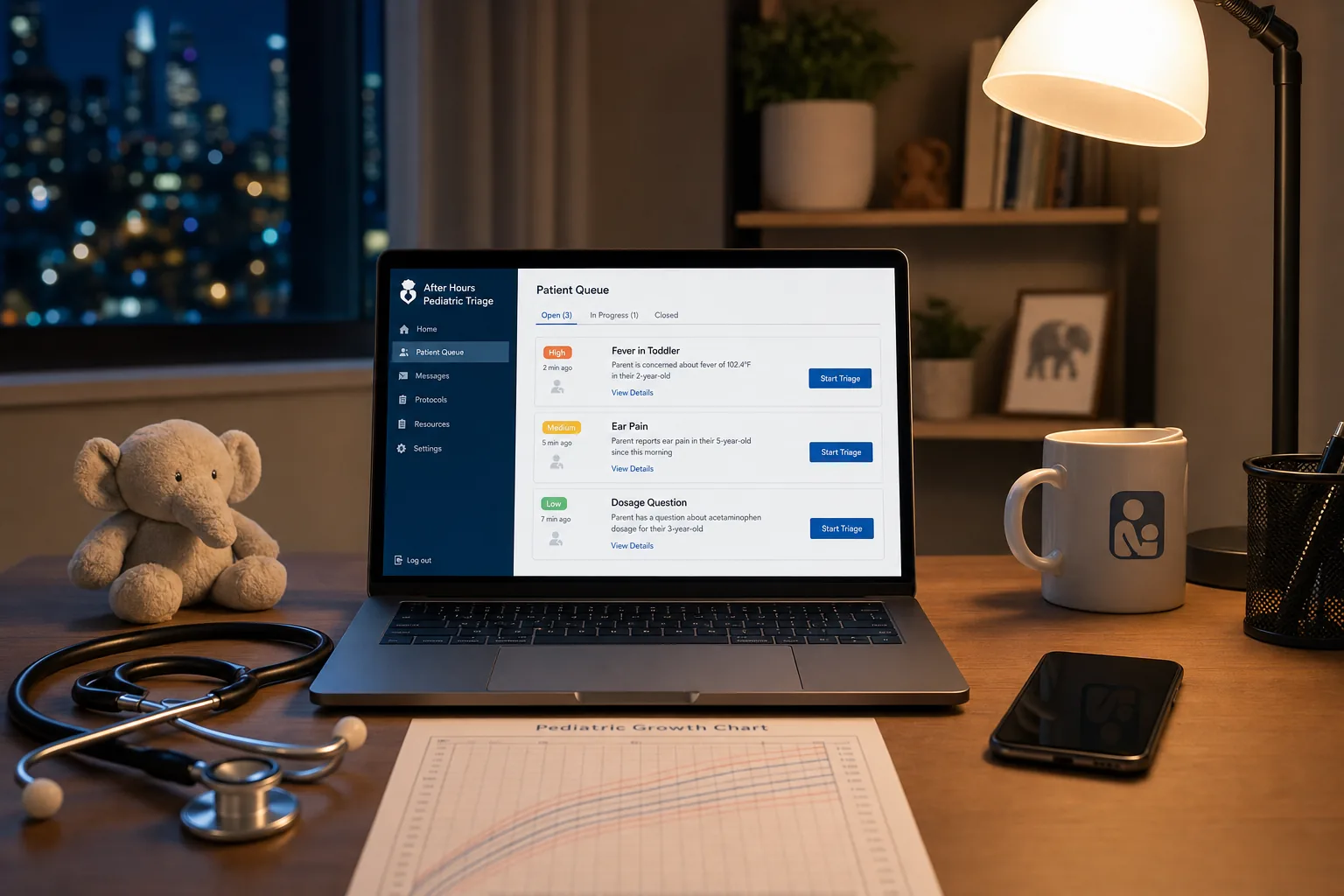
A parent calls your pediatric practice at 9:47pm on a Wednesday. Their 18-month-old has had a fever of 101.8 for six hours. They want to know if this is an ER situation or a wait-until-morning situation. They want to know now. They are not going to sleep until they have an answer.
This is a pediatric after-hours call. The parent needs a reliable way to report what is happening, and the practice needs a workflow that does not guess at the clinical answer. An answering service may wake the on-call provider without context, give generic guidance, or leave the parent waiting.
Pediatric practices field more after-hours calls than almost any other specialty in primary care. Parents are the most attentive healthcare consumers in the market. They monitor their children closely, they have a lower threshold for concern than adult patients have for themselves, and they have more access to information that makes them more anxious rather than less. A 2am Google search on “toddler fever 102” is not going to calm anyone down.
The after-hours call problem in pediatrics is not that parents are calling too much. It is that the system for handling those calls is not designed for the volume or the audience.
The pediatric after-hours call volume problem
After-hours call volume in pediatrics is driven by three factors that are structural and are not going to change.
Parents are available to worry at all hours. An adult patient with a concerning symptom might wait until morning to call. Parents of sick children generally do not. The caregiving role creates a level of vigilance that extends outside business hours by definition.
Children get sick in cycles that do not respect office hours. Fever spikes tend to be worse at night. Croup symptoms are notoriously worse in the cold late-night air. The physical reality of childhood illness means that parents are more likely to be dealing with a concerning symptom at 10pm than at 2pm.
Vaccine-related anxiety generates calls. Pediatric practices administer more vaccines than any other specialty. Post-vaccine reactions, including fever, fussiness, and localized soreness, are common, expected, and documented. Parents who were not adequately prepared for post-vaccine symptoms, or who forgot the instructions they were given, call after hours. These calls are almost entirely answerable with the information that was already given at the appointment.
A one-year study covering after-hours calls for 90% of Colorado’s private pediatric practices logged 141,922 calls. Of the illness calls, 45% were resolved with home-care instructions and 21% were sent for urgent evaluation. That sorting was done by clinicians, and it still has to be: what changes with automation is who takes the call, captures the detail and gets it in front of the clinician, not who makes the decision.
What the standard after-hours model costs pediatric practices
Most pediatric practices rely on one of three after-hours models: an answering service that takes messages and calls back, a nurse triage line that handles clinical questions, or direct on-call provider routing for all calls.
Each of these models has a known failure mode for the pediatric context.
Answering services that take messages and call back leave a gap between when the parent calls and when they get a response. A parent who called because they are anxious and received a “we’ll call you back” message is more anxious, not less, while they wait.
Nurse triage lines are expensive and difficult to staff. Many pediatric practices that want to provide genuine after-hours clinical guidance either outsource this to a third-party service at meaningful per-call cost, or they rely on their on-call provider to do the triage work themselves.
Direct on-call provider routing solves the access problem but creates a different problem: provider burnout. Pediatricians who are the on-call provider for a busy practice may receive many calls overnight. Questions about fevers, feeding concerns, and post-vaccine reactions all need a practice-owned workflow; the agent can capture them and route clinical judgment to the physician.
How AI changes the after-hours workflow in pediatrics
AI voice agents integrated with athenaOne handle the structured, informational component of pediatric after-hours calls. This is a larger portion of the total call volume than it might seem.
The AI answers the call, identifies the patient and reason for calling, and captures the parent’s report as structured intake. It uses the practice’s red-flag screen to recognize emergency indicators and direct the caller to 911 or the appropriate emergency service, while other clinical concerns go to the on-call provider with a structured summary already prepared. It does not diagnose, interpret a post-vaccine reaction, or make the clinical decision.
What the agent does close out is the administrative half of the call: booking the next-morning appointment, confirming practice logistics, and taking the request into the right workflow. The practice writes the routing rules, and in pediatrics they should be written to escalate rather than hold.
The athenaOne integration for pediatric practices
Pretty Good AI integrates with athenaOne through the Marketplace API. In a pediatric practice context, the relevant integration points include:
Patient record access. When a parent calls about their child, the agent identifies the child against athenaOne and attaches the structured intake to the chart for the practice to review. It does not interpret visit notes, vaccine records, or medications for the caller.
Next-day appointment scheduling. When the practice has approved a follow-up, the agent can access the athenaOne schedule, identify availability, and book the appointment before the call ends.
Appointment reminders and vaccine schedule outreach. Pediatric practices have a vaccine schedule compliance interest: well-visit attendance and vaccine completion rates affect quality metrics and, more importantly, patient health outcomes. The AI handles outbound reminder calls for upcoming well visits and vaccine appointments, reducing the staff time spent on reminder campaigns.
Post-visit follow-up. After sick visits, the AI can place a follow-up call the next day to capture the parent’s report, confirm administrative details, and route clinical questions to the practice. These calls can reduce after-hours calls by closing the loop before parents have overnight anxiety.
What this changes for a pediatric practice
On-call providers get their nights back. The physician who is on call for a busy pediatric practice should be available for the calls that genuinely require physician judgment. Routing every post-vaccine fever inquiry and feeding question through the on-call line is not a good use of physician time or physician goodwill.
Staff get time back during business hours. After-hours call logging, message review, and morning callback volume are downstream consequences of an inadequate after-hours system. When the after-hours system handles calls completely, providing information, scheduling appointments, and escalating appropriately, morning staff are not spending the first hour of the day returning the previous night’s queue.
Parents get a clear next step in the workflow. A parent calling at 10pm about a sick child can provide structured information to an agent that identifies the child, records the concern, and connects clinical questions to the practice.
Practical takeaways
- A published study of pediatric after-hours calls logged 141,922 calls; 45% of illness calls were resolved with home-care instructions and 21% were sent for urgent evaluation by clinicians.
- Standard after-hours models, answering services, shared on-call routing, either leave parents waiting or wake physicians unnecessarily.
- AI voice agents integrated with athenaOne handle structured intake, supported administrative work, and practice-owned red-flag screening and clinician escalation.
- The integration identifies the child, attaches structured intake to the athenaOne record, books supported next-day appointments, and routes clinical questions according to practice-owned rules.
- Post-vaccine and fever-related calls are captured as structured intake and routed to clinicians; appointment scheduling can be completed when supported.
- On-call providers handle fewer overnight calls. Morning staff handle fewer callback queues.
After-hours coverage in pediatrics is a patient access and provider sustainability problem at the same time. AI changes the math on both.
If your pediatric practice is running on athenaOne and your on-call providers are fielding administrative calls alongside clinical questions, Pretty Good AI integrates directly with your existing workflow. The AI handles supported administrative work and structured intake. Your physicians handle clinical judgment.
Sources
Ready to reduce missed calls?
15-minute demo. See how an AI team works inside your athenaOne practice.
Schedule a Demo →Written by Kevin Henrikson