Practice Operations
Why 20% of Your Patients Call After Hours (And What Happens When Nobody Answers)
After-hours calls represent 20% of patient volume and significant lost revenue. See how AI voice technology captures appointments while you sleep.
Your practice closes at 5 PM. Patient emergencies do not.
At 7:30 PM on Tuesday, Sarah Martinez calls your practice. Her knee pain flared up after physical therapy, and she wants to know if she should come in tomorrow or wait until Friday’s appointment. She gets your voicemail. The automated message tells her to call back during business hours or go to the ER for emergencies.
She hangs up and calls three more practices. The fourth one answers with an AI agent that books her for Thursday at 10 AM. You just lost a patient.
This scenario plays out thousands of times every day across American healthcare. While your competitors capture after-hours calls with AI voice technology, you’re sending patients to voicemail, or worse, to the emergency room for issues that could be handled with a simple appointment.
The after-hours revenue gap
Most medical practices think they close at 5 PM or 6 PM. But patient needs don’t follow business hours. Call analytics from multi-location practices show roughly 20% of all patient calls arrive outside traditional business hours: evenings, early mornings, weekends, and holidays.
When those calls go to voicemail, three things happen:
- You lose immediate bookings. Patients calling at 7 PM are ready to schedule now. By tomorrow morning when your staff returns those calls, many have already booked elsewhere or simply moved on. Practices report that 40% or more of after-hours voicemails never convert to appointments.
- You create patient frustration. Patients expect access. Amazon operates 24/7. Banks have mobile apps that work at 2 AM. When healthcare is the only industry still operating on banker’s hours, patients notice and judge.
- You send patients to emergency rooms unnecessarily. When patients can’t reach their practice and feel concerned, they default to the ER. This creates unnecessary costs for the healthcare system and terrible experiences for patients who spend four hours waiting to be told they need a follow-up with their regular doctor.
Voice AI solves all three problems by providing 24/7 coverage that handles routine patient needs without requiring human staff at midnight.
Your competitors are already doing this
Here’s what’s happening in your market right now:
That orthopedic practice down the street just implemented after-hours AI. They’re booking appointments at 9 PM while your calls go to voicemail. That pain management group across town answers calls on Saturday morning. Your patients are noticing.
This isn’t theoretical. Practices using AI voice technology capture 10-15% of total appointments outside business hours, appointments that previously didn’t exist. For a practice with 200 appointments weekly, that’s 20-30 additional appointments every week. That’s 1,000+ appointments annually. That’s real revenue walking out the door to competitors who picked up the phone.
The staffing crisis makes this worse. You can’t find front desk staff. Even when you do, you can’t afford overtime for evening coverage. Meanwhile, AI doesn’t call in sick, doesn’t need training, and costs less than a part-time employee.
What after-hours AI coverage actually does
AI voice agents designed for healthcare can handle most routine patient requests at any hour. When a patient calls at 9 PM, the AI can:
Schedule appointments by accessing real-time availability in your EHR system. If Sarah calls about her knee pain, the AI checks your schedule, identifies open slots, and books her for Thursday at 10 AM, just like a staff member would during business hours.
Answer common questions without requiring clinical judgment. Questions like “What are your office hours?” “Where should I park?” “Do you accept my insurance?” “How do I prepare for my procedure?” can all be answered immediately.
Route urgent concerns appropriately. The AI is trained to recognize when a call requires immediate human attention, such as chest pain, severe bleeding, or medication reactions, and can transfer to your on-call staff or direct patients to emergency care when needed.
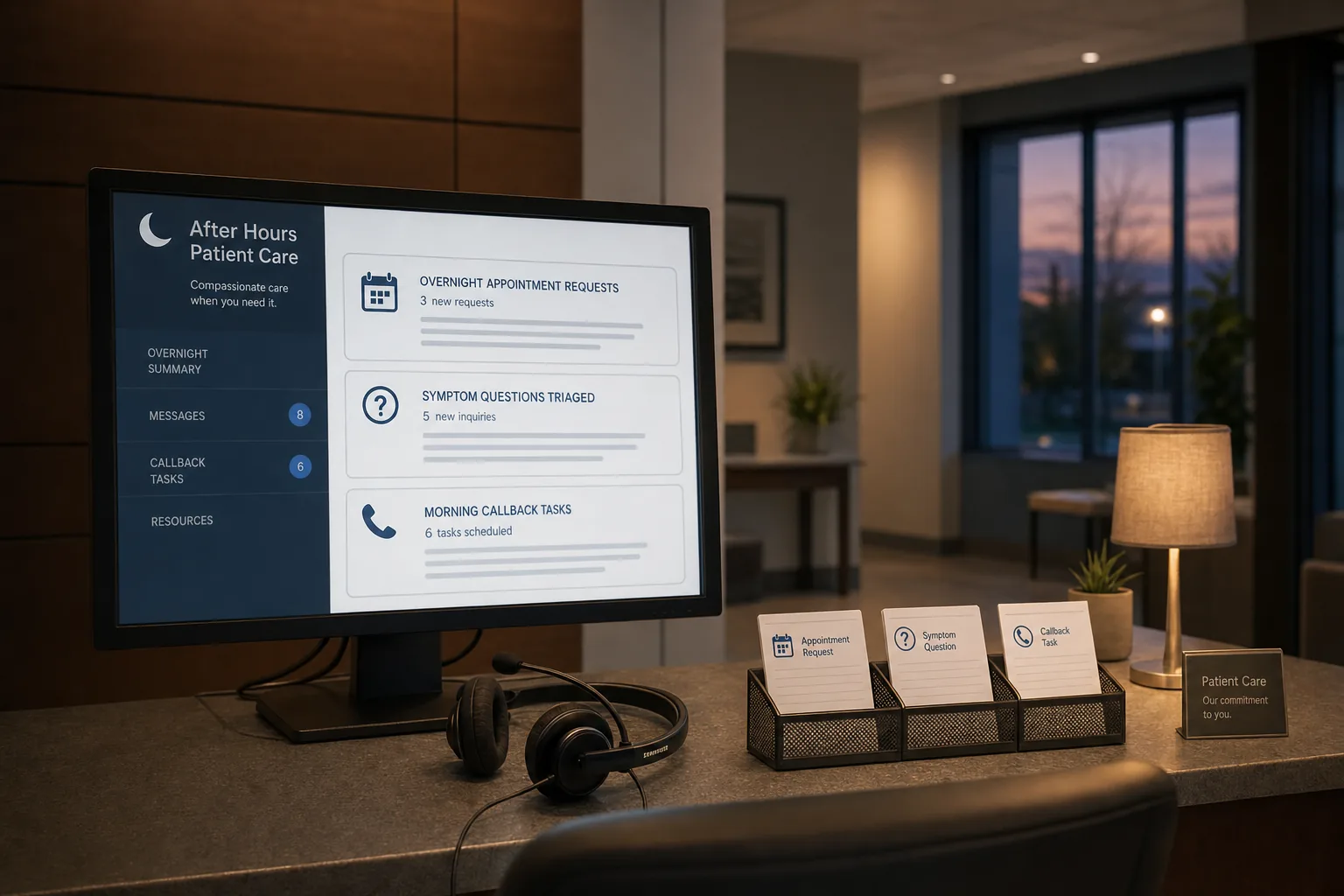
Collect information for morning triage. When a call requires clinical judgment but isn’t urgent, the AI can gather details about symptoms, duration, severity, and current medications, then flag it for staff review first thing in the morning.
The key difference: these systems complete tasks, not just take messages. A voicemail system creates work for tomorrow. An AI agent handles the request now.
Real results from 24/7 voice AI
Practices that implement AI voice coverage are seeing measurable results:
Appointment capture increases. One multi-location specialty practice saw 13% of all appointments booked outside business hours within the first 60 days of deployment. That represents net new revenue that would have been lost to voicemail or competitors.
Example calculation for a 200-appointment-per-week practice:
- 200 weekly appointments x 13% after-hours = 26 additional appointments/week
- 26 appointments/week x 52 weeks = 1,352 net new appointments annually
- At $150 average reimbursement = $202,800 additional revenue
No-show rates drop. When patients can call at 10 PM to confirm their morning appointment or ask a quick question, they’re more likely to show up. The convenience of 24/7 access reduces the friction that leads to no-shows. Practices report 15-25% reductions in no-show rates after implementing voice AI.
Staff time refocuses on complex care. When routine after-hours calls are handled automatically, staff members aren’t spending their mornings returning voicemails for simple scheduling requests. Instead, they can focus on patients with complex needs — like prior authorization workflows — that require human attention.
Work-life balance improves. Your front desk staff can go home at 5 PM without guilt. No more staying late to clear voicemails. No more weekend call-backs. The AI handles after-hours, and staff handle business hours.
The human element at midnight
A common concern about AI handling patient calls is the potential loss of human connection, especially for patients calling with medical concerns.
For after-hours calls, the choice isn’t “human staff vs. AI.” The choice is “AI vs. voicemail.”
Voicemail offers zero human connection and delays resolution by 12-18 hours minimum. AI offers immediate assistance and resolution for most requests, with transfers to human staff when needed.
The best implementations use AI to extend human care beyond traditional hours, not to replace human care during business hours. Patients calling at midnight aren’t choosing between talking to Mary at the front desk or talking to an AI. Mary isn’t there. They’re choosing between an AI that can help them now and a voicemail that can’t.
When a patient calls at 8 AM with a complex insurance question or a nuanced medical concern, your staff is available because they didn’t spend the morning returning 40 voicemails about appointment scheduling and office hours. The AI handles routine logistics so human staff can focus their time and expertise on interactions that benefit from human judgment.
Security and compliance for 24/7 systems
Any technology handling patient communications must meet healthcare security standards. Voice AI systems designed for healthcare operate under HIPAA compliance with Business Associate Agreements (BAAs) in place.
Security controls include:
- Encryption of all data in transit and at rest
- Authentication protocols that verify patient identity before discussing protected health information
- Audit trails that log every interaction for compliance review
- Real-time monitoring that alerts administrators to unusual activity, even at 2 AM
- Integration security that works within the existing security framework of EHR systems like athenaOne
Practices evaluating voice AI should ensure comprehensive BAAs are in place before deployment. This isn’t just a compliance checkbox, it’s peace of mind that your patients’ information is protected around the clock.
Implementation: from voicemail to voice AI
Implementing after-hours voice AI is simpler than most practices expect. Deployment takes days, not months.
The process:
- Integration with your existing EHR to access scheduling data and patient information. For practices on athenaOne, this integration is streamlined and secure.
- Training on your specific protocols using your actual call recordings and practice guidelines. The AI learns how your practice handles different call types.
- Gradual rollout that starts with after-hours coverage only, allowing you to test and refine. Many practices start with nights and weekends as a low-risk pilot.
- Ongoing optimization based on call analytics. You can see which types of calls the AI handles well and which might need refinement.
Timeline: Most practices are live within 7-14 days.
The return on investment is typically visible within the first billing cycle. You can track captured appointments, reduced no-shows, and staff time savings to quantify impact.
Frequently asked questions
Q: Will patients actually talk to an AI?
Yes. Patients care about getting help, not whether it’s a human or AI providing it. When the AI can actually book their appointment or answer their question immediately, satisfaction is high. The alternative — voicemail — is widely disliked and well-documented as a source of patient frustration in healthcare call experiences.
Q: What if the AI makes a mistake?
The AI is designed to handle routine requests (scheduling, questions, information gathering) where mistakes are low-risk and easily corrected. For anything complex or urgent, it transfers to human staff. All interactions are logged for quality assurance.
Q: How much does this cost?
Less than a part-time front desk employee. Most practices see positive ROI within 60-90 days from captured appointments alone, before counting no-show reduction and staff time savings.
Q: What happens to my current staff?
Your staff keeps their jobs and gets their evenings back. The AI handles after-hours when staff isn’t there anyway. During business hours, staff focus on in-person patients and complex calls.
Q: Does this work with my EHR?
If you’re on athenaOne, yes, natively. Other EHR integrations are available or in development. Check with your vendor.
Q: How long does implementation take?
7-14 days for most practices. Integration, training, and go-live happen quickly with minimal disruption.
Getting started with after-hours AI
The first step is understanding your current after-hours call volume and patterns. How many calls currently go to voicemail outside business hours? What types of requests are patients making? What revenue are you missing?
The answers typically surprise practice administrators. When you see hard data showing 20% of calls arriving when no one is there to answer, the opportunity becomes concrete and quantifiable.
We’ve built Pretty Good AI specifically for practices drowning in phone calls. Our voice AI integrates natively with athenaOne and handles patient calls 24/7. Practices typically see 50% call volume reduction during business hours and capture 10-15% of appointments outside traditional hours, appointments that previously didn’t exist.
This isn’t about replacing your staff. It’s about extending their capability beyond the hours they can physically be present, and competing with practices that answer the phone when yours goes to voicemail.
Voicemail-only after-hours coverage is on its way out. The question is whether your practice leads or follows.
Ready to Capture After-Hours Revenue?
See your numbers: 15-minute demo where we analyze your call patterns and show exactly how much revenue you're missing right now. Implementation: Most practices live in 7-14 days with zero disruption to existing workflows. Results: Practices capture 10-15% more appointments outside business hours—appointments that didn't exist before.
Schedule a 15-Minute Demo →Written by Kevin Henrikson