Industry Insights
The Warm Handoff Problem: Why Most AI-to-Human Transfers Fail
When AI transfers a call to your staff, what context comes with it? For most systems, the answer is nothing. Here is how to fix it.
“Hi, I’m transferring you to someone who can help. Please hold.”
The patient has already spent 3 minutes with your AI. They verified their identity. They explained their issue. They answered follow-up questions. The AI gathered everything needed to help them.
Then the transfer happens.
“Thank you for calling. How can I help you today?”
The patient sighs. Everything they just said? Gone. They’re starting from scratch. Name. Date of birth. Reason for calling. The whole thing, again.
This is the warm handoff problem. And it’s why many AI implementations fail to deliver on their promise.
What “warm” actually means
In call center terminology:
Cold transfer: Call is forwarded with no context. Receiving agent starts from zero. Patient repeats everything.
Warm transfer: Transferring party briefs the receiving agent before connecting. Context is passed. Patient doesn’t repeat.
When a human transfers to another human, warm transfers are easy. “Hey Sarah, I’ve got Mrs. Johnson on line 2. She’s calling about her MRI authorization from last week. She’s already verified, patient ID 4521.”
Sarah picks up the call knowing exactly who Mrs. Johnson is, why she’s calling, and that she’s already been verified. The conversation continues, not restarts.
When AI transfers to a human? Most systems just forward the call. No brief. No context. Cold transfer with a “warm” label.
Why this matters
The whole point of AI handling initial calls is efficiency. AI gathers information, resolves simple requests, and escalates complex ones to humans.
But if escalated calls lose all context, you haven’t saved any time. You’ve just added a step.
Without context passing:
- Patient spends 3 min with AI
- Transfer happens
- Patient spends 3 min repeating information to agent
- Agent spends 5 min resolving issue
- Total: 11 minutes, patient frustrated
With context passing:
- Patient spends 3 min with AI
- Transfer happens with full context
- Agent already knows patient, issue, and AI actions taken
- Agent spends 5 min resolving issue
- Total: 8 minutes, patient experience uninterrupted
That 3-minute difference matters. Multiply it by hundreds of transfers per day. Factor in patient satisfaction. Factor in staff efficiency.
Transfers without context don’t just waste time. They make patients feel like they don’t matter.
What context should transfer
When AI hands off to a human, the human should immediately know:
1. Who is calling
- Patient name
- Patient ID (if verified)
- Verification status (verified vs. not verified)
- Phone number calling from
2. Why they’re calling
- Stated reason for call
- Underlying intent (scheduling, billing, clinical question, etc.)
- Urgency level (routine vs. needs immediate attention)
3. What the AI already did
- Questions asked and answers received
- Actions attempted (and whether they succeeded)
- Why the AI is transferring (hit a limitation, patient requested human, etc.)
4. What the human should do
- Suggested next steps
- Relevant patient history pulled from EMR
- Any special notes or flags
This isn’t a nice-to-have. It’s the difference between AI that helps and AI that adds friction.
Why most systems can’t do this
The technical challenge is integration. For AI to pass context to your staff, several things need to connect:
The AI system needs to know what information to capture and package.
The phone system needs to support context passing. Many legacy phone systems can transfer calls but can’t carry data with them.
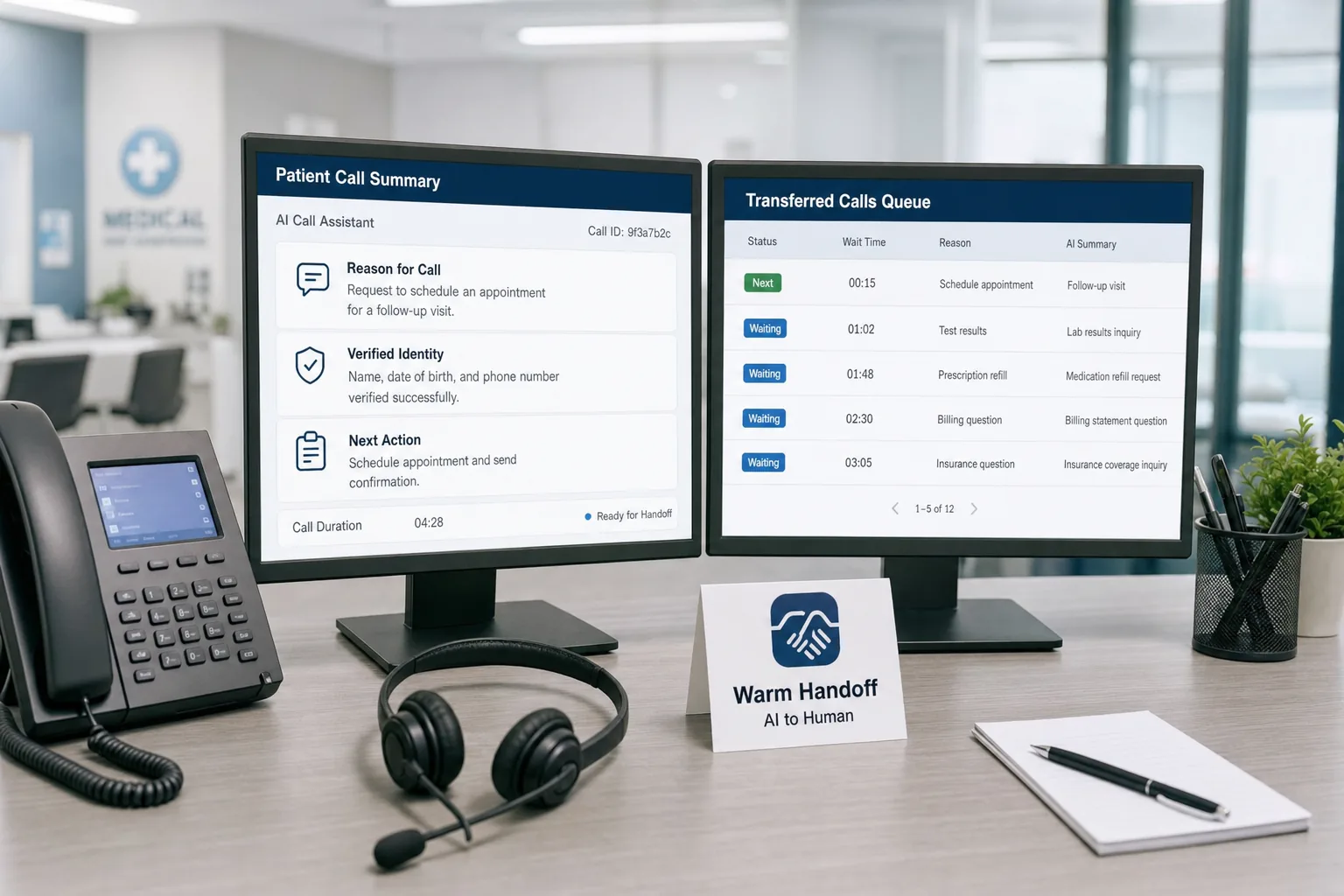
The agent interface needs to display the context. Your staff needs to see the information somewhere, such as a screen pop, a dashboard, or another view.
The EMR ideally connects so the AI can pull and push patient information.
Most AI voice vendors focus on the AI. They don’t solve the integration problem. So you get an AI that’s great at conversations but can’t actually hand off properly.
How we think about this
At Pretty Good AI, we treat the handoff as important as the AI conversation itself. Here’s our approach:
1. EMR-first integration
We integrate directly with your EMR (athenaOne). When a patient calls, we already know who they are (caller ID match), their upcoming appointments, their recent history. This context informs the AI conversation and the handoff.
2. Structured context package
Every transfer includes a standardized context package: patient ID, verification status, call reason, AI actions taken, recommended next steps. This isn’t free-form notes. It’s structured data your staff can scan in seconds.
3. Multiple delivery methods
Context can appear as a screen pop in your phone system, a message in your EMR, or a whisper to the agent before connecting. We adapt to how your team works.
4. Learning from transfers
When AI transfers a call, we track why. Too many transfers for the same reason? That’s a signal to expand AI capabilities. Context not useful? We adjust what we capture. Continuous improvement.
The patient experience difference
Here’s what a good handoff sounds like from the patient’s perspective:
AI: “I understand you’re calling about your MRI authorization. I’ve confirmed your identity and pulled up your account. This request needs to be handled by our authorization team. Let me transfer you, and they’ll have all your information.”
Agent (after transfer): “Hi Mrs. Johnson, I see you’re calling about your MRI authorization from January 15th. I have your account pulled up. Let me check the status for you.”
No repeating. No re-verification. No “let me put you on hold while I look this up.” The conversation continues as if it never switched hands.
That’s what warm actually means.
Questions to ask your AI vendor
If you’re evaluating AI voice solutions, ask these questions about handoffs:
- What context is passed when AI transfers to a human? Get specifics. “Full context” is not an answer.
- How does context appear to my staff? Screen pop? EMR note? Dashboard?
- Does it integrate with my phone system? Many AI vendors require you to replace your phones.
- Can I see a demo of an actual transfer? Not the AI conversation, the handoff itself.
- What happens if context fails to pass? Is there a fallback? Does your staff even know AI was involved?
If the vendor can’t answer these clearly, their handoffs are probably cold transfers in disguise.
The bottom line
AI that can’t hand off properly isn’t saving you time. It’s adding a middleman.
The goal isn’t “AI handles some calls.” The goal is “every call, whether handled by AI or human, is a good experience.”
That requires thinking about the handoff as carefully as the AI itself. What context transfers? How does it appear? Does the patient notice the switch?
Many AI vendors under-invest here. Impressive demos of AI conversations don’t say much about what happens when the conversation needs a human.
A warm handoff isn’t a feature. It’s the difference between AI that works and AI that frustrates.
See how our handoffs actually work.
We'll demo an AI conversation AND the transfer to a human. See what context passes and how your staff would experience it.
Book a Demo →Written by Kevin Henrikson