Practice Operations
Behavioral Health Prior Authorization Denials
Behavioral health practices face prior authorization denial rates 2-3x higher than medical specialties. AI voice agents integrated with athenahealth automate the documentation and follow-up that drives approvals.
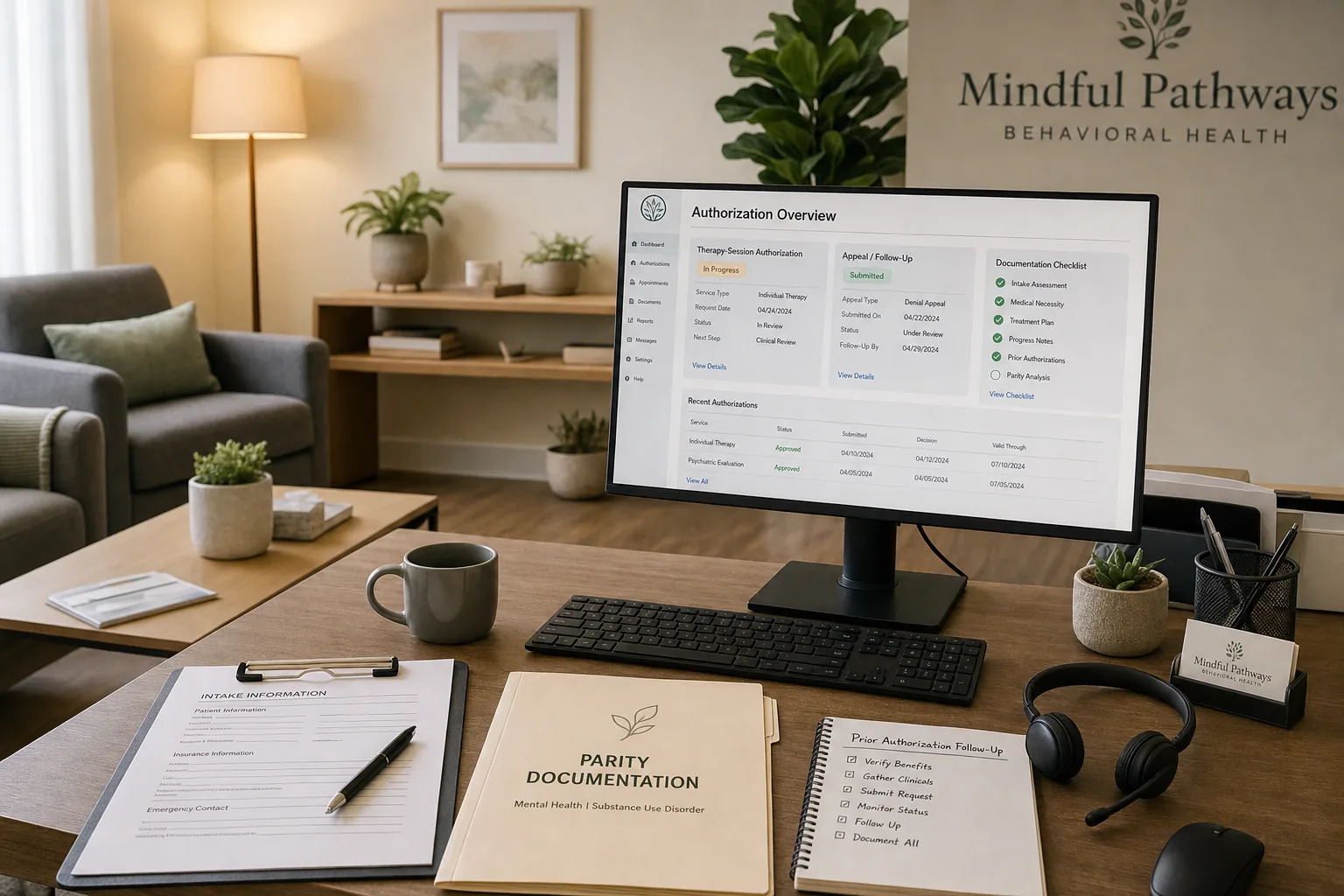
Behavioral health providers spend more time on prior authorization per patient than any other outpatient specialty. The denial rate is higher, the documentation requirements are less standardized, and the mental health parity rules that are supposed to equalize coverage with medical care are inconsistently applied by payers. Behavioral health prior authorization AI does not fix payer policy. It does reduce the administrative damage from it.
The prior authorization problem in behavioral health is structural, not incidental. Unlike an orthopedic practice that requests auth for a knee MRI with a standard clinical indication, a behavioral health practice is requesting authorization for ongoing therapy sessions with documentation requirements that vary by payer, by plan type, and often by individual reviewer. The same clinical presentation can be approved by one payer reviewer and denied by another, and the practice has no visibility into why until they request an appeal.
This article covers what makes behavioral health prior auth different from other specialties, what drives the high denial rates, and what AI-assisted processes change about the outcome.
Why behavioral health prior auth fails more often
Parity law does not require insurers to cover mental health and substance use disorder treatment; it requires that a plan offering those benefits not apply authorization rules or treatment limits more restrictive than the ones it applies to medical and surgical care. In practice, compliance with that requirement is incomplete. Health Affairs research on the current state of prior authorization documents that behavioral health services face prior authorization requirements that medical services of equivalent necessity often do not, and that behavioral health denial rates consistently exceed medical specialty denial rates.
Three structural factors drive this gap.
Medical necessity criteria are not standardized for behavioral health. An authorization for a cardiac stress test follows relatively objective criteria. An authorization for ongoing psychotherapy is evaluated against “medical necessity” standards that differ by payer and that turn on clinical documentation of functional impairment, treatment response, and continued need. The documentation required to meet those standards is labor-intensive to prepare and easy to submit incompletely, which creates technical denial grounds even when the clinical need is clear.
Concurrent review requirements create recurring administrative overhead. Many behavioral health services require authorization not just at initiation but at recurring intervals throughout treatment. A patient in weekly therapy may require re-authorization every 8-12 sessions, and the questions that generates do not wait for office hours, which is why how after-hours calls get captured and routed against the practice’s own escalation rules matters in this specialty. Each re-authorization cycle requires updated documentation, another submission, and another approval wait. An active practice managing 150 therapy patients may have 15-20 concurrent review requests pending at any given time.
Mental health parity enforcement is inconsistent. The AMA has documented that AI-driven payer review systems are generating prior authorization denials that do not meet medical necessity criteria, including in behavioral health. Practices that appeal denials with peer-to-peer reviews frequently obtain approvals, which indicates the denial was reviewable rather than grounded in clinical assessment. But filing appeals requires staff time that most behavioral health practices cannot sustain at scale.
Research on prior authorization challenges in behavioral health consistently shows that a significant share of patients seeking mental health treatment encounter authorization barriers that interfere with accessing care. Those barriers reflect policy failure. The administrative response to them can be improved.
What the prior auth workload looks like in a behavioral health practice
A behavioral health practice with 5-10 providers typically has 40-60 active prior authorization cases at any time, between initial authorizations, concurrent reviews, and pending appeals. The breakdown:
Initial session authorization. Most commercial payers and Medicaid MCOs require authorization before a patient begins therapy or medication management with a new provider. The authorization request requires a clinical summary, diagnosis codes, and a treatment plan. Submitting this completely and correctly on the first attempt is the single highest-value action for reducing denials. Incomplete submissions create technical denials that require resubmission and add 5-7 business days to the process.
Concurrent review. Once an authorization period ends, re-authorization requires updated documentation of treatment progress, current symptoms, functional status, and continued medical necessity. This documentation has to be pulled from the treating provider’s notes, structured into the payer’s required format, and submitted before the authorization expires. Authorizations that lapse because concurrent review was not filed on time interrupt care for patients who need consistency.
Prescription authorization. Behavioral health medication management, particularly for conditions requiring atypical antipsychotics, mood stabilizers, or ADHD medications, generates prior auth requests that may include step therapy requirements. A patient who has already failed on a first-line medication and been escalated to a preferred agent still needs the practice to document that failure history for the payer.
Appeals. A denial rate of 15-25% is common in behavioral health. Each denial generates a potential appeal, and appeals that include peer-to-peer reviews succeed at high rates. Filing those appeals requires staff time to identify the denial reason, pull supporting documentation, and initiate the peer-to-peer request.
What behavioral health prior authorization AI changes
AI voice agents integrated with athenahealth address the coordination and follow-up steps that drive denial rates without changing clinical decision-making.
Complete documentation submission on first attempt. The most common cause of technical denials is incomplete documentation at submission. The AI reviews the required documentation fields for each payer’s prior auth form, checks that the relevant clinical documentation exists in athenahealth, and flags incomplete submissions before they are sent. A practice that currently submits 80% of auths correctly on first attempt and moves that rate to 95% materially reduces its denial volume without changing any clinical workflows.
Concurrent review tracking. The AI monitors active authorizations in athenahealth and identifies upcoming concurrent review deadlines based on the authorization end date. It generates a prompt for the treating provider to update clinical documentation at the right interval, then handles submission of the updated documentation to the payer once it is complete.
Status follow-up and escalation. After submission, payer response times vary widely. The AI contacts the payer at defined intervals to obtain authorization status, updates athenahealth with current status, and escalates to staff when a denial arrives or when a response has not been received within the payer’s stated turnaround window.
Denial routing with appeal deadline flagging. When a denial arrives, the AI identifies the denial reason code, calculates the appeal deadline, and creates a task in athenahealth for the appropriate staff member with the denial reason and deadline. Practices that miss appeal deadlines lose the right to appeal. An AI that flags those deadlines when they are created prevents the most common reason behavioral health practices fail to appeal recoverable denials.
What practices typically see after AI deployment
Behavioral health practices that deploy AI prior auth automation on athenahealth typically report three measurable changes in the first 90 days.
First-pass approval rates increase as documentation completeness improves. Concurrent review lapse rates drop as the AI tracks deadlines automatically rather than relying on staff to remember. Staff time per authorization decreases as follow-up calls to payers are handled by the AI rather than by a human.
None of those outcomes require changing how clinicians document. They require connecting the existing documentation in athenahealth to a process that submits, follows up, and escalates consistently rather than depending on a staff member to track every case manually.
The appeal rate does not necessarily decrease with AI deployment, because the underlying payer denial rate is driven by payer policy, not by practice administration. What changes is the rate at which practices successfully appeal recoverable denials, because the AI ensures those denials are identified, deadlines are flagged, and staff have the information they need to file within the required window.
Sources
Ready to reduce missed calls?
See how Pretty Good AI handles prior auth for behavioral health practices
Schedule a Demo →Written by Kevin Henrikson