Practice Operations
Can AI Answer Patient Calls in Spanish? Yes
Yes. An AI voice agent takes the whole booking, reschedule and reminder conversation in Spanish, so Spanish-preferring patients stop waiting for the one bilingual person at the desk.
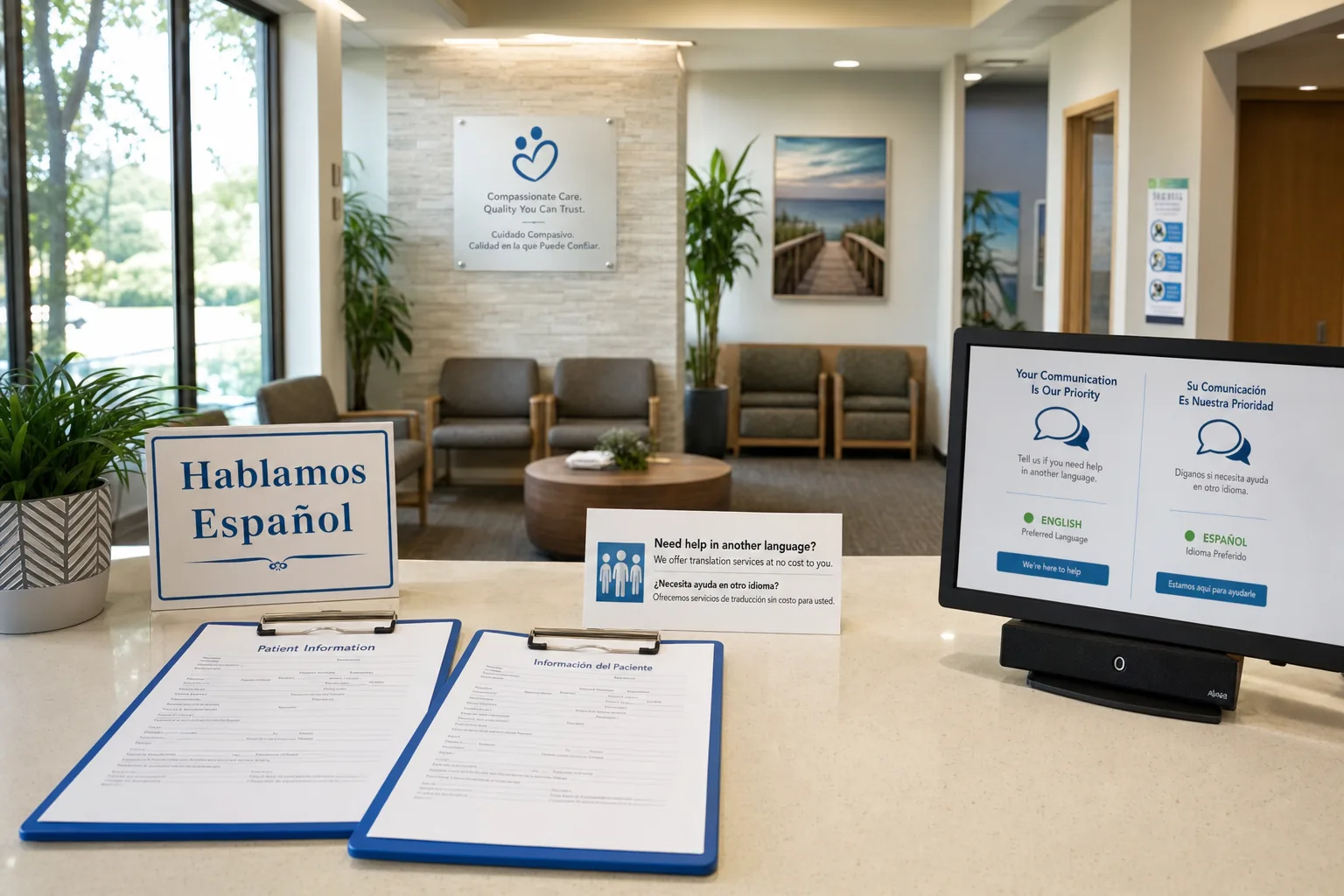
Maria called your practice at 2 PM yesterday. She speaks limited English. Your front desk speaks limited Spanish.
After 90 seconds of frustration, Maria hung up and called the clinic down the street that has Spanish-speaking staff.
You just lost a patient worth roughly $1,800 a year in revenue, and several times that over the life of the relationship. And she’s telling her friends.
Language barriers aren’t just a patient experience problem. They’re a revenue problem, a compliance problem (Title VI of the Civil Rights Act requires language access), and a health equity problem.
Roughly 29% of California residents and 28% of Texas residents speak Spanish at home, per Census Bureau American Community Survey data. Your patient demographics probably mirror this, but your phone system doesn’t.
The current (broken) solutions
Option 1: Hire bilingual staff
- Salary premium: 5-20% above base rate
- Limited availability in some markets
- Still single-threaded (one call at a time)
- Doesn’t scale to multiple languages
- Cost: a 5-20% bilingual differential adds roughly $2,000-$9,000/year on top of base pay; a dedicated bilingual hire runs $3,000-$4,500/month fully loaded
Option 2: Language Line / phone interpreters
- Per-minute charges: $2.50-$4.50/minute
- Average call duration with interpreter: 12-18 minutes
- Setup time: typically under a minute to connect a common-language interpreter, 2-3 minutes for rare languages, plus the IVR menu and account codes first
- Patient frustration with three-way calls
- Cost: typically $30-$80 per interpreted call at published per-minute rates (lower under volume contracts), monthly spend scales directly with your LEP call volume
Option 3: “Family member translates”
- HIPAA concerns (unauthorized disclosure)
- Accuracy issues (family member may filter information)
- Not available for all calls
- Violates language access requirements
- Cost: Free, but creates compliance risk
Option 4: “We’ll call you back”
- 30-40% of promised callbacks don’t happen (staff forgets, shift change, etc.)
- Patient waits hours or days
- Many don’t answer the callback
- Appointment slots get filled by English-speaking patients
- Cost: Lost revenue plus compliance exposure
None of these options deliver what bilingual patients actually need: immediate, accurate, culturally appropriate communication in their language.
What bilingual patients experience
Let’s walk through a typical scheduling call for a Spanish-speaking patient:
Current experience (English-only staff):
- Patient calls, front desk answers in English
- Patient struggles to explain “necesito una cita”
- Front desk person speaks slowly and loudly (doesn’t help)
- Front desk transfers to “someone who speaks Spanish” (maybe)
- Patient on hold for 3-8 minutes
- Transferred person speaks some Spanish, but not medical terminology
- Patient gives up or settles for unclear appointment details
Result:
- Documented in the literature: in a California secret-shopper study, nearly 1 in 5 Spanish-language calls ended with the scheduler hanging up or saying no one could help in Spanish
- LEP patients have roughly 32% higher odds of missing appointments than English-proficient patients
- Patient tells community about difficult experience
With voice AI (bilingual capability):
- Patient calls, AI detects Spanish from first words
- AI switches to native Spanish immediately
- “Hola, habla con el asistente de [Practice Name]. En que puedo ayudarle?”
- AI conducts full scheduling conversation in Spanish
- Books appointment, confirms insurance, sends SMS confirmation in Spanish
- Entire call: 3-4 minutes
What changes, and what to watch:
- The call is completed in one attempt rather than transferred, held, or ended with a promise to call back
- The appointment type is captured correctly, because the reason for the visit was understood the first time
- The confirmation goes out in the language the conversation happened in
- Track completion rate and no-show rate for Spanish-language calls separately from your English-language calls. A blended number hides exactly the gap you are trying to close.
The business case for bilingual voice AI
Illustrative example: a 5-physician practice in a heavily Spanish-speaking market:
- Total active patients: 8,000 (about 1,600 per physician, in line with published panel-size research)
- Spanish-speaking patients: 25% (2,000 patients), realistic in states like California or Texas
- Annual revenue per patient: $1,800 (substitute your own financials)
- Spanish-speaking patient revenue: $3.6M
Illustrative language barrier impact (a worked scenario, not a third-party benchmark):
- 15% of Spanish-speaking patients leave the practice annually due to poor communication
- Lost annual revenue: ~$540,000 (based on the revenue per patient and churn assumptions above)
- Acquisition cost per patient: $200-$400
- Replacement cost: $400,000-$800,000
The specific dollar figures depend heavily on your LEP patient mix and revenue per patient. For peer-reviewed context on the costs of inadequate language access in healthcare, see the HHS Limited English Proficiency resources.
The scenario above prices the problem. It does not price the fix, and no honest version of this page can, because how much of that churn is recoverable depends on your panel, your market, and how much of the loss is language rather than location or wait time.
What you can do before buying anything is measure the gap. Pull your Spanish-language call outcomes and your Spanish-preferring patients’ no-show and retention rates, and set them beside the same numbers for your English-speaking panel. The difference between those two columns is the addressable amount. Evaluate that against what the bilingual staffing alternative costs you today.
Beyond Spanish: multilingual reality
Spanish is the obvious first language to support, but it’s not the only one:
Top 5 non-English languages in US healthcare:
- Spanish (41M speakers)
- Chinese (3.5M)
- Tagalog (1.7M)
- Vietnamese (1.5M)
- Arabic (1.2M)
Hiring bilingual staff is expensive and geographically limited, and coverage disappears the week that person is out. Automating the routine administrative calls in a language removes the staffing dependency for that language entirely, which is why practices usually start with the one that covers most of their panel.
Pretty Good AI runs the full administrative call in 10 languages today, English, Spanish, French, German, Hindi, Russian, Portuguese, Japanese, Italian and Dutch, with the same workflows in each. Spanish covers most of the language gap in most US panels, which is why practices usually turn it on first.
For languages outside that set, the honest design is a layered one rather than a promise: they route to your language line or to bilingual staff with the automation collecting what it can first so the interpreted portion of the call is shorter, and clinical conversations in any language go to people. That layering is worth building deliberately, because it is what stops the rest of your panel from quietly falling back to the callback queue.
Cultural competency beyond language
True bilingual support isn’t just translation, it’s cultural adaptation:
What voice AI adjusts for Spanish-speaking patients:
- Formal vs informal address (usted vs tu) based on context
- Cultural health terminology (some conditions have colloquial names)
- Family-centered communication style (Latinx patients often involve family in healthcare decisions)
- Appointment reminder timing (may need more lead time for work schedule coordination)
Example:
English-speaking patient: “Your appointment is confirmed for Tuesday at 2 PM. Reply CONFIRM to confirm.”
Spanish-speaking patient: “Su cita esta confirmada para el martes a las 2 PM. Necesita que llamemos a un familiar para recordarles?”
The Spanish version acknowledges family involvement without assuming it, culturally appropriate without stereotyping.
Compliance: Title VI language access requirements
Federal law requires healthcare providers receiving federal funds (Medicare/Medicaid) to provide language access.
Current compliance approach:
- “We offer language line services” (expensive, slow)
- “We have one Spanish-speaking staff member” (doesn’t scale)
- “Family members can translate” (violates rules)
Voice AI compliance advantages:
- Immediate language access 24/7
- Consistent quality across all calls
- Documented in EHR (audit trail)
- Consistent workflow coverage across call volume
- Scales to any call volume
Risk reduction:
- Fewer missed appointments (reduces scrutiny on health equity metrics)
- Better patient outcomes (clear communication)
- Documentation proves language access compliance
ROI comparison
Cost to support Spanish-speaking patients:
| Solution | Monthly Cost | Limitations |
|---|---|---|
| Bilingual staff hire | $3,000-$4,500 | Single-threaded, limited hours |
| Language Line service | $30-$80/call, scales with volume | Per-minute charges, delays |
Voice AI can expand language access beyond the hours and capacity of a bilingual hire or interpreter service. Compare measured completion, retention, and recovered access against your language mix, call volume, and interpreter usage.
Implementation
Week 1-2: Language configuration
- Identify patient language demographics from EHR
- Choose which of the 10 languages to turn on, and on which queues
- Set language detection preferences (auto-detect vs menu option)
- Translate key practice-specific terms
Week 3: Testing
- Staff who speak target languages test call flows
- Verify medical terminology accuracy
- Check cultural appropriateness of phrasing
- Test appointment confirmation SMS in each language
Week 4+: Live deployment
- Monitor first 100 calls in each language
- Adjust phrasing based on patient feedback
- Expand language support based on demand
Go-live timeline: 3-4 weeks
What this means for your practice
If 20%+ of your patient population speaks a language other than English, you’re losing patients, revenue, and compliance standing every day.
Voice AI delivers native-language communication at scale without the staffing constraints of a single bilingual hire. Evaluate the business case using your language mix, call volume, and measured patient access.
What to measure, before and after:
- Retention and no-show rate for Spanish-preferring patients, held beside the same figures for your English-speaking panel
- Share of Spanish-language calls completed on the first attempt rather than transferred, held, or ended in a callback promise
- Interpreter line spend and the call volume driving it
- Title VI language-access documentation, which the call record produces as a by-product rather than as a separate exercise
The practices holding their ground in Spanish-speaking communities are not doing it by out-hiring the market for bilingual front-desk staff. They are removing the staffing dependency from the routine administrative call, so a Spanish-speaking patient is not waiting on one person’s schedule to book an appointment.
Ready to serve your entire patient population?
Schedule a demo in the language your patients speak.
Related articles:
See How It Works in Your Practice
A 15-minute live demo shows voice AI handling a real patient call, scheduling, insurance verification, and EHR lookup. No slides, no pitch deck.
Book a 15-Minute Demo →Written by Kevin Henrikson