Practice Operations
Cardiology After-Hours Patient Call Intake
Cardiology practices field after-hours calls about medications, devices, scheduling, and symptoms. AI voice agents capture intake and escalate clinical calls.
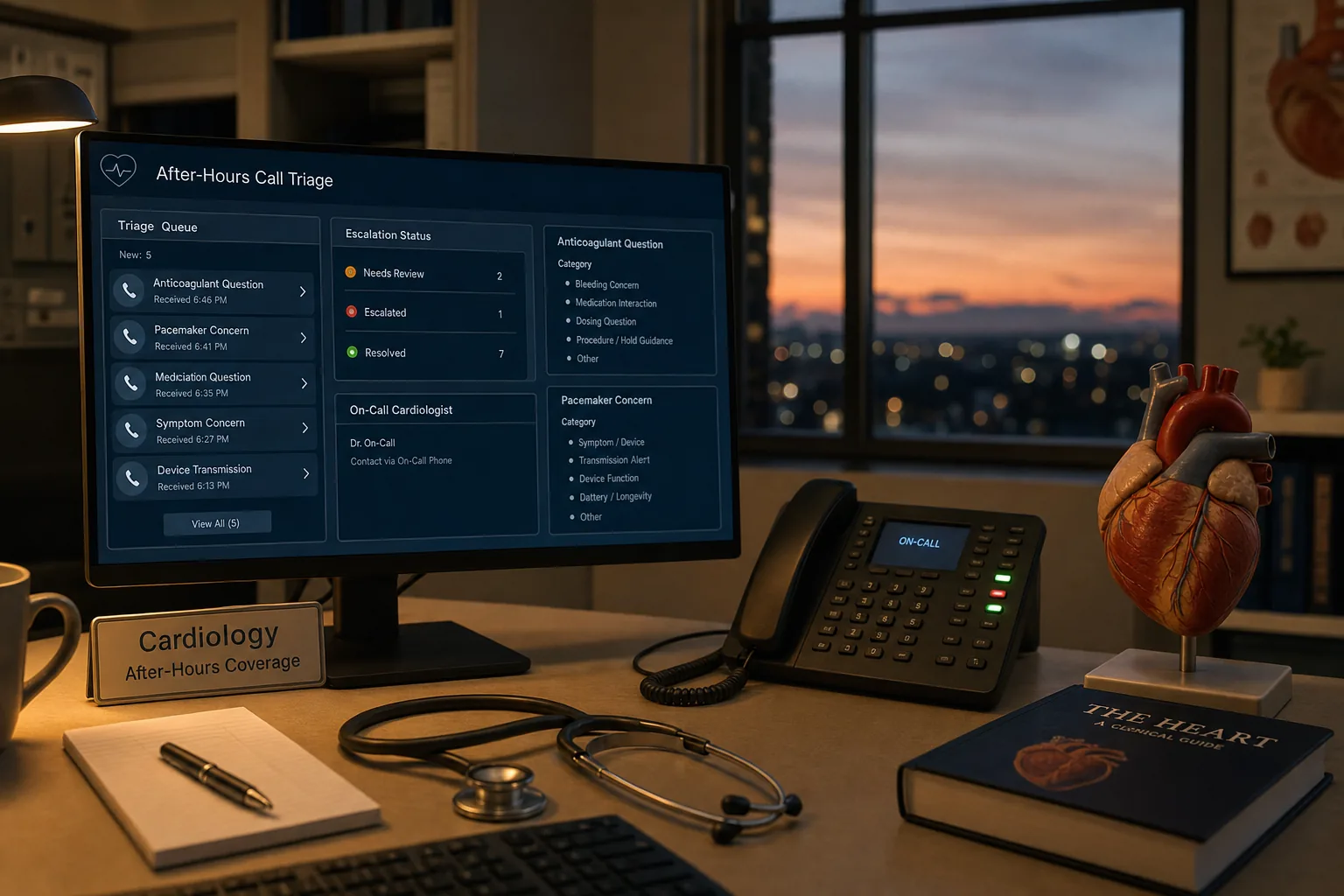
Cardiology practices get after-hours calls that other specialties don’t. A patient with a new pacemaker who feels a flutter at 10pm isn’t going to wait until morning. A patient on a new anticoagulant who notices unusual bruising at 9pm calls the practice. Cardiology after-hours calls are high-volume, emotionally charged, and most of them are not emergencies. AI voice agents can help cardiology practices capture these calls systematically, complete supported administrative work, and escalate clinical concerns to the practice.
The volume of after-hours calls in cardiology comes from the nature of the patient population. Cardiac patients are typically older, often managing multiple medications, and dealing with a condition they know can be life-threatening. Anxiety around symptoms is high, and the threshold for calling the practice after hours is lower than in almost any other specialty. A headache at night isn’t just a headache for a hypertension patient on beta blockers. It’s a question.
This article covers what drives cardiology after-hours call volume, what it costs to handle it with on-call physicians, and how AI is changing the first layer of call intake.
What Cardiology Patients Actually Call About After Hours
Cardiology after-hours calls commonly include the following categories; each practice should review its own call log to understand the mix:
- Medication and refill requests (missed dose, side-effect concern, drug interaction worry)
- Symptom reports (palpitations, chest tightness, shortness of breath, leg swelling)
- Appointment and prescription refill requests
- Questions about pre-procedure logistics
- Calls that require clinician escalation
Administrative requests can be handled without waking a physician. Medication and symptom questions are captured and routed to the practice’s clinicians; the agent does not provide clinical answers.
The problem is that most cardiology practices route all after-hours calls to an on-call physician or a general medical answering service. The physician wakes up for a question about whether it’s okay to take a double dose of metoprolol tomorrow if the patient forgot tonight. The answering service gives vague “call 911 if symptoms worsen” guidance that doesn’t actually help the patient. Neither approach is optimal.
The Real Cost of On-Call Call Volume
An on-call cardiologist fielding frequent after-hours calls loses sleep and recovery time. The immediate operational cost is physician burnout and its downstream effects.
Cardiology practices face a meaningful retention risk when administrative burden and after-hours call responsibilities accumulate. Practices that reduce unnecessary physician interruptions protect recovery time and physician retention.
For practices that use medical answering services for after-hours coverage, the cost is lower per call but comes with quality tradeoffs. Answering services give scripted responses that often fail to satisfy a worried cardiac patient. The patient hangs up still anxious, either calls back again or calls 911, and the next morning the physician has a message about an unresolved patient concern.
How AI Voice Intake Works for Cardiology After-Hours
AI voice intake for cardiology after-hours captures structured information, completes supported administrative work, and routes clinical calls according to practice-owned rules. It does not make clinical decisions.
A cardiology-trained AI voice agent handles a call from a pacemaker patient who felt a “click” in their chest this way:
- Greets the patient, confirms identity and that they’re calling about a cardiac concern
- Asks structured symptom questions: Are you having chest pain right now? Shortness of breath? Dizziness? Is the sensation ongoing or did it resolve?
- If the patient reports active chest pain or ongoing symptoms suggesting potential arrhythmia or emergency: immediate physician escalation with call summary
- If the patient reports a resolved sensation: AI records the report, offers supported scheduling, and routes the clinical question to the practice for review
- Logs the call with full transcript and escalation decision for physician review
The physician receives the clinical calls that the practice’s routing rules designate for escalation, with structured intake rather than an uncontextualized callback.
What AI Does Not Handle
Being clear about scope matters in cardiology. AI voice agents do not:
- Interpret ECGs, imaging results, or lab values
- Advise on medication dose adjustments (except to confirm documented instructions)
- Make clinical decisions on symptom severity
- Replace on-call physician availability for genuine emergencies
The design principle is conservative escalation. When AI is uncertain whether a call warrants physician attention, it escalates. The goal is to filter out the calls that clearly don’t need a physician, not to handle borderline calls without oversight.
Implementation for Cardiology Practices
A cardiology practice deploying AI for after-hours calls needs a few things to work well:
Practice-owned routing: The AI’s call flow captures structured intake and follows routing rules defined by the cardiologists who take on-call shifts. Those rules should not be imported from generic templates.
Medication database alignment: Common cardiac medications, typical side effects, and documented patient instructions need to be in the system so AI can respond accurately to medication questions without making up information.
Clear handoff to physician: When AI escalates, the physician needs immediate context. The call summary should include patient name, reason for call, symptoms reported, and what the AI has already asked and answered. A well-structured handoff takes 30 seconds to read. A cold escalation without context doesn’t.
Morning follow-up queue: All after-hours calls, escalated or not, should queue for morning physician review. This creates accountability and allows the practice to catch anything that might have been missed.
Key Takeaways
- Cardiology after-hours calls include medication, device, scheduling, and symptom concerns from patients who need a clear workflow.
- Administrative requests can be completed or routed without physician involvement; symptom and medication questions go to clinicians.
- AI voice intake captures the call, completes supported administrative work, and escalates clinical questions according to practice-owned rules.
- On-call physician burnout is a real retention risk. Reducing unnecessary overnight calls protects physician satisfaction and retention.
- AI does not make clinical decisions. Conservative escalation rules ensure borderline cases go to the physician.
- Implementation requires routing rules and administrative workflows developed with cardiologist input, not generic templates.
The cardiology after-hours call problem is fundamentally a handoff problem, not an answering problem. AI handles structured intake and administrative work. The physician handles clinical judgment.
See how Pretty Good AI handles after-hours calls for cardiology practices.
Sources:
Ready to reduce missed calls?
See how Pretty Good AI handles after-hours calls for cardiology practices
Schedule a Demo →Written by Kevin Henrikson