Practice Operations
Dermatology Prior Auth for Biologic Approvals
Dermatology practices managing biologic prior auth face payer-specific step therapy requirements, frequent renewal cycles, and high denial rates. AI integrated with athenaOne automates the tracking and documentation that consumes staff time.
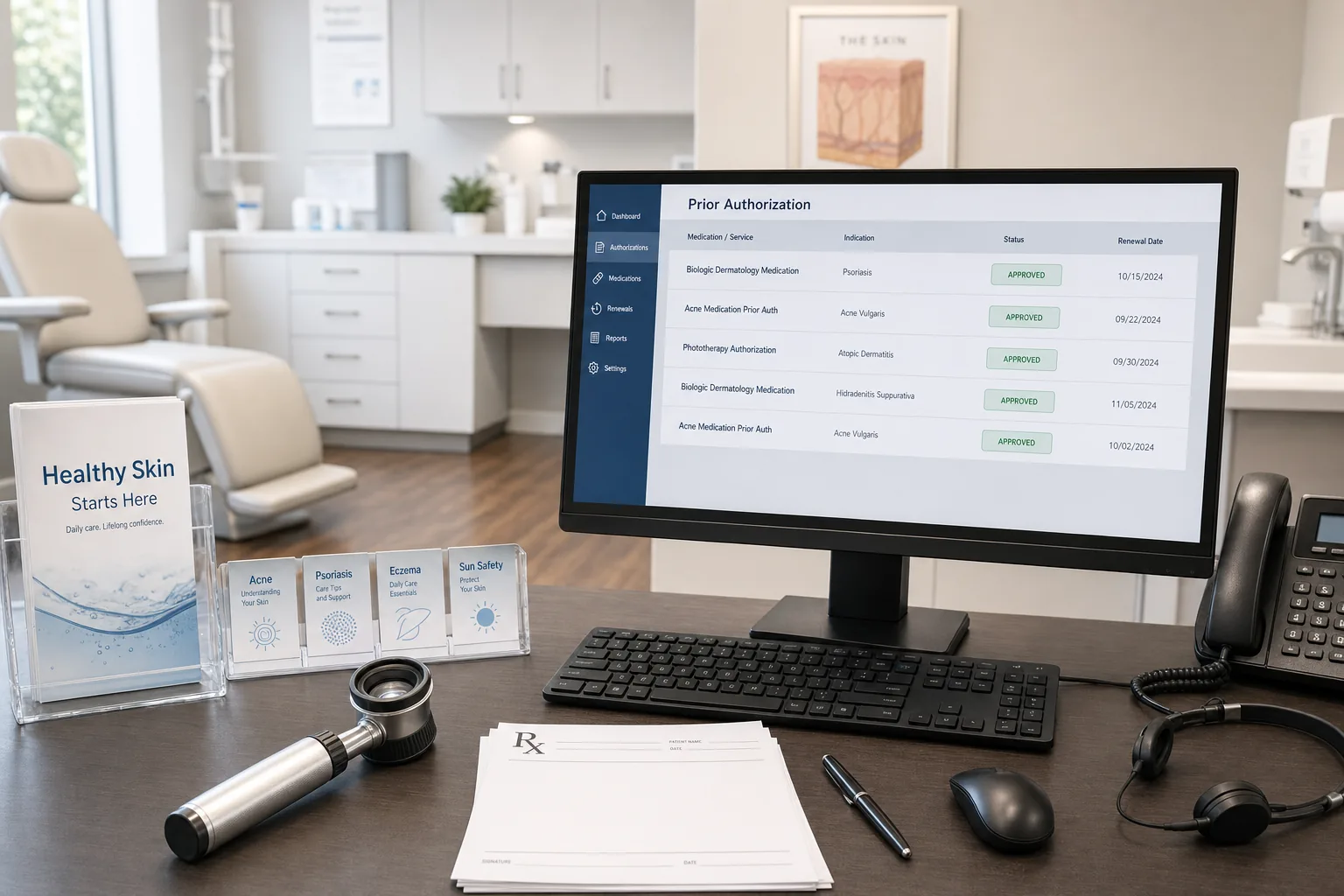
A dermatologist prescribes dupilumab for a patient with moderate-to-severe atopic dermatitis. The patient has tried two topical corticosteroids, a topical calcineurin inhibitor, and a course of cyclosporine. The clinical case is solid. The payer still requires step therapy documentation, a specific prior auth form, a letter of medical necessity, and a review clock that can stretch to 15 calendar days, longer if the plan invokes an extension, even now that CMS requires Medicare Advantage and Medicaid plans to decide standard requests within 7 calendar days.
The medication lists at roughly $4,200 per month, about $2,100 per injection. The patient cannot afford it without insurance approval. The dermatologist knows it will work. The insurance company is not disputing the diagnosis. The only thing between the patient and the medication is paperwork.
That paperwork takes your staff 45 minutes to compile correctly for one authorization request. Multiply that by 15 to 20 biologic prior auths per week in a busy dermatology practice, and you have one full-time employee whose job is entirely prior authorization, and that person is still behind.
Dermatology practices billing biologics face one of the highest prior authorization burdens in outpatient medicine. Dupilumab, secukinumab, ixekizumab, guselkumab, risankizumab: each has its own payer-specific step therapy requirements, its own formulary tier, its own documentation checklist. AI does not change the payer rules. It manages the documentation and tracking process so your staff does not have to do it manually.
Why dermatology biologic prior auth is uniquely difficult
The mechanics of prior authorization exist across many specialties. Dermatology’s version has features that compound the burden.
Step therapy requirements are deep and vary by drug and payer. Most commercial payers require documented failure of multiple first-line treatments before approving biologics. But the specific sequence, the number of failed treatments required, the documentation format, and even the definition of “failure” vary by payer. What counts as adequate documentation of methotrexate failure for Anthem is not the same as what UnitedHealthcare requires. Your staff has to know both, and both change.
Biologic medications generate frequent renewal cycles. Unlike a one-time surgical authorization, biologic approvals typically expire every 6 to 12 months. A patient on dupilumab requires a renewal authorization every year for as long as they are on the medication. A dermatology practice with 80 active biologic patients has 80 independent renewal timelines running simultaneously, each at risk of expiring before the renewal is processed.
Denial rates for dermatology biologics are high. Biologics are expensive, and payers deny first attempts at rates that vary from 20% to 40% depending on the drug and payer. Each denial triggers an appeal workflow that requires additional documentation, sometimes a peer-to-peer review, and weeks of additional delay. Practices without a structured appeals process lose a meaningful percentage of biologic revenue to denials that are clinically unwarranted.
New biologics enter the market with inconsistent payer policies. When a new dermatology biologic is approved by the FDA, payers add their own step therapy and documentation requirements that are not standardized across the industry. A practice prescribing a newer agent like tralokinumab has to figure out each payer’s requirements from scratch, and those requirements may change as the payer accumulates claims experience with the medication.
What the prior auth workflow actually looks like
A typical dermatology biologic prior auth involves these steps:
- Physician prescribes the medication
- Staff identifies that prior auth is required
- Staff retrieves payer-specific requirements for that medication
- Staff compiles the step therapy documentation from the patient chart
- Staff completes the prior auth form
- Staff writes or requests a letter of medical necessity from the physician
- Staff submits the request through the payer portal or fax
- Staff monitors the request status, anywhere from 72 hours for a clean electronic pharmacy submission to the 7-to-15-day regulatory maximums, and longer when a documentation request or appeal restarts the clock
- If approved, staff notifies patient and pharmacy
- If denied, staff routes to appeal, which restarts a parallel workflow
Each of those steps has a failure mode. Documentation is pulled from the wrong date range. The form is submitted to the wrong portal. The status check falls off the calendar because the person tracking it was out for two days. The patient calls asking for an update and the person who handles that call does not know where the request stands.
AI addresses steps 3 through 10. Step 2 can be flagged automatically when a prescription is written for a biologic in athenaOne. Step 1 belongs to the physician.
What AI does in dermatology prior auth
Payer rule lookup and documentation prep. For each biologic authorization request, AI identifies the relevant payer requirements for that specific medication, which step therapy is required, what documentation format the payer accepts, and whether a letter of medical necessity is needed. It then pulls the relevant treatment history from athenaOne and compiles the documentation package for staff review.
Authorization tracking without manual follow-up. Rather than having a staff member call each payer every few days to check on pending authorizations, AI monitors request status through payer portals and electronic authorization systems where available. Requests that exceed the payer’s standard turnaround time trigger an automatic flag to the appropriate staff member.
Renewal calendar management. Every active biologic patient has an authorization expiration date. AI tracks those dates and generates renewal initiation alerts 45 to 60 days before expiration, enough time to complete the renewal before the authorization lapses and the patient faces a gap in medication access.
Denial routing and appeal tracking. When an authorization is denied, AI logs the denial code from athenaOne, identifies whether the denial is administratively correctable or requires a clinical appeal, and routes it to the appropriate staff member with the denial reason and the relevant clinical documentation. Staff does not have to find the denial in the payer portal and reconstruct the context from scratch.
Patient status communication. Patients waiting for biologic authorization call in to ask for updates. Those calls take time and often result in callbacks because the person answering the phone does not know the current status. AI handles proactive outbound updates: when the authorization is approved, the patient is notified. When a denial is received, the patient is told there is a delay and what the practice is doing about it. Most inbound status calls disappear.
The peer-to-peer review problem
Biologic prior auth denials in dermatology frequently require peer-to-peer review, a call between the prescribing dermatologist and a medical reviewer at the payer. These calls are not optional if the practice wants to appeal the denial effectively. They are also not something AI can do.
What AI can do is make peer-to-peer reviews less painful to coordinate. When a denial requires peer-to-peer, AI creates a structured brief for the physician: the denial reason, the payer’s stated clinical criteria, the patient’s treatment history, and a summary of the clinical literature supporting the prescribed medication. The physician walks into the call prepared rather than scrambling to reconstruct the case from a chart they haven’t looked at in weeks.
AI also tracks whether the peer-to-peer has been scheduled and follows up if the request goes unanswered for more than 48 hours. The practice does not lose the appeal window because nobody noticed the 15-day clock was running.
Cosmetic vs. medical authorization complexity
Dermatology practices that see both cosmetic and medical patients have a particular challenge: cosmetic patients typically do not generate prior auth requests because cosmetic procedures are not covered by insurance. Medical patients (those with psoriasis, atopic dermatitis, hidradenitis suppurativa) do.
The prior auth burden is concentrated in the medical side of the practice, but the staff handling it is often shared across both patient populations. A busy cosmetic schedule does not pause while prior auth requests pile up. AI handles the medical side’s prior auth workflow without competing for the same staff attention as the cosmetic patient calls.
What happens when authorization lapses
A patient on dupilumab who misses a renewal and loses authorization typically has two choices: pay out of pocket at roughly $4,200 per month, or stop the medication and watch their condition flare.
Most patients stop the medication.
When a patient who was well-controlled on a biologic goes off therapy, the disease activity that comes back during the lapse is the physician’s problem to manage. The practice that let the authorization lapse also has to restart the entire prior auth process, resubmitting with updated documentation, waiting for a new approval, and potentially renegotiating step therapy requirements that have changed since the original authorization was granted.
The cost of a lapsed authorization is not just the lost revenue. It is the clinical cost of a disease that was under control and is now not.
AI prevents lapses. That is the clearest argument for automation in this workflow.
Key takeaways for dermatology practice administrators
- Biologic prior auth is the highest-volume, highest-stakes administrative task in medical dermatology: mistakes result in patient harm, not just billing delays
- Step therapy requirements are payer-specific and change frequently: AI manages the rule library so staff does not have to track it across 10+ payers
- Renewal calendar management is the most preventable risk: AI initiates renewals 45 to 60 days before expiration across all active biologic patients
- Denial rates run 20 to 40%: structured appeal routing and peer-to-peer brief preparation make appeals more recoverable
- Patient status calls are largely eliminable: proactive outbound updates when auth is approved or denied reduce inbound volume significantly
- Cosmetic/medical split creates a staffing conflict: AI absorbs the prior auth load on the medical side without competing for front desk capacity
Where the biologic market is going
The dermatology biologic market is growing. Newer agents continue to enter the market, each with its own prior auth requirements. IL-17, IL-23, IL-31, and JAK inhibitors each have distinct payer rule sets, and the rules for newer agents are less standardized than for established drugs.
Practices that have been managing biologic prior auth manually are already at capacity. Growth in the biologic patient panel means growth in prior auth volume, and that volume does not scale with manual workflows.
The practices that build automation around this problem now will handle the growth. The ones that try to manage it with more staff will find that the staff ceiling comes before the patient ceiling.
See how Pretty Good AI integrates with athenaOne to manage dermatology prior authorization workflows
Ready to reduce missed calls?
15-minute demo. See how an AI team works inside your athenaOne practice.
Schedule a Demo →Written by Kevin Henrikson