Practice Operations
Direct Primary Care Scheduling Automation
DPC practices promise same-day or next-day access to their members. As panel size grows, delivering on that promise requires more than a responsive physician. AI voice agents handle the scheduling coordination that makes access real.
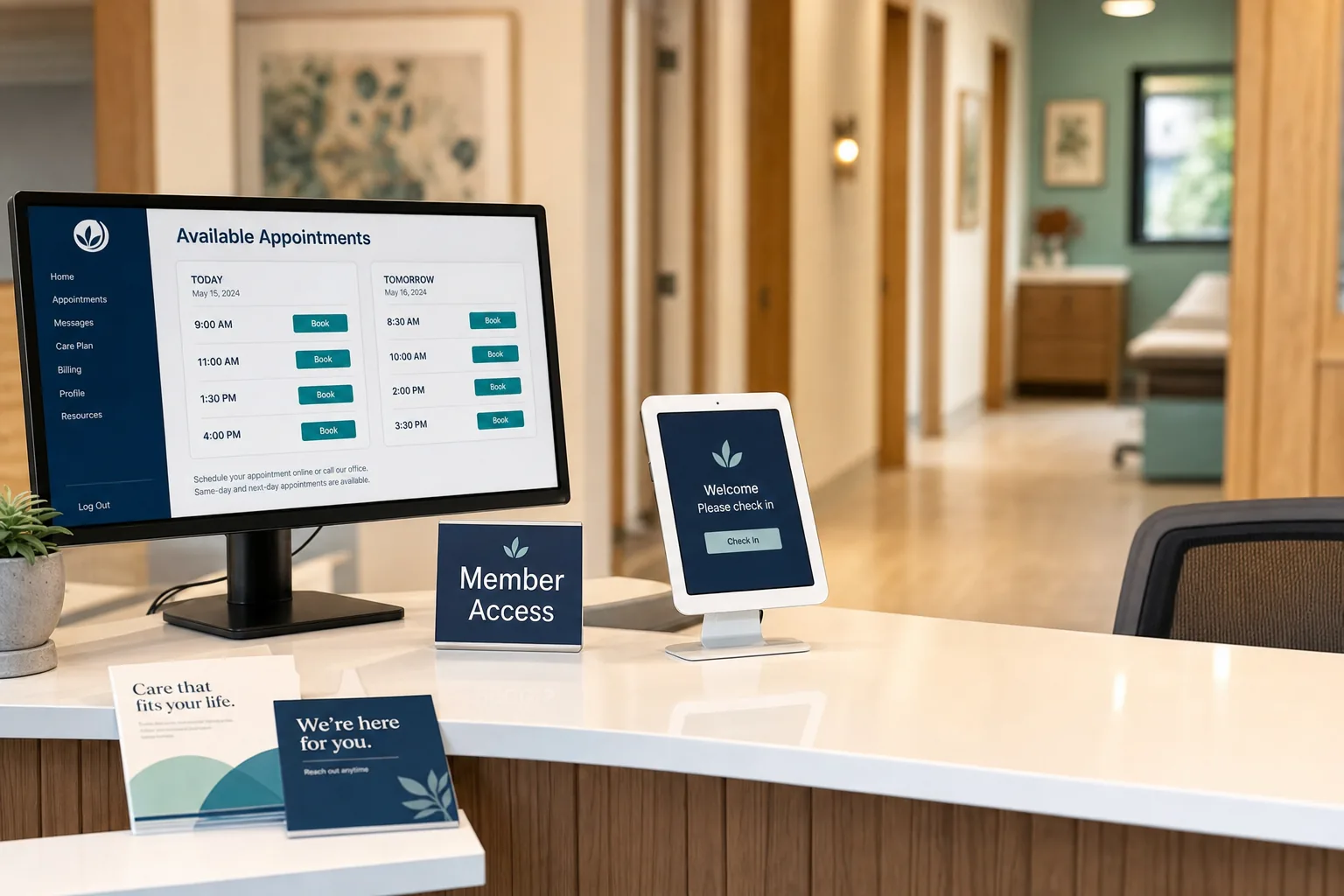
The DPC value proposition is access. Members pay a monthly fee and get same-day or next-day appointments, a physician who knows their history, and no waiting room full of strangers with different plans and different copays.
That value proposition is easy to deliver at 400 members. It gets harder at 600. At 800, a DPC physician without good scheduling infrastructure is personally fielding appointment requests during clinical hours, or paying a front desk person whose entire job is managing the schedule, or watching same-day access become same-week access as the panel grows.
The access promise is not just marketing. It is what members paid for. When the schedule starts to slip, when “same day” becomes “we can get you in Thursday”, members notice. Some of them renew anyway because the relationship is good. Some of them do not.
AI handles the scheduling coordination layer so the physician can keep the access promise without personally managing the appointment queue.
What makes DPC scheduling different from fee-for-service
Members expect responsive access, not filtered access. In a traditional fee-for-service practice, a patient calls, leaves a voicemail, waits for a callback, gets transferred to the scheduler, and books an appointment two weeks out. Members in a DPC practice did not join to get that experience. They expect to reach the practice, communicate their need, and get an appointment within 24 hours.
Meeting that expectation requires someone, or something, to handle appointment requests responsively without the physician being the one-person response team.
Chronic disease management generates recurring scheduling needs. DPC panels tend to attract members with chronic conditions who want ongoing relationships with a primary care physician. A panel of 600 members at a DPC practice with a chronic disease-focused patient population generates more scheduling activity per member per year than a comparable fee-for-service panel. Members with hypertension, diabetes, hypothyroidism, and anxiety are not calling once a year for an annual physical. They are calling 4 to 6 times for follow-ups, medication adjustments, and lab reviews.
Telehealth and in-person scheduling require different intake. Most DPC practices offer both in-person visits and telehealth visits. The scheduling intake for each is different: telehealth visits require a platform link, a confirmed device and connectivity, and sometimes a technical walkthrough for members who are less comfortable with video appointments. When scheduling intake is manual, these steps fall to the physician or an administrative person. When it is automated, the member receives the right information for the right visit type without anyone having to remember to send it.
Membership renewal is influenced by scheduling experience. Members who have consistently good access experiences renew. Members who feel like access is getting harder, longer waits, more voicemails, more friction in booking, are more likely to leave at renewal time. The scheduling experience is not just an operational metric. It is a retention metric.
The panel size problem
A DPC physician can see 8 to 12 patients per day in a typical schedule. At that rate, a panel of 600 members can be served at roughly one visit per year per member if every appointment is filled. But members with chronic conditions visit 4 to 6 times per year. High-utilizers account for a disproportionate share of scheduling activity.
At 600 members with mixed utilization, the scheduling demand is not evenly distributed. Some weeks, appointment demand is light. Other weeks, after a flu spike, after a local health event, in January when members are making good on health resolutions, demand spikes and the schedule fills.
AI handles scheduling demand variability without requiring manual intervention at each spike. When the schedule fills, the AI presents the next available slots accurately and confirms appointments without human scheduling assistance. When a member wants a same-day appointment and none are available, the AI offers the earliest available slot, confirms the member’s preference for in-person or telehealth, and captures the appointment, rather than sending the member to a voicemail queue that gets processed later.
What AI handles in DPC scheduling
Inbound appointment requests. When a member calls to schedule, the AI handles the intake, member identification, reason for visit, preference for in-person or telehealth, and books the appointment based on available slots. The physician reviews the schedule each morning. Most appointments are confirmed without physician involvement in the booking step.
Telehealth coordination. For telehealth visits, the AI sends the platform link, confirms that the member has the technology they need, and sends a reminder an hour before the visit. Members who have not used the platform before receive a brief setup guide. Technical questions before the visit are handled through the AI; actual clinical questions get routed to the physician.
Chronic disease follow-up scheduling. For members with defined care plans that include scheduled follow-up visits, quarterly A1C reviews for diabetic members, monthly blood pressure checks for hypertensive members, the AI initiates outbound scheduling reminders at the appropriate interval. The member receives a reminder that their follow-up is due and a direct link or call to book the appointment. Follow-up adherence increases without the physician tracking each member’s schedule manually.
Cancellation handling and rebooking. When a member cancels an appointment, the AI captures the reason for the cancellation, confirms whether they want to reschedule, and presents available slots for rebooking. Cancellations that are due to clinical reasons, a member canceling because they feel better, get handled differently than cancellations due to scheduling conflict. AI captures the context and logs it.
After-hours appointment requests. Members who decide at 8pm that they need a morning appointment the next day want to be able to book it without waiting until the office opens at 8am. AI handles after-hours scheduling requests and confirms appointments for the next morning. The physician arrives to a filled schedule without having managed the overnight booking queue.
Member communication and reminders. Appointment reminders for DPC members are different from standard practice reminders. DPC members have an ongoing relationship with the practice; the reminder can acknowledge that relationship. AI sends personalized reminders that include the visit type, any prep needed, and the physician’s name, not a generic “you have an appointment tomorrow” message.
The member intake question
DPC practices onboard new members through an intake process that may involve a welcome visit, a health history review, and an initial physical. The scheduling of that intake process sets the tone for the membership.
A new member who calls to join the practice and gets to a voicemail, waits two days for a callback, and then has to call again to actually book the welcome visit starts the membership with a negative impression of the access experience they are paying for.
AI handles new member scheduling intake immediately. When a new member is added to the panel, the AI contacts them within 24 hours to schedule the welcome visit, collect the health history intake, and explain how to reach the practice for future appointments. The first impression is not a voicemail callback.
The telehealth vs. in-person decision
Members calling to schedule often do not know whether their concern requires an in-person visit or can be handled by telehealth. In a fee-for-service practice, that distinction often gets made by whoever answers the phone, with varying accuracy.
In a DPC practice with a relationship-oriented model, the right question is: what does this member need, and what is the most efficient way to deliver it? AI can handle the intake question, “what is the reason for your visit today?”, and route to the appropriate visit type based on the member’s description and the physician’s clinical preference rules. Concerns that can be addressed via telehealth get booked as telehealth visits. Concerns that require in-person evaluation get booked for a physical appointment.
This routing is not clinical triage. The physician still evaluates. But the scheduling step, which visit type, how long, what prep, can be automated based on rules the physician sets.
What happens at scale
A DPC physician at 800 members with solid scheduling infrastructure can continue to deliver same-day access because the scheduling capacity scales with the panel, not with the physician’s personal availability to manage appointments.
At 800 members without scheduling infrastructure, the physician is the bottleneck. Every appointment request that requires human attention is a request the physician or their staff has to touch. At some panel size, that volume exceeds what one person can handle without affecting clinical care quality or access times.
The practices that have crossed the 600 to 800 member threshold without degrading access are almost universally the practices that automated the scheduling layer before the panel grew into it, not after access times started slipping.
Key takeaways for DPC practice owners
- The access promise degrades at scale without scheduling infrastructure: same-day access at 400 members is a personal commitment; at 800 members it requires automation
- Chronic disease members generate 4 to 6 visits per year: proactive follow-up scheduling prevents care gaps and reduces no-show rates
- Telehealth coordination is different from in-person booking: platform links, setup guidance, and confirmation are scheduling steps AI handles automatically
- After-hours scheduling demand is real: members who decide they need a morning appointment at 8pm will book with practices that accept the request
- New member intake sets the retention tone: a 24-hour response to a new member’s welcome visit request creates a first impression the practice can build on
- Cancellation recovery is a revenue and retention lever: members who cancel and are promptly offered rebooking stay in care continuity; members who cancel and hear nothing are at churn risk
The practice growth question
A DPC practice that wants to grow from 400 to 800 members cannot use the same scheduling infrastructure it used at 400 members. The personal calendar management approach that works at smaller panels does not scale, and scaling it by adding front desk staff adds fixed cost that erodes the per-member margin.
AI handles the scheduling volume as the panel grows, without the cost structure changing proportionally. The access promise that attracted members at 400 remains deliverable at 800.
Ready to reduce missed calls?
15-minute demo. See how an AI team works inside your athenaOne practice.
Schedule a Demo →Written by Kevin Henrikson