Practice Operations
FQHC Prior Authorization and the Medicaid Backlog
FQHCs process more Medicaid prior authorization requests than nearly any outpatient setting. AI voice agents integrated with athenahealth handle the administrative coordination so clinical staff focus on patients.
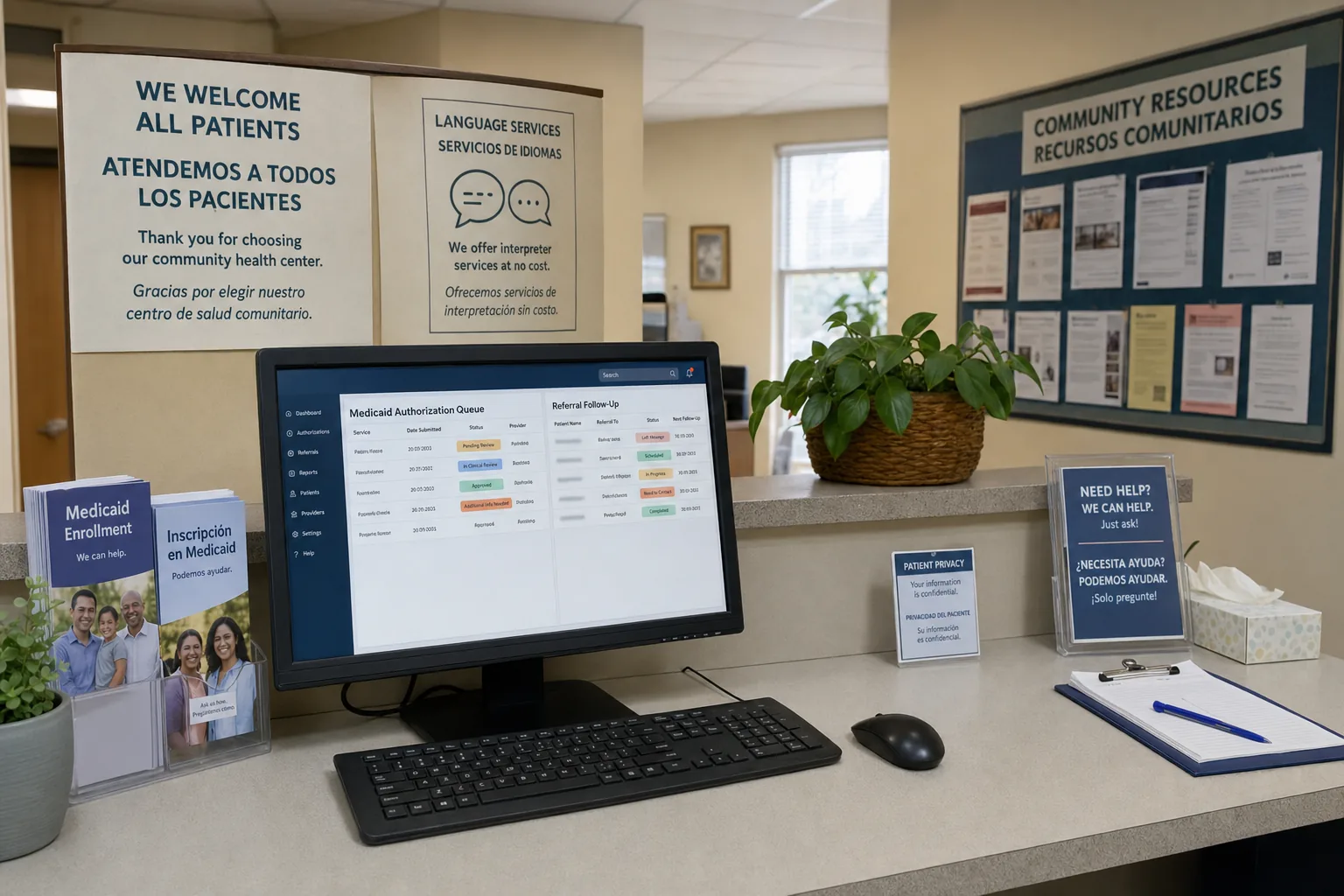
FQHCs run on thin margins, serve the highest-acuity Medicaid populations in any outpatient setting, and face prior authorization requirements that were designed around commercial insurance workflows. The mismatch is expensive. FQHC prior authorization AI is starting to close that gap in a way manual processes never could.
The prior authorization problem at FQHCs is not the same as at private specialty practices. It is larger in volume, harder to staff for, and more consequential when it fails. A delayed authorization at a rheumatology private practice costs a patient a week of pain. A delayed authorization at a community health center can mean a patient goes without a specialist referral for months, because the patient has no backup option.
This article covers why prior auth is disproportionately difficult for FQHCs, what AI-assisted processes actually change, and what implementation looks like when built on top of athenahealth.
Why prior auth hits FQHCs differently than private practices
FQHCs serve approximately 30 million patients annually across more than 1,400 health center organizations in the US, according to HRSA data. The majority of those patients are on Medicaid, uninsured, or on Children’s Health Insurance Program (CHIP) coverage. That payer mix drives several structural prior auth challenges that private practices do not face at the same intensity.
Medicaid prior auth rules vary by state, by plan, and by service type. An FQHC serving patients across multiple Medicaid managed care organizations in a single state is navigating three or four distinct prior auth workflows for the same clinical services. A specialist referral for a Medicaid patient might require prior auth through the MCO rather than the state program directly, with different documentation requirements, different turnaround timelines, and different appeal processes.
Staff capacity is structurally constrained. FQHCs operate with tighter administrative budgets than private specialty practices. The administrative staff handling prior auth are often also handling scheduling, patient intake, and billing. There is no dedicated auth team. Prior auth tasks get queued, tracked manually, and followed up on when time allows. The result is a backlog that grows faster than it clears.
Patients cannot self-advocate through denials. A prior auth denial at a private cardiology practice triggers a call from the patient’s family to the practice, pressure to refile, and often resolution within days. A prior auth denial at an FQHC often results in a patient who does not know the authorization was denied, does not have the phone access or administrative familiarity to push for resolution, and ultimately does not receive the care.
Health Affairs research on billing complexity found Medicaid the most challenging payer type to bill: fee-for-service Medicaid claims are denied at a rate nearly 18 percentage points higher than fee-for-service Medicare. MACPAC has separately examined how states and managed care organizations use automation in the prior authorization process. The burden is driven partly by the complexity of Medicaid plan structures and partly by the high volume of prior auth requirements imposed by managed care organizations.
What the prior auth workload actually looks like at a typical FQHC
A mid-sized FQHC with 20-30 providers processes several dozen prior authorization requests per week at minimum. The breakdown typically includes:
Specialist referrals account for the largest share. Primary care providers at FQHCs are managing patients with multiple chronic conditions, undiagnosed conditions that require specialist evaluation, and mental health needs that require behavioral health referrals. Most specialist referrals through Medicaid MCOs require prior authorization. The authorization confirms that the referral is to an in-network provider, that the clinical indication supports the referral, and that the MCO agrees the service is medically necessary.
Imaging and diagnostic testing generates a second significant volume. MRI authorizations, CT scans, and specialty lab panels each require their own authorization from most Medicaid MCOs. A primary care provider ordering an MRI for a patient with persistent headaches is creating an authorization task that can take 2-5 business days to resolve and requires a staff member to initiate the request, submit clinical documentation, follow up on status, and notify the patient when the authorization clears.
Prescription authorizations for specialty medications, particularly for patients transitioning from specialist care to primary care management, add another layer. Step therapy requirements under Medicaid managed care mean that patients sometimes need documented failure on first-line therapies before authorization for preferred medications.
What FQHC prior authorization AI actually does
AI voice agents integrated with athenahealth handle the coordination and follow-up tasks in prior auth that currently require staff time without clinical judgment.
Authorization initiation from the EHR. When a provider enters a referral order or imaging order in athenahealth, the AI identifies that the order requires prior authorization based on the patient’s payer, pulls the relevant clinical documentation from the chart, and initiates the authorization request with the appropriate MCO. The staff member does not need to manually identify which orders require auth or pull documentation separately.
Status tracking and follow-up. Prior auth requests submitted to Medicaid MCOs often have no proactive notification when they are approved or denied. The standard workflow is staff-initiated follow-up calls to the MCO at intervals until status is obtained. AI handles those follow-up calls on a defined schedule, checks status through the MCO’s IVR or provider portal, and updates athenahealth with the current status.
Patient notification. When an authorization clears, the AI places an outbound call to the patient notifying them that their referral or imaging order has been approved and offering to connect them to scheduling at the specialist office or to schedule the imaging appointment directly. This closes the loop on a step that frequently gets missed when staff are managing high volumes manually.
Denial triage. When an authorization is denied, the AI identifies the denial reason, documents it in athenahealth, and flags the case for staff review with the denial reason and relevant appeal deadline. Staff can then decide whether to file an appeal, request a peer-to-peer review, or modify the order. The AI does not make the clinical determination, but it surfaces the information needed to make that determination quickly.
Implementation on athenahealth at an FQHC
FQHCs that run on athenahealth have an implementation advantage for AI prior auth integration. The AI reads from athenahealth’s existing order management workflow and payer configuration rather than requiring a separate database of payer rules.
Configuration time for a new FQHC deployment typically runs 4-6 weeks. That time covers mapping the specific Medicaid MCOs the FQHC contracts with, configuring which service types require authorization for each payer, and setting the escalation rules for which denial types go to which staff role.
The measurement baseline for any FQHC considering AI prior auth should be current time-to-authorization per request and denial rate. FQHCs with manual prior auth processes that average more than three business days to authorization, or denial rates above 8%, typically see the clearest return on AI integration.
The patient impact
The administrative case for AI prior auth at FQHCs is the staffing efficiency argument: the same staff can manage more authorizations with less manual follow-up. That is real.
The patient care argument is harder to quantify but more important. An FQHC that clears prior authorizations faster and catches denials faster closes the gap between ordered care and received care. For patients who have no other source of care and no resources to navigate a delayed authorization on their own, that gap is where health outcomes are made or lost.
Prior authorization was not designed with FQHC patient populations in mind. AI integration does not fix the policy problem. It does reduce the operational damage the policy inflicts on the practices trying to serve those patients.
Sources
Ready to reduce missed calls?
See how Pretty Good AI reduces prior auth burden for FQHCs
Schedule a Demo →Written by Kevin Henrikson