Practice Operations
GI Prior Auth: Cut the Endoscopy Approval Backlog
Prior auth for colonoscopies and endoscopies buries GI staff. See how AI voice agents work the payer queue and cut the approval backlog.
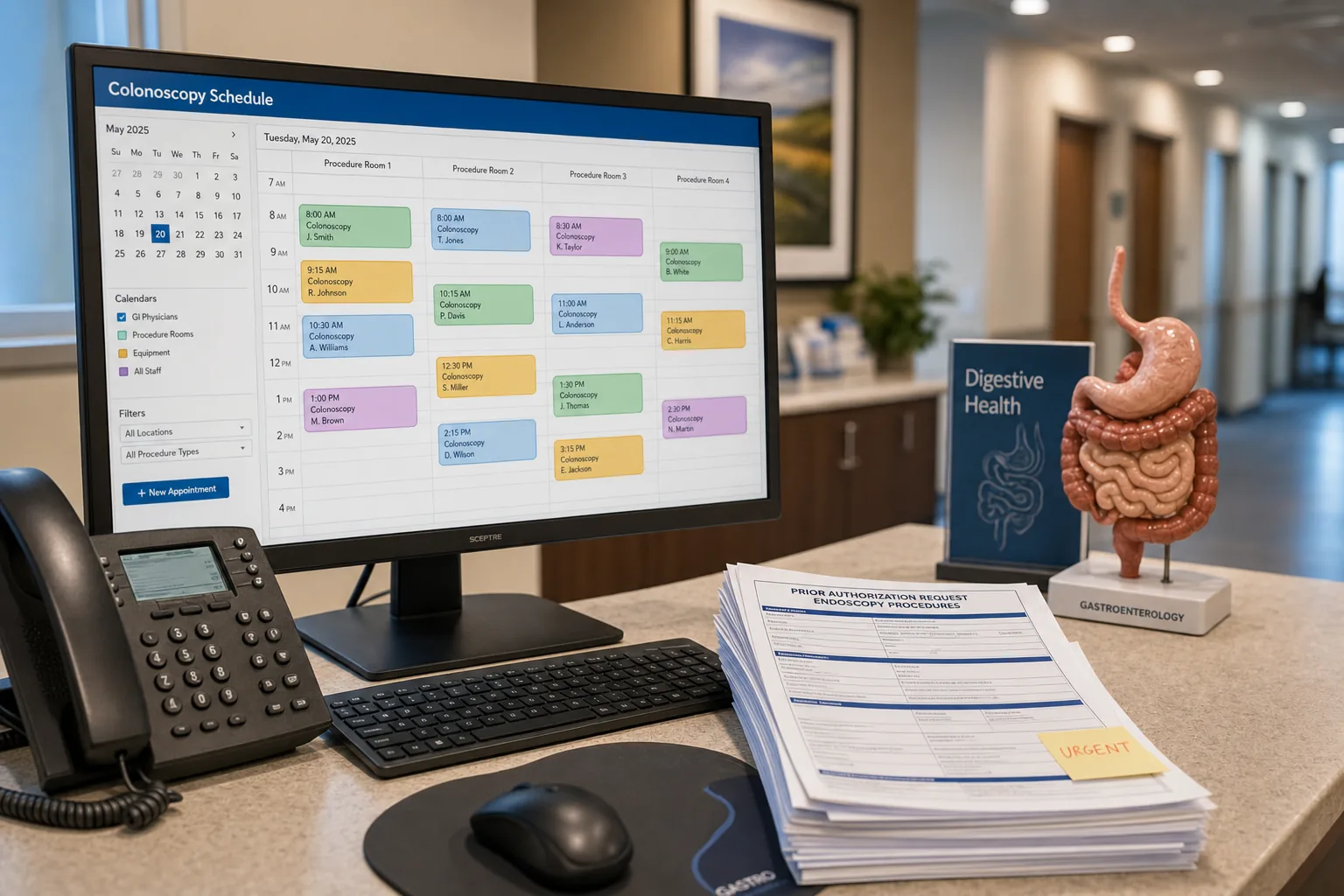
Gastroenterology practices run some of the most documentation-heavy prior authorization workflows in medicine, and gastroenterology prior authorization AI is the most direct fix for the time it wastes.
Diagnostic and surveillance colonoscopies and upper endoscopies frequently trigger payer review. UnitedHealthcare, for example, requires advance notification for non-screening endoscopies, and many Medicare Advantage and commercial plans require full prior authorization. Infliximab for a Crohn’s disease patient requires it. So does capsule endoscopy. Screening colonoscopies are generally exempt, but everything downstream of a positive finding is not. For a GI practice seeing 30 to 50 procedures per week, this adds up to dozens of separate authorization requests per week, each requiring clinical documentation, each tied to a specific payer’s criteria, and each subject to a denial that sends a staff member back to assemble additional records and resubmit.
The gastroenterology authorization burden is compounded by procedure complexity. A patient presenting with rectal bleeding may need a colonoscopy authorized, and the colonoscopy may reveal a polyp requiring biopsy, which may require a separate authorization for a pathology review. Each step in the clinical cascade has its own administrative step. Practices that manage this manually are running a parallel administrative operation alongside the clinical one, and the administrative operation has no end in sight.
What GI prior auth actually looks like operationally
For gastroenterology practices, prior authorization falls into three main categories.
Procedure authorizations. Colonoscopies and upper endoscopies generate the highest volume. Diagnostic and surveillance procedures frequently require prior auth or advance notification from commercial payers and Medicare Advantage plans, with clinical documentation requirements that vary by payer; screening colonoscopies are generally exempt. A patient with a family history of colon cancer may qualify under different criteria than a patient with active bleeding. Staff need to match the clinical documentation to the specific payer’s criteria, not just submit a generic request.
Specialty medication authorizations. GI practices prescribing biologics for inflammatory bowel disease, infliximab, adalimumab, vedolizumab, ustekinumab, face some of the most restrictive prior auth criteria in gastroenterology. Payers typically require documented failure of first-line therapy before approving biologics. Step therapy requirements mean the authorization process involves tracking and documenting prior treatment history across multiple medications before the request even gets submitted. A single biologic authorization can take several weeks from initial request to approval.
Follow-on and surveillance authorizations. Patients with a history of colorectal polyps or inflammatory bowel disease require surveillance colonoscopies on defined schedules. These recurring authorizations consume staff time for patients who are already established in the practice, repeating the same documentation work at guideline-defined intervals, typically every 3 to 10 years after polypectomy under the 2020 Multi-Society Task Force recommendations, and as often as every 1 to 3 years for higher-risk patients such as those with inflammatory bowel disease.
The American Gastroenterological Association has documented that prior authorization creates significant care delays for GI patients, with some procedures delayed by weeks when payers request additional documentation or require peer-to-peer reviews. Those delays are not just administrative inconveniences; they represent clinical risk for patients who need timely diagnostic or therapeutic procedures.
Where AI fits into the GI prior auth workflow
AI prior authorization tools for gastroenterology practices take on the work that does not require clinical judgment: documentation gathering, submission, status tracking, and follow-up.
Documentation assembly. For colonoscopy prior auth, the clinical documentation requirements are largely predictable, indication for procedure, relevant history, patient demographics. AI can pull this information from the EHR and assemble a pre-populated authorization request that matches the specific payer’s submission template. Staff review the assembled request rather than building it from scratch.
First-pass submission. For payers with portal-based authorization submission, AI can complete the submission after staff review. For payers that still require phone-based authorization, a category that includes many regional insurers and some Medicare Advantage plans, AI voice agents handle the call, provide the required documentation verbally, and document the authorization number in the EHR when received.
Denial management. First-pass denial is common in GI prior auth, particularly for biologics where payers routinely deny first submissions to enforce step therapy requirements. AI tracks denial reasons, identifies the specific additional documentation requested, and routes the appeal to the appropriate staff member with the specific gap highlighted. Staff know exactly what is needed rather than reading through the denial letter to identify the missing element.
Status follow-up. Commercial payers can still take a week or two to process prior auth requests, and even under the CMS rule that now caps Medicare Advantage and Medicaid standard decisions at 7 calendar days (72 hours expedited, effective January 2026), nothing notifies the practice proactively, status follow-up contact is still required. AI handles this follow-up automatically, checking status on a defined schedule and escalating to staff when a request has been pending longer than expected or when the approval window is approaching a clinically significant deadline.
The biologic authorization problem
The biologic medication prior authorization workflow in GI practices deserves specific attention because it is the most resource-intensive category.
A patient diagnosed with moderate-to-severe Crohn’s disease who is moving to a biologic medication typically needs to demonstrate failure of conventional therapy. That means the authorization request must document what prior therapies were tried, at what doses, for how long, and why they failed. Different payers define “adequate trial” differently. Some require 3 months on a conventional agent. Others require 6 months. Some accept documented intolerance as an alternative to treatment failure.
Without AI, a GI practice managing biologic authorizations maintains this documentation manually. Staff track which payers have which step therapy requirements, pull prior treatment records from the EHR, and assemble documentation packages that match each payer’s specific criteria. When a patient changes insurance, common when patients change jobs, the process starts over with the new payer’s requirements.
AI systems that maintain payer-specific criteria databases can match a patient’s treatment history against the relevant payer’s requirements and identify what documentation is present, what is missing, and what needs to be generated before the first submission goes out. That reduces the back-and-forth between practices and payers that currently defines biologic authorization.
What changes for GI practice staff
Practices that implement AI prior authorization consistently describe the same operational shift: prior auth coordinators move from reactive to proactive work.
In a manual prior auth workflow, coordinators spend most of their time responding to immediate needs: a new authorization request that needs to be submitted today, a denial that needs to be appealed, a payer status call for a procedure scheduled tomorrow. The work is driven by urgency rather than planning.
With AI handling the submission, status tracking, and initial denial triage, coordinators see the authorization pipeline rather than just the immediate queue. They can identify patterns (for example, a payer denying upper endoscopies at a higher rate than expected, or a biologic gaining a new step therapy requirement) and address them systematically rather than case by case.
For a GI practice scheduling 30 to 50 procedures per week, that shift from reactive to proactive authorization management changes both the staff experience and the practice’s denial rate over time.
What to verify before implementing
GI practices evaluating AI prior authorization tools should verify specific capabilities before committing to a vendor.
Does the system maintain a database of payer-specific criteria for GI procedures and biologics, and how frequently is that database updated? Payer criteria change. A system running on outdated criteria will generate authorization requests that fail for avoidable reasons.
Does the system handle phone-based authorization for payers that do not accept portal submissions? For many regional and Medicare Advantage plans, this is not optional.
How does it integrate with athenahealth? For practices on athena, native integration means authorization status is visible in the patient chart and drives scheduling workflow, a procedure cannot be scheduled until authorization is confirmed. Systems that integrate via file transfer instead of native workflow create reconciliation work rather than eliminating it.
What is the escalation process for peer-to-peer reviews? Some GI procedure authorizations require a physician peer-to-peer call with the payer’s medical director. AI can prepare for these reviews, assembling the documentation, scheduling the call time, but the physician still needs to make the call. The system should make that handoff efficient rather than creating confusion about who owns the escalation.
Key takeaways
- GI practices process three categories of prior auth: procedure authorizations, biologic medication authorizations, and surveillance authorizations, each with different documentation requirements and timelines.
- Biologic medication prior auth is the most resource-intensive category, requiring documentation of prior treatment history that varies by payer-specific step therapy criteria.
- AI handles documentation assembly, first-pass submission, denial triage, and status follow-up, the work that does not require clinical judgment.
- First-pass denial rates in GI biologic authorization are high because payers use denial as a step therapy enforcement mechanism. AI can reduce turnaround time on required appeals.
- Native EHR integration with athenahealth means authorization status drives scheduling workflow directly rather than requiring manual reconciliation.
- The operational outcome is coordinators shifting from reactive queue management to proactive authorization pipeline management.
See how Pretty Good AI handles GI prior authorization with athenahealth integration
Sources:
- American Gastroenterological Association. GI Patients and Physicians Urge Congress to Fight Back Against Out-of-Control Prior Authorization. Gastro.org, 2023.
- American Medical Association. 2025 AMA prior authorization physician survey. AMA, 2025.
- US Multi-Society Task Force on Colorectal Cancer. Recommendations for Follow-Up After Colonoscopy and Polypectomy: A Consensus Update. 2020.
- Centers for Medicare & Medicaid Services. CMS Interoperability and Prior Authorization Final Rule (CMS-0057-F).
- UnitedHealthcare. Gastroenterology Prior Authorization and Advance Notification.
Ready to reduce missed calls?
15-minute demo. See how an AI team works inside your athenaOne practice.
Schedule a Demo →Written by Kevin Henrikson