Practice Operations
Home Health After-Hours Intake for Caregivers
Home health after-hours calls span scheduling, equipment, and patient concerns. AI voice agents capture structured intake and escalate clinical calls.
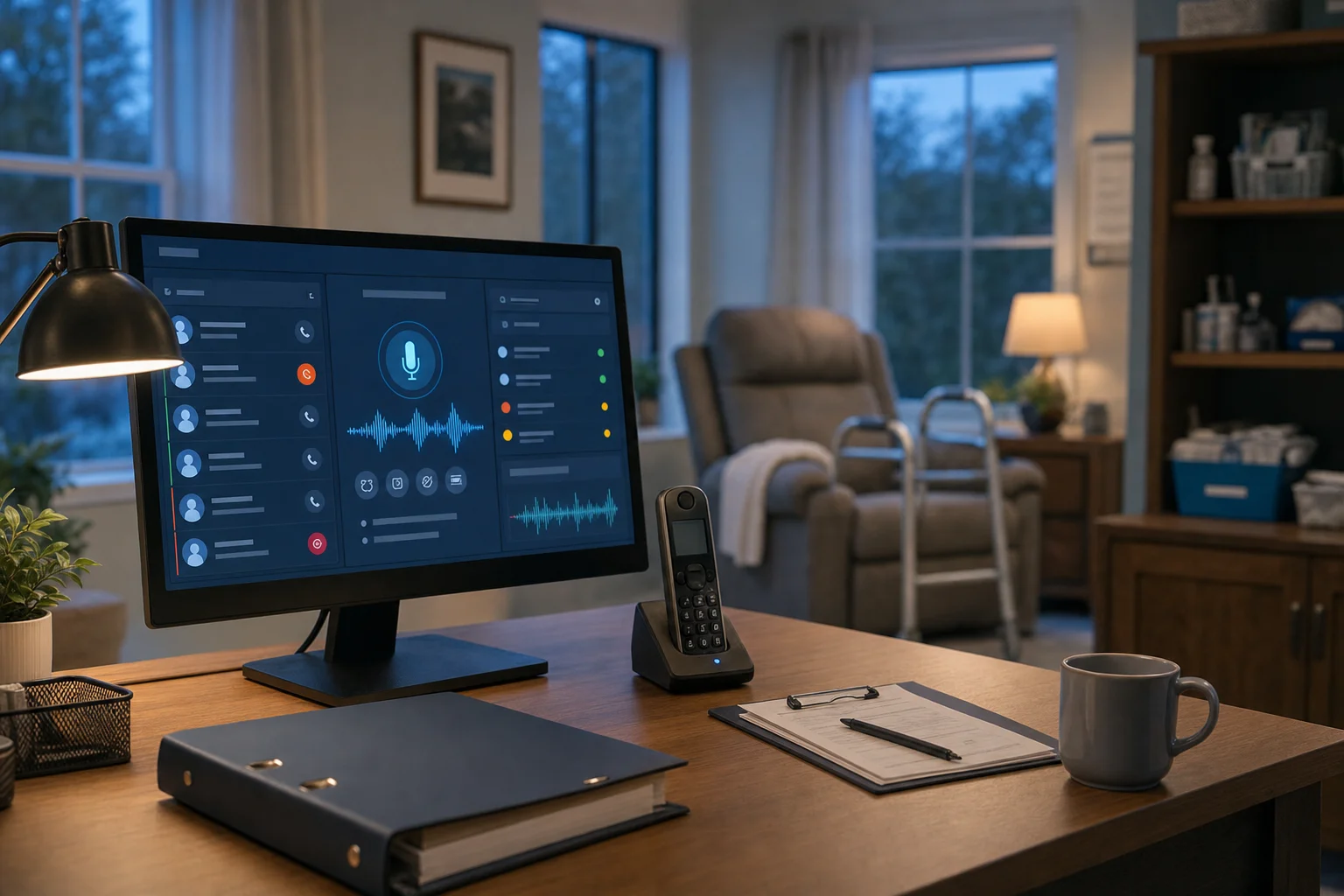
Home health after-hours calls come from more directions than almost any other setting. The patient calls. The spouse calls. The adult child three states away calls. A hired caregiver calls. And they call about everything, a missed visit, a medication they cannot find, a wound that looks wrong, equipment that stopped working, or a parent who suddenly seems confused. The person on the other end is often frightened and not clinically trained, and they are describing a situation the agency cannot see.
Most of these calls are manageable: scheduling, medication questions, equipment troubleshooting, visit confirmations. But home health serves a medically complex, often elderly population, and buried in the routine volume are the calls that signal a real problem, a fall, a change in mental status, a wound infection, breathing trouble. Any after-hours system has to move the routine calls efficiently while catching the emergencies from callers who may not know what counts as one.
Why home health after-hours volume is different
Home health patients are managed remotely, across a distributed workforce, in settings the agency does not control. That structure generates after-hours calls no clinic sees.
Visits get missed or run late, and patients and families call to find out where the nurse is. Medications get confused in homes managing complex regimens. Equipment, oxygen concentrators, hospital beds, wound vacs, infusion pumps, fails at night, and no technician is on site. Caregivers who are not clinically trained encounter concerns they cannot describe easily and call for help documenting them. And the patients themselves are frequently elderly, frail, and living with multiple chronic conditions, which raises the baseline risk of any given call.
The caller variety is the complicating factor. A clinic mostly hears from the patient. A home health agency hears from patients, family members near and far, and paid caregivers, each with different information and different levels of alarm. Structured intake has to work regardless of who is on the line and how well they can describe what is happening.
What home health after-hours calls actually look like
The call mix breaks into four groups.
Scheduling and visit calls are a large, routine share. Where is the nurse? Why was my visit missed? Can we move tomorrow’s visit? When is the aide coming? These are logistical and rarely need clinical input, but they are urgent to the caller and generate real volume.
Medication and care-plan questions are the second group. Which pill is which, whether a dose was already given, how to use a prescribed device, or what a care-plan instruction means. The agent captures these questions and routes anything clinical to the care team.
Equipment calls are the third group. Oxygen concentrator alarms, bed malfunctions, wound-vac or pump errors, supply shortages. Many are answerable from device guides or resolved by dispatching a supply run, but some, a failed oxygen concentrator for an oxygen-dependent patient, become clinical fast.
Calls that need urgent escalation are the minority by count but the reason the system exists. Falls, chest pain, breathing difficulty, sudden confusion or change in mental status, signs of wound infection, uncontrolled bleeding, a failed device the patient depends on to breathe. These need a clinician immediately, and the danger is they arrive undifferentiated alongside the scheduling question, often from a caller who does not realize how serious the situation is.
Why answering services fail home health
Most agencies cover after hours with an answering service or an on-call nurse line. Answering services fail home health for a specific reason: no chart access and no care-plan context.
When a daughter calls because her father “seems off,” the answering service does not know his diagnoses, his medications, his baseline mental status, or that he is on oxygen. Without that, “seems off” is impossible to place. So the service either escalates everything to the on-call nurse, burning out a scarce clinical resource with scheduling questions, or gives generic guidance that misses a patient whose confusion signals a real event. Neither works, and neither documents the call where the visiting nurse will see it tomorrow.
The distributed nature of home health makes this worse. The on-call nurse escalated to at 2 a.m. often has no immediate context on a patient they may never have visited. They start every call cold.
What AI can actually handle
AI voice agents integrated with a home health EHR change the equation because they bring the patient’s context to a call from any caller.
When someone calls at 2 a.m. about a patient who “seems off,” the agent identifies the patient against athenaOne and captures the caller’s description in a structured intake. It checks practice-owned red flags to route an emergency to 911 or the appropriate emergency service, then gives the on-call clinician the context needed for a handoff. It does not diagnose or decide what the symptoms mean.
“I’ll capture what you’re seeing and connect this to the on-call team. What happened, when did it start, and what should the clinician know before they call you back?”
Those questions capture the caller’s account in a form a clinician can use. Administrative requests can be completed or routed; anything clinical is escalated with full context.
The categories AI handles well are scheduling and visit questions, refill requests entered into the provider-approved workflow, and equipment logistics, including dispatching a supply run or after-hours equipment contact when appropriate.
The categories AI does not decide: anything suggesting a clinical emergency. Falls, chest pain, breathing trouble, mental-status change, wound infection, bleeding, or a failed life-sustaining device. These route to the on-call nurse or emergency services immediately with a structured summary prepared.
The escalation path
A structured after-hours intake for home health works like this.
The call comes in from a patient, family member, or caregiver. The agent identifies the patient against athenaOne, records the reason for calling, and prepares the chart context for the agency’s on-call team.
Structured intake begins, phrased for whoever is calling. What is the concern? When did it start? What has changed? The agent records the answers as data and checks practice-owned red flags without interpreting the condition.
Administrative requests can be completed or routed, confirming the schedule, taking a refill request into the provider-approved workflow, or dispatching a supply run, and the interaction is logged to the chart. Clinical concerns go to the on-call team.
Clinical concerns connect the on-call nurse with a structured summary: patient name, reported concern, timing, relevant volunteered context, and the full conversation. For life-threatening situations, the agent directs the caller to emergency services without delay. The on-call nurse picks up already briefed instead of starting cold.
The athenahealth integration advantage
For home health agencies on athenahealth, native EHR integration is what makes structured intake from any caller possible.
Without integration, an agent works from whatever the caller can provide. With athenahealth integration, it can identify the patient, surface relevant chart context for the handoff, and document the interaction without asking the caller to repeat administrative details.
Integration also closes a documentation gap that is acute in distributed care. Every after-hours interaction, AI-handled or escalated, is logged back to the chart. When the visiting nurse arrives the next day, they see that the family called overnight about confusion, what was reported, and how the call was routed. Continuity across a distributed workforce is one of home health’s hardest problems. Automatic charting directly attacks it.
What implementation requires
Deploying AI for home health after-hours coverage requires several things done right.
Caregiver-friendly intake design. The intake has to work for non-clinical callers. Questions must capture the caller’s account in plain language, and the system must handle callers who are frightened, unsure, or unfamiliar with the patient’s history.
Practice-owned routing. Home health serves a high-risk population, and callers may be unsure how to describe what happened. Routing rules should be built by the agency’s clinical leadership and send clinical questions to the on-call nurse rather than holding them.
On-call nurse buy-in before go-live. The on-call clinician needs to trust that the AI escalates the right things with real context. The setup phase should include clinical staff reviewing and approving escalation rules before any patient is routed through the system.
Morning review as a standard step. Every after-hours call should queue for review by the care team the next day. This creates accountability, catches edge cases, and feeds protocol improvement over time.
Why this matters beyond call volume
The on-call burden in home health falls on a scarce and expensive resource: experienced nurses. An after-hours system that handles scheduling, medication, and equipment calls without a page protects those nurses for the calls that need clinical judgment. In a labor market where home health staffing is a constant challenge, protecting nurse time is not a luxury.
The documentation benefit compounds. When a family calls about a missed visit or a medication question and the interaction is charted, the visiting nurse walks in informed. Patterns become visible, recurring confusion, repeated equipment failures, a caregiver who is struggling, and the agency can act on them proactively rather than discovering them at the next crisis. Better continuity, better safety, better support for the families doing the day-to-day caregiving.
Answering services deliver none of that. The on-call nurse still gets paged cold, and the interaction disappears.
Key takeaways
- Home health after-hours calls come from patients, families, and caregivers about everything from scheduling to concerns that require clinician review
- Answering services cannot create a useful handoff because they lack the patient’s chart context and structured intake
- AI integrated with athenahealth identifies the patient and brings relevant context to a call from any caller
- Clinical concerns route to the on-call nurse, and life-threatening situations are directed to emergency services, with a full structured summary prepared
- Every interaction is charted in real time, closing the continuity gap across a distributed workforce
- Caregiver-friendly intake and practice-owned escalation rules are non-negotiable for a high-risk, remotely managed population
Home health after-hours call volume is not going away as long as medically complex patients are cared for at home by families and aides. The question is who handles the routine scheduling and equipment majority and how reliably clinical concerns reach the care team. AI intake built on chart context can take the routine calls, protect scarce on-call nurses, and send clinical reports with a structured handoff.
Internal links
Ready to reduce missed calls?
See how Pretty Good AI handles after-hours calls for home health agencies
Talk to our team →Written by Kevin Henrikson