Practice Operations
Health System Call Centers at Patient Volume
Hospital systems and health networks run call centers that take thousands of patient calls per day. AI voice agents integrated with athenaOne handle the high-volume structured calls so your staff handles complex cases.
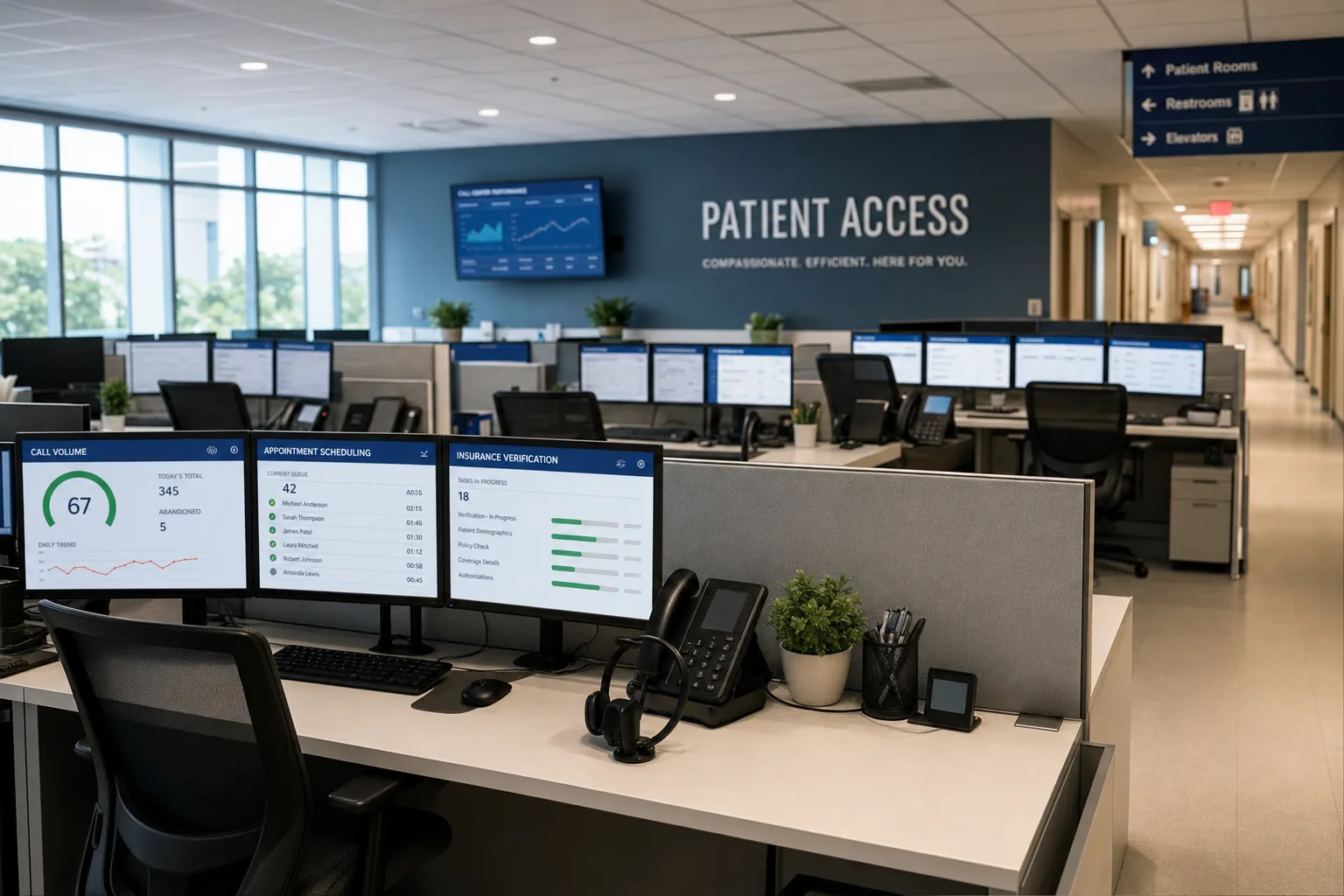
Your health system’s patient access center handles 8,000 calls on a slow Tuesday. On a Monday after a holiday weekend, that number is closer to 14,000. Your staff, the ones doing scheduling, insurance verification, prior authorization follow-up, and referral coordination, are the same 40 people on both days. Something always breaks.
The math does not work at hospital scale. A staff member can handle maybe 50 to 70 calls per shift. That covers the complex calls, the ones where a patient needs to discuss a specialist referral or navigate a billing dispute. But 60% of the call volume coming into a health system’s patient access center is not complex. It is appointment scheduling, prescription refill requests, general information queries, and insurance verification. Tasks with structured inputs, predictable outputs, and zero need for clinical judgment.
AI voice agents built natively into athenaOne handle that structured call volume. Not with an IVR that frustrates patients. With a conversational AI that schedules appointments, verifies insurance in real time, routes prior auth requests to the right department, and answers questions, while your staff handles the calls that actually require a human.
Why hospital call center volume keeps growing
Health system call centers have been absorbing volume growth for over a decade without a structural solution. Four dynamics are making the problem worse.
Patient volume is rising. Aging demographics, expanded insurance coverage, and consumer-grade expectations around access are driving more patients to seek care more frequently. Sg2’s Impact of Change forecast projects outpatient volumes will grow roughly 18% over the next decade. Most of that growth reaches the patient access center first.
Service line complexity is increasing. A health system that added a cardiac center, a women’s health pavilion, and three urgent care locations in the last five years has also added three distinct scheduling workflows, three sets of insurance protocols, and three queues of prior authorization requirements. Each new service line adds call volume. It rarely adds proportional staff.
Same-day demand is unbudgeted. Health systems typically staff call centers based on historical average volumes. But patient demand is not average, it spikes with flu season, weather events, post-holiday surges, and news cycles. The system staffed for Tuesday’s 8,000 calls has no graceful response to Friday’s 13,000.
Staff turnover is structural. Patient access representatives are among the highest-turnover roles in healthcare operations. Average tenure at most health systems is 14 to 18 months. Every departure takes institutional knowledge about workflows, insurance quirks, and provider preferences with it.
What AI actually handles in a hospital call center
Health system call centers that deploy AI voice agents through athenaOne are routing two categories of calls to automation: structured intake and administrative follow-up.
Structured intake includes appointment scheduling for established patients, new patient registration, referral coordination, and prescription refill routing. These calls follow a predictable flow. The patient needs to schedule an appointment with cardiology on a Thursday. The AI reads provider availability from athenaOne in real time, offers options, books the appointment, and sends a confirmation. The patient access rep never picks up the phone.
Administrative follow-up includes insurance verification status checks, prior authorization status updates, and billing inquiry routing. A patient calling to ask whether their colonoscopy has been authorized by their insurer does not need a human to answer that question. The AI checks the prior auth status in athenaOne, reads the result back to the patient, and closes the call. If the auth is still pending, the AI logs the inquiry and routes an alert to the appropriate department.
The key constraint is athenaOne integration. Health systems that have fragmented EHR environments, one system for the hospital, a different one for the employed physician group, cannot fully realize AI call center value without a single source of truth for scheduling and clinical data.
Prior authorization at hospital scale
Individual specialty practices have their own prior auth burden. Health systems have all of those problems simultaneously, plus coordination overhead across departments.
A prior authorization request for a joint replacement that originates in orthopedics may require clinical documentation from the primary care physician, a facility authorization from hospital administration, and a separate implant authorization from a device-specific vendor. At a health system with 100 orthopedic cases per month, managing that workflow manually through phone calls and faxes produces a predictable backlog.
AI voice agents integrated with athenaOne handle the high-volume, lower-complexity portion of this workflow: checking auth status, routing requests to the correct department, collecting missing documentation details from patients or referring physicians, and sending status updates. The clinical determination, whether the procedure is medically necessary, remains with the provider. The phone and fax work around that determination does not.
Research from the American Medical Association shows physicians and their staff spend an average of 13 hours, nearly two business days, each week completing prior authorizations, with practices averaging about 40 requests per physician per week, and physician practices spend an average of $14.4 billion annually on prior authorization compliance work. At health system scale, those numbers multiply across every service line.
Standardizing across service lines
The challenge unique to health systems is standardization. A community hospital that acquired three physician practices in the last four years may be running three different scheduling systems, two different insurance verification processes, and one highly inconsistent patient communication style.
AI voice agents deployed at the health system level offer a path to standardization that hiring and training cannot. The AI operates from a single rulebook, applied consistently across every call. A patient scheduling at the cardiac center and a patient scheduling at the women’s health pavilion have the same experience, because the same AI is handling both.
This consistency matters for patient satisfaction scores. HCAHPS results and patient experience surveys increasingly reflect access quality, not just clinical quality. A health system that delivers a confusing, inconsistent scheduling experience is losing patient loyalty to competitors with better access models.
What integration with athenaOne looks like at enterprise scale
Pretty Good AI’s integration with athenaOne is built for enterprise deployment. Health systems with multiple tax IDs, multiple practice locations, and multiple service lines can deploy a single AI configuration across the entire network, with service-line-specific customizations layered on top.
The technical integration reads from and writes to athenaOne using the athenahealth Marketplace API. Appointments booked by the AI appear in the provider’s schedule in real time. Insurance verification results are logged against the patient’s record. Prior auth requests are routed to the correct workflow based on the service type.
Key takeaways for health system operations leaders
- 60% of patient access call volume is structured and automatable: scheduling, verification, auth status, and refill routing do not require human judgment
- Peak volume spikes are a significant operational exposure: AI handles surge volume without staffing changes, 24/7
- athenahealth-native integration means no parallel systems: AI reads and writes to the same record used by your clinical staff
- Standardization across service lines is the long-term enterprise value: consistent patient access experience regardless of which department is fielding the call
- Staff turnover impact decreases when structured call volume is handled by AI, the calls requiring institutional knowledge stay with experienced staff
- Prior auth workflow support at health systems with high procedure volume cuts administrative tracking time significantly
The bottom line
The ROI question for AI deployment in a health system is not whether AI can handle calls. It can. The question is whether the integration is reliable enough to operate at enterprise scale without creating a second system to manage.
The answer depends on how the AI is connected to the EHR. An AI built natively into athenaOne, reading real-time availability and updating patient records directly, eliminates reconciliation risk by design.
If your health system runs on athenaOne and your patient access center is handling more volume than your staff can absorb, start with the integration architecture.
Sources:
- Sg2 (a Vizient company), “Impact of Change Forecast” (2025): https://www.vizient.com/newsroom/news-releases/sg2-forecasts-18-percent-growth-in-outpatient-care-5-percent-inpatient-care
- American Medical Association, “AMA Prior Authorization Physician Survey”: https://www.ama-assn.org/practice-management/prior-authorization/ama-prior-authorization-physician-survey
- Advisory Board, “Patient Access Center Benchmarking Report”
See how Pretty Good AI integrates with athenahealth for health networks
Ready to reduce missed calls?
15-minute demo. See how an AI team works inside your athenaOne practice.
Schedule a Demo →Written by Kevin Henrikson