Practice Operations
Scheduling Automation for Independent Primary Care
Independent primary care practices field 60-100 scheduling calls daily with 1-2 front desk staff. AI voice agents integrated with athenahealth handle the routine calls so staff handle the complex ones.
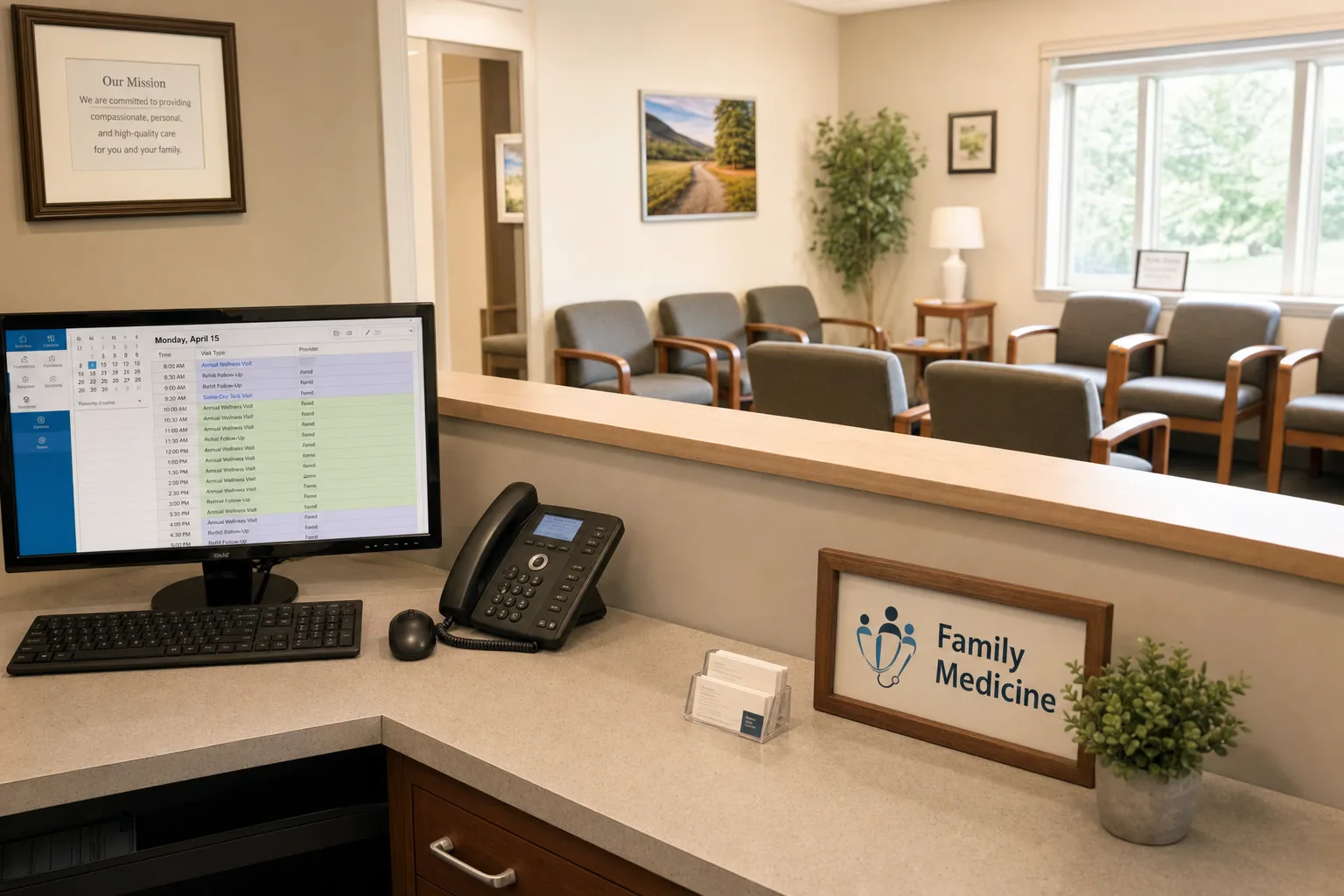
The independent primary care front desk is answering the same call it answered 200 times last month. Someone needs an appointment. Someone needs to reschedule. Someone needs a referral status. Independent primary care scheduling AI changes which of those calls require a human and which ones do not.
Independent primary care practices field more scheduling calls per provider than any other outpatient setting. A solo physician with 2,000 active patients and one front desk staff member is managing an inbound call volume that would stress a practice twice that size. The calls are not complex individually. They are overwhelming in aggregate.
The math is simple and brutal. A primary care practice with 1,800 active patients generates 4-6 scheduling contacts per patient per year: new appointments, prescription refill appointment requests, annual wellness visits, follow-up scheduling after lab results. That is 7,200-10,800 scheduling contacts per year, or 600-900 per month, from an active panel. A front desk staff member handling calls back-to-back at 3-5 minutes each can realistically complete 10-15 scheduling calls per hour, and scheduling is only part of the inbound mix alongside clinical, billing, and pharmacy calls. The volume and the capacity are close enough that any disruption, a staff member out sick, a morning of complex calls, creates a backlog that takes days to clear.
This is the environment independent primary care scheduling AI is solving for.
What the scheduling call mix looks like in independent primary care
Scheduling calls at an independent primary care practice cluster into a handful of categories with different complexity levels and different automation candidacy.
New patient scheduling (20-25% of call volume). A new patient calling to establish care needs insurance verification, provider availability, appointment type selection (new patient vs. Medicare wellness vs. same-day sick), and new patient packet instructions. These calls take 8-12 minutes in a manual process. They are automatable: the information exchange follows a predictable flow, the payer verification can be run against the practice’s athenahealth payer list in real time, and the appointment can be booked directly.
Established patient appointment requests (35-40%). An established patient calling to schedule a follow-up, a wellness visit, or a same-day sick appointment needs a straightforward scheduling interaction. The patient is in the system, their insurance is on file, and the provider preference is documented. These calls take 3-5 minutes and are almost entirely automatable for patients whose information is current.
Prescription refill appointment requests (15-20%). Patients calling because they need a refill and their provider requires an office visit first. These calls require scheduling the appointment and noting the refill request so the provider knows in advance. Automatable.
Reschedules and cancellations (10-15%). Established patients who need to move an existing appointment. These calls require real-time schedule access and rebooking capability. Fully automatable for standard appointment types.
Referral status and results inquiries (10-15%). Patients calling to check on a specialist referral status, lab result, or imaging result. These require chart access and, often, provider involvement for results interpretation. Less automatable, but the AI can triage: confirming that results are available and directing patients to the patient portal, or flagging chart review needed for provider callback.
Why standard scheduling systems do not solve the problem
Practice management systems with patient portal scheduling and automated appointment reminders exist. They handle a portion of the volume. The portion they miss is large and getting larger.
Patient portal adoption in independent primary care hovers around 40-60% for active patient panels, with lower adoption rates among elderly patients, low-income patients, and patients with limited digital access. The scheduling calls that portals do not absorb are the calls from the 40-60% of patients who are not using the portal. That is a substantial portion of the practice.
Automated reminders with confirmation press-1 functionality reduce no-shows but do not reduce inbound call volume. A reminder that generates a cancellation creates a scheduling call: the patient who cancels needs to be rescheduled.
Phone trees that route calls to voicemail or to a general scheduling line add friction without reducing demand. Patients who cannot reach a live scheduler call back. A practice that routes scheduling calls to voicemail and calls back within 24 hours is running a callback operation that consumes as much staff time as the original calls, with added complexity.
AI voice agents are different because they are interactive, bidirectional, and connected directly to athenahealth. They do not route to voicemail. They do not play a menu. They have a conversation, access the schedule, and book the appointment.
What independent primary care scheduling AI handles in practice
For an independent primary care practice on athenahealth, AI voice agents handle the following scheduling interactions autonomously:
New patient intake. The AI verifies the patient’s insurance against the practice’s accepted payer list in real time, asks for the reason for the visit to select the correct appointment type, explains what to expect for a new patient appointment, and books the slot. For practices with specific provider preferences, some patients request to see the physician owner, others are comfortable with the NP, the AI handles provider matching in the booking flow.
Established patient appointment scheduling. For patients already in athenahealth, the AI confirms identity via date of birth and callback phone number, offers available appointment times for the relevant appointment type, and books without staff involvement.
Appointment reminders with reschedule handling. Reminder calls that include a two-way reschedule path reduce the net scheduling overhead. A patient who reschedules via the reminder call rather than by calling in as a separate inbound call does not create a new inbound demand event. The AI handles the rebooking in the same interaction.
Referral portal routing. When a patient calls about a referral or result that is available in the patient portal, the AI confirms availability and provides navigation instructions for the portal. This closes the loop on a category of calls that currently require a staff member to pull the chart and verify.
What the capacity change looks like
A two-physician independent primary care practice with two front desk staff handling 80 scheduling calls per day shifts roughly 60-65 of those calls to AI handling for the routine categories. The front desk is handling the complex calls: insurance disputes, patients who need same-day clinical triage, new patient calls with unusual payer situations, and the referral coordination that requires chart review.
The physicians are not taking scheduling questions at end-of-day because the front desk is still catching up. The front desk is not trading clinical coordination work for scheduling calls. The AI is handling the predictable call volume so humans handle the unpredictable.
For independent practices competing with health systems that have nurse lines, same-day care centers, and online scheduling platforms, AI scheduling parity is a patient retention argument as much as a cost argument. Patients who cannot reach a scheduler within minutes call elsewhere.
Sources
Ready to reduce missed calls?
See how Pretty Good AI automates scheduling for independent primary care
Schedule a Demo →Written by Kevin Henrikson