ROI Analysis
The Insurance Verification Trap: Why Your Staff Wastes Half Their Day on Hold
Medical practices waste 4+ hours daily on manual insurance verification. See how AI automates eligibility checks in real-time for $35K-50K annual savings.

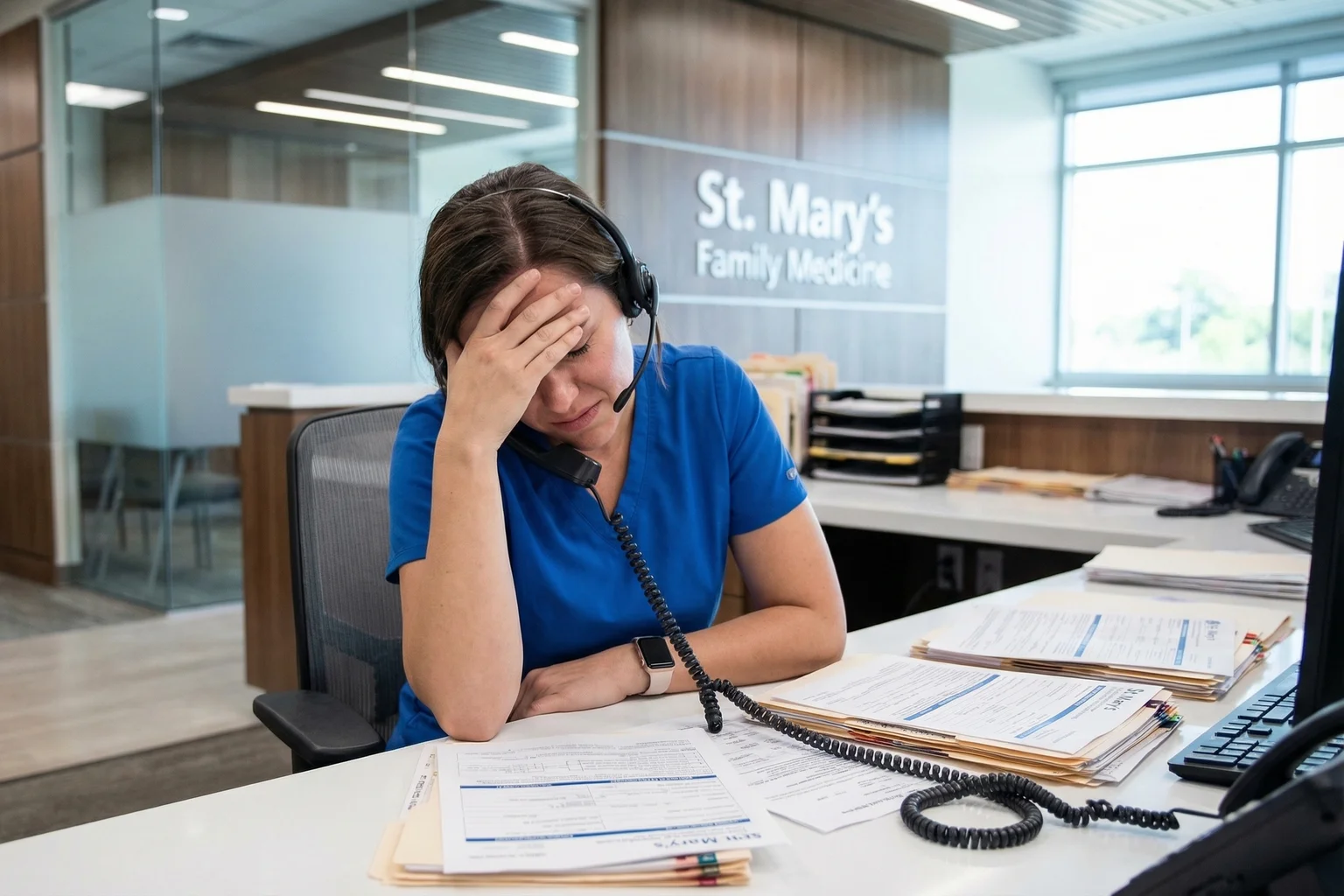
Your front desk staff arrives at 7:30 AM. By 8:00 AM, they’re on hold with Aetna. By 8:15, they’re navigating Blue Cross’s automated system. By 9:00, they’ve verified three patients and have 42 more to go before the day starts.
This is how medical practices burn 4-5 hours daily: calling payers, entering portal credentials, waiting on hold, transcribing coverage details, and fixing data mismatches.
It’s the most expensive make-work in healthcare.
The make-work nobody questions
Insurance verification feels mandatory. Patient coming in? Check if they’re covered. Confirm copay amounts. Verify the plan hasn’t changed since last visit. This eats 3-5 hours per day.
For a single staff member, this is 50-75% of their day. For larger practices, it’s a full FTE dedicated to calling insurance companies.
Manual insurance verification: the hidden $50K annual cost
CAQH research shows that 1,250 manual eligibility checks per year cost practices an average of $6,000. That’s just under 5 checks per business day.
Most practices do 10-20x that volume.
Let’s calculate for a mid-sized practice:
Staff time cost:
- 4 hours/day x 250 business days = 1,000 hours/year
- At $22/hour (front desk rate + benefits)
- Direct cost: $22,000/year
Denial and rework cost:
- Preventable claim denials from coverage issues cost practices $8,000-12,000 annually per provider (Healthcare Revenue Cycle Analysis, 2025)
- 2-3 provider practice: $16,000-36,000/year
Error cascade cost:
- Patient shows up with lapsed coverage
- Staff scrambles to verify in real-time
- Appointment delayed 15-30 minutes
- Provider schedule disrupted
- Patient frustrated
- Revenue delayed or lost
Total annual cost: $45,000-60,000
And this assumes your staff never makes mistakes. They do.
Why manual verification fails
Three problems compound into a verification crisis:
Insurance status changes constantly. Patients switch jobs. Employers change carriers. Plans lapse. Dependents age out. Coverage you verified last month might be invalid today. You find out when the claim denies.
Portal hell is real. Most practices verify through multiple insurance portals. Each has different login requirements, different interfaces, and different data formats. Your staff maintains 15-20 sets of credentials and navigates 15-20 different systems.
Hold times kill productivity. When portal verification doesn’t work (often), staff calls. Average hold time: 8-15 minutes. Multiply by 40-50 daily calls. That’s 5-12 hours of productive time lost to hold music.
Manual verification is slow, error-prone, and expensive.
The traditional solutions don’t solve it
You’ve probably tried batch verification software. Maybe you’ve looked at outsourcing. They help, but they don’t eliminate the problem.
Outsourced verification services cost $2-4 per verification x 40-50 daily checks = $80-200/day = $20,000-50,000/year. They check insurance, but they can’t update your EHR automatically. Staff still handles data entry and patient communication.
Most EHRs include basic eligibility checking. But they require manual initiation. Staff clicks verify for each patient, then transcribes results, then fixes mismatches. Automation in name only.
Batch verification software is better than manual, but still requires daily setup. Upload patient list, wait for batch results, review and fix errors, update EHR. Saves time but doesn’t eliminate the work.
None of these remove the core problem. Someone still has to shepherd insurance data from payer to EHR, patient by patient, day after day.
How AI automates the entire flow
Voice AI with EHR integration changes the model completely.
Instead of staff verifying insurance, the AI verifies in real-time during patient calls. When a patient calls to schedule or ask questions, the AI:
Phase 1: Call intake (real-time)
- Patient provides insurance info during call
- AI captures member ID, group number, payer verbally
- Cross-checks against EHR records
- Flags discrepancies immediately
Phase 2: Automated verification (background)
- AI queries insurance payer eligibility systems
- Retrieves active coverage status, copay, deductible
- Updates EHR automatically with current information
- No staff involvement required
Phase 3: Exception handling
- If coverage is lapsed or invalid, AI informs patient during call
- Patient can provide updated insurance immediately
- AI re-verifies and updates EHR in real-time
- Appointment proceeds with correct coverage or patient reschedules
Staff time spent on verification drops from 4 hours per day to handling exceptions only.
The AI doesn’t replace your verification process. It eliminates the need for one.
Real numbers from multi-specialty practices
Medical practices using voice AI with automated insurance verification see concrete results:
Time savings:
- 50-70% reduction in staff time spent on verification
- Daily batch verification processing eliminated
- Front desk staff redirected to patient care and complex cases
Financial impact:
- $18,000-30,000 annual savings in staff time
- 30-50% fewer claim denials from coverage issues
- Faster cash flow from fewer delayed or denied claims
Patient experience:
- Insurance issues resolved during the scheduling call, not at check-in
- No surprises at the front desk about lapsed coverage
- Fewer appointment delays from verification problems
All of this runs in the background. Patients get better service. Staff stops wasting time on hold. Revenue cycle tightens.
The economics
Let’s recalculate costs with automated verification:
AI platform cost: $3,000-5,000/month (varies by call volume and integrations)
Staff time savings:
- Before: $22,000/year in verification labor
- After: $3,000-5,000/year (exceptions only)
- Savings: $17,000-19,000/year
Denial reduction:
- Before: $16,000-36,000/year in preventable denials
- After: $6,000-15,000/year (60% reduction)
- Savings: $10,000-21,000/year
Where the time goes:
- 1,000 hours/year of staff time redirected
- High-value work: patient relationship building, complex case coordination
- Improved patient satisfaction and retention
Total annual benefit: $27,000-40,000
Break-even: 45-75 days
What changes for staff
When verification automation goes live, your front desk workflow changes:
Old workflow (daily):
- Pull tomorrow’s schedule (5 min)
- Verify each patient insurance manually (5-6 min x 45 patients = 225 min)
- Update EHR with findings (30 min)
- Call patients with coverage issues (45 min)
Total: 305 minutes (5 hours)
New workflow (daily):
- Review AI-flagged exceptions (10-15 patients with verification issues) (20 min)
- Follow up on complex cases AI escalated (15 min)
Total: 35 minutes
Your staff goes from spending 5 hours on insurance to 35 minutes on exceptions. The 4+ hours saved goes to:
- Building patient relationships
- Handling complex scheduling
- Coordinating care
- Reducing no-shows through proactive outreach
Staff do less data entry and more patient care.
How it actually works
- Weeks 1-2: Connect the AI platform to your EHR for read/write access to patient demographics and insurance fields. Configure payer connections for real-time eligibility checks. Set exception rules.
- Weeks 3-4: AI handles verification for a subset of patient calls. Staff monitors accuracy. System refines based on corrections.
- Week 5 onward: AI verifies insurance for all inbound calls automatically. Staff focuses on exceptions only (typically 15-25% of volume). Daily verification batch eliminated.
No disruption to existing workflows. No patient-facing changes. No additional staff training required.
The AI integrates into your current EHR and call flow. Patients get better service. Staff stops drowning in verification work.
Why this matters for growth
Insurance verification isn’t just expensive. It’s a growth limiter.
When you add providers or expand locations, verification burden scales linearly. Add 2 providers means 2x verification load. Open a new location means duplicate verification staff.
Automated verification removes this constraint:
- Add providers without adding verification staff
- Scale to multiple locations with centralized AI handling all verification
- Redirect staff from verification to revenue-generating activities
- Improve patient experience (no more “we’ll have to call you back after we verify your insurance”)
This is what enables expansion without proportional admin bloat.
Stop accepting this
Your staff spends 4+ hours per day on hold with insurance companies. That’s 1,000 hours per year of productivity lost to a task that should take minutes, not hours.
You’ve tried batch verification tools. You’ve looked at outsourcing. They help at the margins. They don’t eliminate the problem.
Voice AI with real-time eligibility checking eliminates the problem. Insurance gets verified during the scheduling call. EHR updates automatically. Staff handles exceptions only. Denials drop. Cash flow improves.
Every day you wait costs 4+ hours of staff time. That’s $88 in wasted labor. $440 per week. $22,000 per year.
Schedule a 30-minute demo. We’ll show you exactly how automated verification works with your EHR and what 4 hours of daily verification time looks like when it disappears. Book your demo ->
Stop Burning 4 Hours a Day on Insurance Verification
PGA automates real-time eligibility checks before every appointment — no hold music, no manual entry, no missed copays.
See How It Works →Written by Kevin Henrikson