Industry Insights
The Medical Assistant Shortage and Voice AI
Medical practices struggle to hire MAs while existing staff burn out. Voice AI can absorb routine work so your team can focus on patient care and judgment.
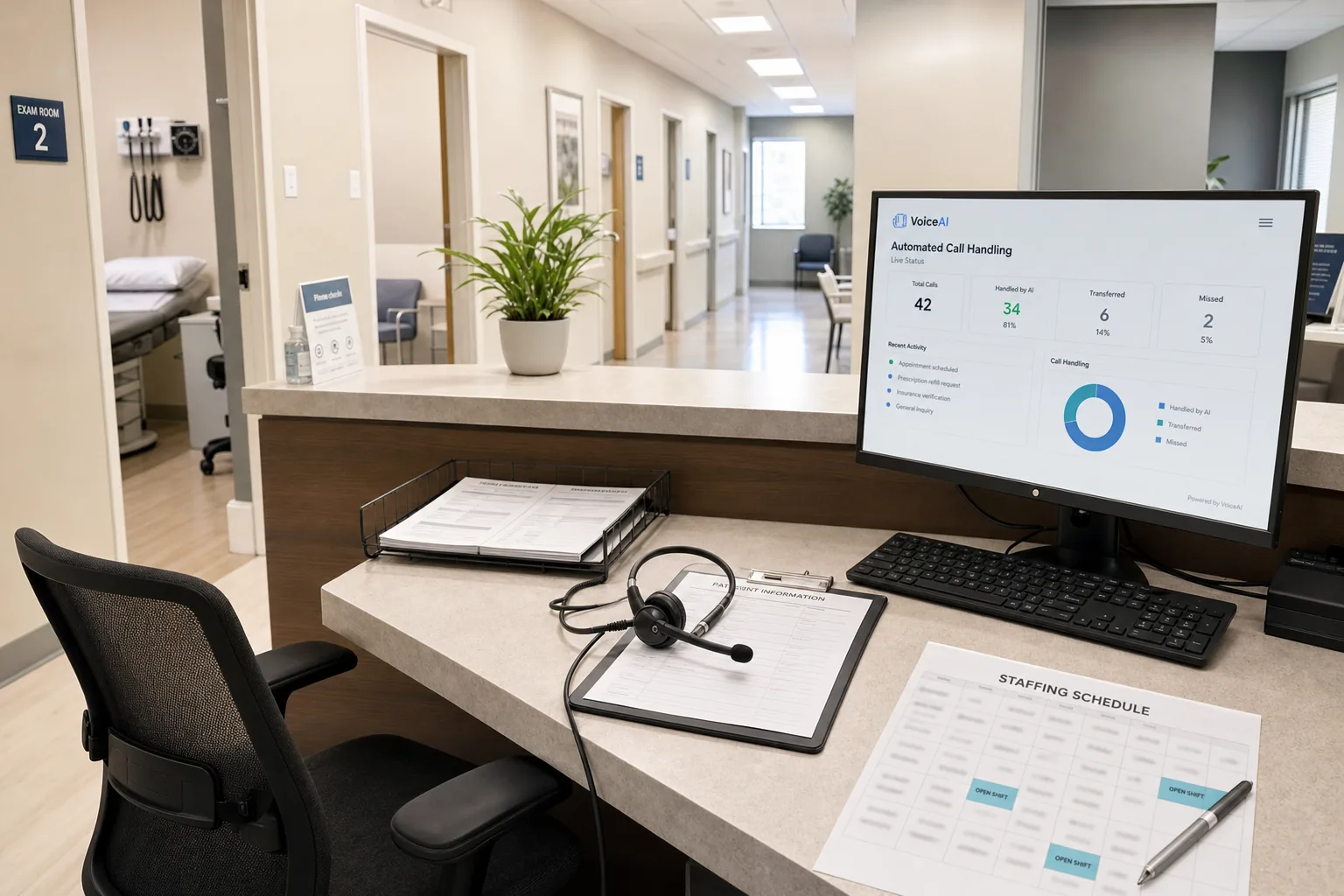
In 2021, Mercer projected healthcare would be short 3.2 million workers by 2026.
That projection was specific to lower-wage roles, medical assistants, home health aides, nursing assistants. Mercer’s 2024 update now projects a smaller overall gap, about 100,000 healthcare workers by 2028. But the hiring reality on the ground hasn’t changed: MA and front desk roles remain among the hardest jobs in healthcare to fill.
For medical practices, the shortage hits hardest in medical assistant and front desk roles. You post a job for an MA. You get three applicants. Two no-show the interview. The third takes a hospital job that pays $3 more per hour.
Meanwhile, your existing staff is drowning. They are covering two roles instead of one. Burnout is setting in. And when they leave, you are back at square one, except now you are short two people instead of one.
This is the vicious cycle medical practices face in 2026: can’t hire, can’t retain, can’t keep up with patient demand.
Voice AI does not solve the shortage. But it is a force multiplier, automating high-volume, low-judgment tasks so your existing team can focus on work that actually requires human expertise.
The result: one MA can do the work of two. Your team stops burning out. And you stop posting job ads that nobody applies to.
The MA shortage is structural, not cyclical
Medical assistant turnover surged to historic highs between 2020 and 2022. Burnout, pandemic stress, and competition from higher-paying employers drove the exodus.
Turnover rates have improved slightly in 2025, but they remain elevated. More importantly, the underlying problem is getting worse, not better.
Supply is not keeping pace. BLS projects roughly 112,000 medical assistant job openings every year through 2034 as the field grows and workers leave, while formal MA programs graduate on the order of 50,000 completers annually. The math does not work.
The figures below are a worked example, not measured benchmarks. Your numbers will vary with call volume, payer mix, and revenue per visit.
Wages are not competitive. Median MA pay is about $21 per hour (BLS, May 2024). Amazon’s fulfillment jobs now average more than $23 per hour, and Starbucks says its hourly partners average over $19 with a benefits package it values at roughly $30 per hour all-in. When your MA can earn the same money making lattes without dealing with insurance companies, they do.
Burnout is accelerating exits. MGMA data shows that practices unable to hire MAs see higher stress and burnout among existing staff taking on extra work. This creates a vicious cycle: understaffed, then overworked, then more turnover, then more understaffed.
Baby Boomers are aging out. MA roles skew older. As Boomers retire, there are not enough Gen Z and Millennial workers entering the field to replace them.
Traditional solutions (raise wages, offer signing bonuses, improve benefits) help but do not solve the structural imbalance. There are simply not enough qualified people to fill open positions.
What voice AI can (and cannot) do
Voice AI is not a replacement for medical assistants. It cannot room patients, take vitals, or administer injections.
But it can automate a significant portion of the administrative tasks that consume MA time every day:
Tasks voice AI handles autonomously:
- Answering inbound patient calls (scheduling, refills, basic questions)
- Insurance verification and eligibility checks
- Appointment reminders and confirmations
- Prescription refill coordination with pharmacies
- After-hours call triage and message routing
- Patient intake form completion via phone
- Outbound follow-up calls on provider-reviewed results, at the practice’s direction
Tasks that still require human judgment:
- Rooming patients and taking medical histories
- Clinical assessments and symptom evaluation
- Administering medications and injections
- Complex billing questions and dispute resolution
- Patient education on new diagnoses or procedures
By automating the high-volume phone work, voice AI frees your MAs to focus on the clinical tasks they were trained to do.
The force multiplier effect
The argument for automating MA phone work is a capacity argument, and it is one you can run on your own staffing before anyone demonstrates anything. It takes three numbers you already have.
Start with the share of MA time that is not clinical. Take one MA and one ordinary week, and have them mark what the phone and administrative work actually consumes. Most practices are surprised by this number in one direction or the other, which is the reason to measure it rather than accept a benchmark.
Then split that administrative share into two buckets. Routine, rule-driven contacts (booking, rescheduling, refill requests, directions, coverage questions) sit in one. Exceptions that need someone who knows the patient sit in the other. Only the first bucket is addressable, and the ratio between them is specific to your specialty and your patient population.
Then convert. If an MA currently spends two fifths of the week on administrative work and most of that is the routine bucket, recovering it returns close to a third of that person back to clinical work. Across three MAs that is meaningful fractional capacity, and it arrives without a req, a recruiter, or an onboarding ramp. Price it against the fully loaded cost of the hire you would otherwise be making.
Two things that model deliberately does not claim. It does not tell you how much of the routine bucket automation will actually absorb in your practice, because that depends on how your own workflows are built. And it is not a headcount reduction argument: the capacity shows up as MA time returned to rooming, injections, patient education and the calls that genuinely need a person, not as a smaller team.
Why this matters for scaling practices
When you are growing from 4 to 10 providers, MA staffing becomes a critical bottleneck.
Traditional math: 1 MA per 1-1.5 providers = 7-10 MAs needed.
But you cannot find 7-10 qualified MAs. You post jobs for six months. You get crickets. Meanwhile, your providers are seeing patients without adequate support.
Voice AI changes the equation:
- automate a significant portion of the administrative load
- Scale from 4 to 7 providers with existing 3-4 MA team
- Hire incrementally (1 MA every 18-24 months instead of 1 every 6 months)
You still need MAs for clinical work. But you need fewer of them, and you can be more selective about who you hire.
Implementation: 14-day sprint
Voice AI for front desk automation deploys in two weeks:
Week 1: Integration and training
- Connect to your EHR’s API (athenaOne)
- Map workflows: scheduling, refills, triage, insurance verification
- Train AI on your practice’s protocols and exception handling rules
- Configure call routing and escalation logic
Week 2: Go-live and parallel run
- AI answers calls alongside existing staff
- Staff monitor accuracy and flag discrepancies
- Refine exception handling based on real cases
- Flip switch to full automation
Automation rates increase as the system learns your practice workflows and specific nuances.
The staffing math in 2026
Two scenarios for a four-provider practice trying to scale to seven providers:
Traditional hiring approach:
- Hire 3 additional MAs ($18/hour = $112,000 annual labor cost)
- 6-12 month hiring timeline (if you can find candidates)
- Onboarding and training overhead (3-4 months to full productivity)
- Turnover risk: 35-40% annual MA turnover = replacing 1-2 MAs per year
- Total annual cost: $140,000 (labor + recruitment + training + turnover)
Voice AI and strategic hiring:
- Assess voice AI for the routine workload
- Hire 1 additional MA ($37,000 annual labor cost)
- 30-day deployment timeline
- Zero turnover risk for AI layer
- Total annual labor cost: $37,000, before the separately assessed technology investment
The AI approach can preserve capacity while avoiding the hiring and turnover burden. Compare the measured staff time avoided with a custom assessment of technology scope.
What your team gains
Voice AI does not replace your MAs. It removes the work they hate:
- No more answering the same scheduling questions 30 times per day
- No more phone tag with pharmacies on refill requests
- No more staying late to clear the voicemail backlog
- No more apologizing to patients for 48-hour callback delays
When you ask MAs why they leave, they cite burnout and administrative overload. When you remove that overload, retention improves.
What changes for the people doing the work:
- The routine call queue stops setting the pace of the day
- Patient education and relationship-building stop being the first things cut when the phones back up
- Clearing the backlog stops being an after-hours task
If you want a number on this, the one worth collecting is your own. Ask the question in your next round of one-to-ones, and ask it again ninety days after anything changes.
Your team didn’t go into healthcare to answer phones all day. They wanted to help patients.
Voice AI lets them do that.
Why this matters now
The MA shortage is not temporary. It is structural.
Training programs cannot produce enough graduates. Wages are not competitive with non-healthcare alternatives. Burnout is accelerating exits. And patient volume is increasing as Baby Boomers age into higher-need years.
Practices that wait for the shortage to resolve will be waiting indefinitely.
Practices that start now are working on the problem while it is still a staffing inconvenience rather than a capacity ceiling. The comparison to run is straightforward: the fully loaded annual cost of the MA hires you are planning, set against the administrative workload you could remove from the MAs you already employ. Recruitment time and turnover risk belong on the same side of that ledger as salary.
Your existing team can do the work of a larger team, if you remove the administrative burden that is drowning them.
That is what voice AI does. It does not replace your MAs. It frees them to do the work they were hired for.
Ready to turn your 3-person MA team into a 5-person equivalent? Schedule a 15-minute demo to see how voice AI automates front desk workflows with your EHR.
Short-Staffed? AI Handles the Call Volume Your Team Cannot.
Pretty Good AI acts as a force multiplier, handling high-volume inbound calls so your existing staff focuses on work that requires human judgment.
Book a Demo →Written by Kevin Henrikson