Practice Operations
MSO Scheduling Automation and AI Solutions
MSOs run one scheduling standard across sites that each book differently. How AI holds appointment types, slots, and provider groups consistent in athenaOne.
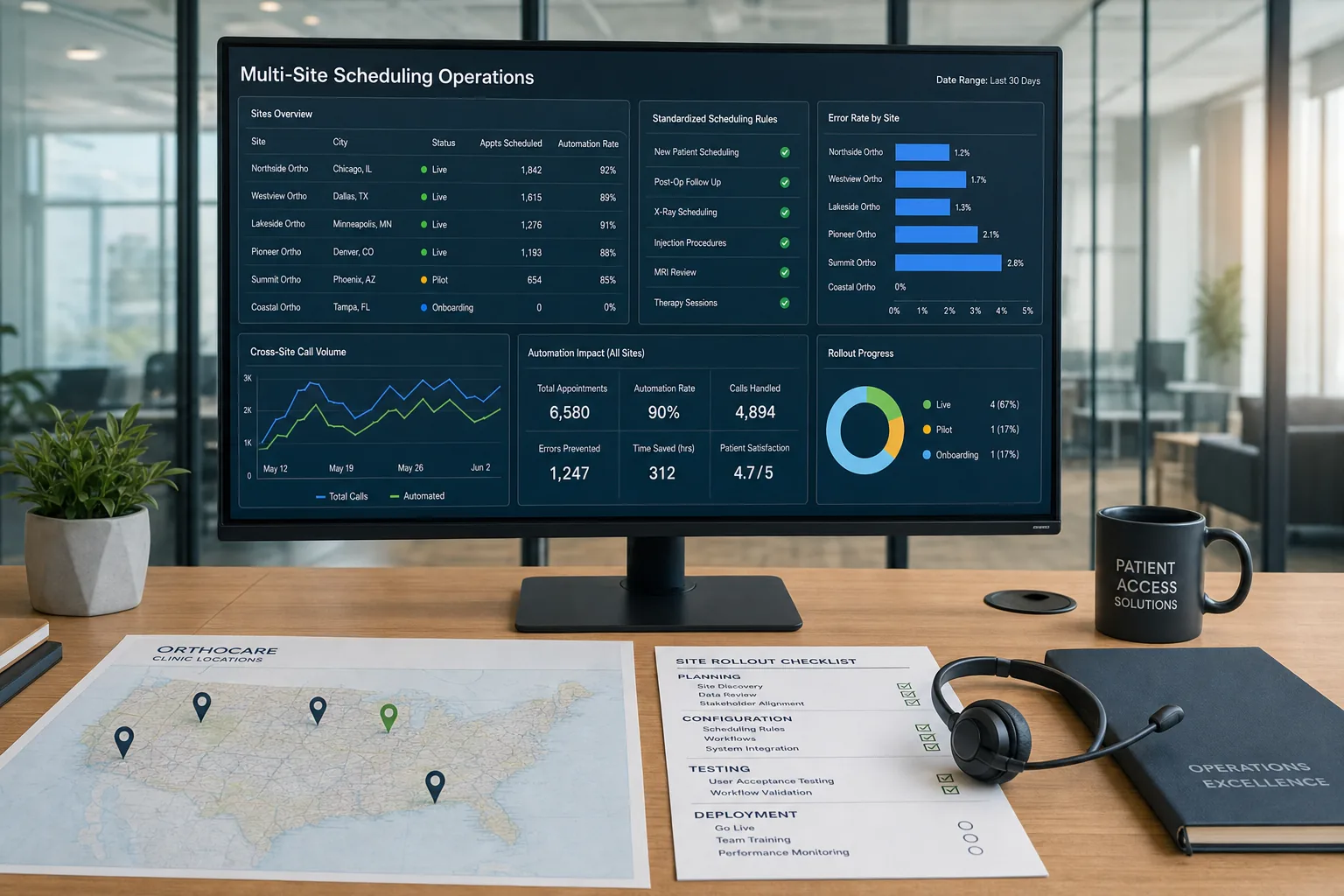
When you run operations for a management services organization with 15 practice sites, you know what the call reports look like. Site 4 has an 8% scheduling error rate. Site 9 is missing 30% of post-visit follow-up calls. Site 12 had four staff turnover events in the last quarter and the front desk is running on new hires who haven’t been fully trained yet.
You also know what you can’t do: send trainers to every site every time the call process drifts.
MSO operators face a structural problem that individual practice owners don’t. The pain of inconsistent front desk execution multiplies across every location you manage. A scheduling error at one site is a problem. Scheduling errors at 15 sites, all with slightly different protocols, different staff tenure levels, and different payer mix, is a compounding revenue cycle problem that your COO can see in the weekly KPI dashboard but can’t easily fix from headquarters.
This piece covers where MSO scheduling consistency breaks down, what it costs, and why AI voice agents deployed through athenaOne change the math on scaling operations.
Why scheduling consistency is an MSO problem, not a site problem
Single-practice owners can walk the front desk. They know their staff. When a scheduling protocol breaks down, they see it quickly and fix it.
MSO operators manage the same problem at scale, through layers of indirect visibility. You have site managers, regional directors, and performance dashboards. But the signal you’re seeing is lagging: call reports from last week, cancellation rates from last month, revenue cycle variance from last quarter.
By the time a scheduling inconsistency shows up in your KPIs, it has already been costing revenue for weeks. And fixing it requires human intervention at the site level, which is slow, expensive, and doesn’t scale.
The specific scheduling failures that create the most downstream damage at multi-site practices:
Insurance eligibility not verified at booking. When the front desk skips or rushes eligibility verification at the time of scheduling, the failure surfaces at the visit, as a denied claim, a patient with the wrong copay, or an authorization that was never initiated. Across 15 sites, even a 5% eligibility-miss rate on 500 appointments per week is 25 claims per week starting with preventable errors.
Incomplete intake information collected by phone. Different staff members ask for different information. Some capture chief complaint and insurance card details. Others book the appointment and note to get the rest at check-in. When intake is incomplete at scheduling, the visit takes longer, providers are less prepared, and coding is more likely to be delayed.
Inconsistent follow-up call execution. Post-visit follow-up calls are a scheduling function at many practices, confirming the next appointment, capturing feedback, following up on outstanding referral or test results. When staff turnover is high or training is inconsistent, follow-up call rates drop. Patients don’t rebook. Chronic care gaps widen.
After-hours calls going unanswered. At multi-site practices, after-hours coverage typically depends on an answering service or a rotating on-call coordinator. The call quality, the information captured, and the follow-up the next morning varies by site and by staff.
What standardization actually requires
The traditional answer to scheduling inconsistency in an MSO is operational: build better training programs, improve SOPs, install call monitoring software, add a layer of regional management.
Each of these interventions has value. None of them solves the underlying problem, which is that you’re relying on human consistency at scale.
Training helps until staff turns over. SOPs help when staff reads them. Call monitoring helps you identify problems after they happen. Regional management helps if you can afford the overhead.
AI voice agents change the equation because the process is in the system, not in the staff member. The scheduling flow, the eligibility verification questions, the intake protocol, the after-hours routing rules, all of it is encoded in the AI and consistent across every call it handles. You do not retrain the AI when a front desk coordinator quits at Site 7. You do not see drift at Site 12 because a new hire forgot a step.
What AI handles across MSO sites on athenaOne
Pretty Good AI integrates with athenaOne through the athenahealth Marketplace. For MSOs, the integration architecture matters: a single configuration connects all sites through their shared athenaOne instance, meaning the AI has live access to scheduling, patient records, and eligibility data across every location from one integration.
Inbound appointment requests. Patients calling to book appointments, at any site, go through a consistent scheduling flow. The AI verifies insurance eligibility in real time using the athenaOne eligibility engine, captures chief complaint and visit reason, selects the appropriate provider and slot based on the patient’s location and payer, and confirms the appointment. The same process, every site, every call.
Appointment confirmation and reminder calls. Outbound calls for appointment confirmation run on a consistent schedule, typically 48 hours and 24 hours before the appointment. Cancellations captured by the AI open slots for waitlist fills automatically. No-show rates at practices using automated appointment confirmation typically decline as patients receive more consistent reminders.
After-hours call handling. Every site has the same after-hours coverage: the AI answers, triages the call type, handles scheduling and information requests, and escalates clinical concerns to the on-call protocol. Site 12 with its new front desk hires does not have worse after-hours coverage than Site 4 with its veteran staff.
Insurance verification for complex payer mixes. For MSOs operating across multiple states or markets, payer mixes vary by site. The AI handles eligibility verification using the same athenaOne data at every site, flagging authorization requirements before appointments are confirmed.
The standardization dividend
The operational benefit of consistent scheduling AI across MSO sites is not just cost savings. It’s data quality.
When every call goes through the same process, your KPI dashboard stops comparing apples to oranges. You can see real variation in performance across sites, not variation caused by different staff following different procedures. If Site 4 has a higher no-show rate than Site 9 after both are using the same AI scheduling protocol, the variance is in the patient population or the provider mix, not the front desk process. That’s a data signal you can actually act on.
For MSO operators who are managing toward acquisition or platform growth, consistent scheduling data across sites also has a different kind of value: it makes the revenue cycle story cleaner, the per-site performance more comparable, and the operational documentation more credible to investors or acquirers.
The turnover absorption effect
The staffing math matters separately from the operational consistency story.
Front desk turnover in healthcare runs 25 to 40% annually. For an MSO with 15 sites and an average of four front desk staff per site, that’s 15 to 24 staff events per year: new hires who are not yet proficient, open positions being covered by stretched colleagues, and the 60 to 90 days it takes for a new coordinator to reach full call-handling speed.
AI voice agents handle the portion of call volume that doesn’t require human judgment: scheduling, eligibility questions, status updates, basic intake capture, after-hours routing. That portion of calls, roughly the majority of routine calls, is handled consistently regardless of staffing events.
When Site 7 loses a front desk coordinator, the AI handles the volume gap the same day. There is no 60-day ramp period. There is no call quality drop. The site’s scheduling metrics do not move.
For the MSO operator looking at 15 sites and managing staff turnover as a constant operational variable, this is not a theoretical benefit. It is a structural one.
What setup looks like at the MSO level
MSOs on athenahealth connect Pretty Good AI through a single Marketplace integration that covers all sites sharing the same athenaOne instance. The configuration process takes six to eight weeks for an MSO deployment, longer than a single practice because each site’s scheduling templates, payer mix, and call routing rules need to be mapped.
The first phase covers the shared protocols: eligibility verification flow, appointment booking logic, intake questions common to all sites. The second phase covers site-specific variations: specialty routing at sites with specific service lines, language preferences in markets with bilingual populations, site-specific after-hours protocols.
Go-live is typically staggered by site. Practices run the AI alongside existing staff initially, with the AI handling inbound calls and staff handling exceptions. Call handling rates typically reach a large share of routine calls per site.
Key takeaways
- Scheduling inconsistency in an MSO multiplies across every site, the same error at 15 locations is 15 times the revenue cycle impact
- Traditional fixes (training, SOPs, call monitoring) don’t solve the underlying problem at scale because they rely on human consistency
- AI voice agents encode the scheduling process in the system, consistent across every call at every site, regardless of staff tenure or turnover
- MSOs on athenaOne get a single integration point that covers all sites sharing the same athenaOne instance
- After-hours coverage becomes uniform across all sites, no quality variation based on which site has more experienced staff
- Front desk turnover events do not create scheduling gaps: the AI handles the volume the same day
- The operational data benefit: consistent protocols produce comparable performance data across sites, making KPI variance actionable
Scaling an MSO is not just a growth problem. It’s an operational consistency problem. The practices that grow cleanly are the ones where the front desk process does not degrade as the site count rises.
How Pretty Good AI integrates with athenaOne
Sources: MGMA DataDive Management and Staff Compensation Data Report (2024); MGMA Stat, “Stabilized but not solved: Staff turnover in medical practices looking no better, no worse in 2026” (2026); MGMA Stat, “Medical groups’ productivity still struggling in 2023 amid staffing shortages” (Oct. 2023); athenahealth Marketplace integration documentation.
Ready to reduce missed calls?
15-minute demo. See how an AI team works inside your athenaOne practice.
Schedule a Demo →Written by Kevin Henrikson