Practice Operations
Multi-Specialty Group Scheduling With AI
Multi-specialty groups run scheduling workflows that differ by department, payer, and appointment type. AI standardizes operations without a department-by-department rollout.
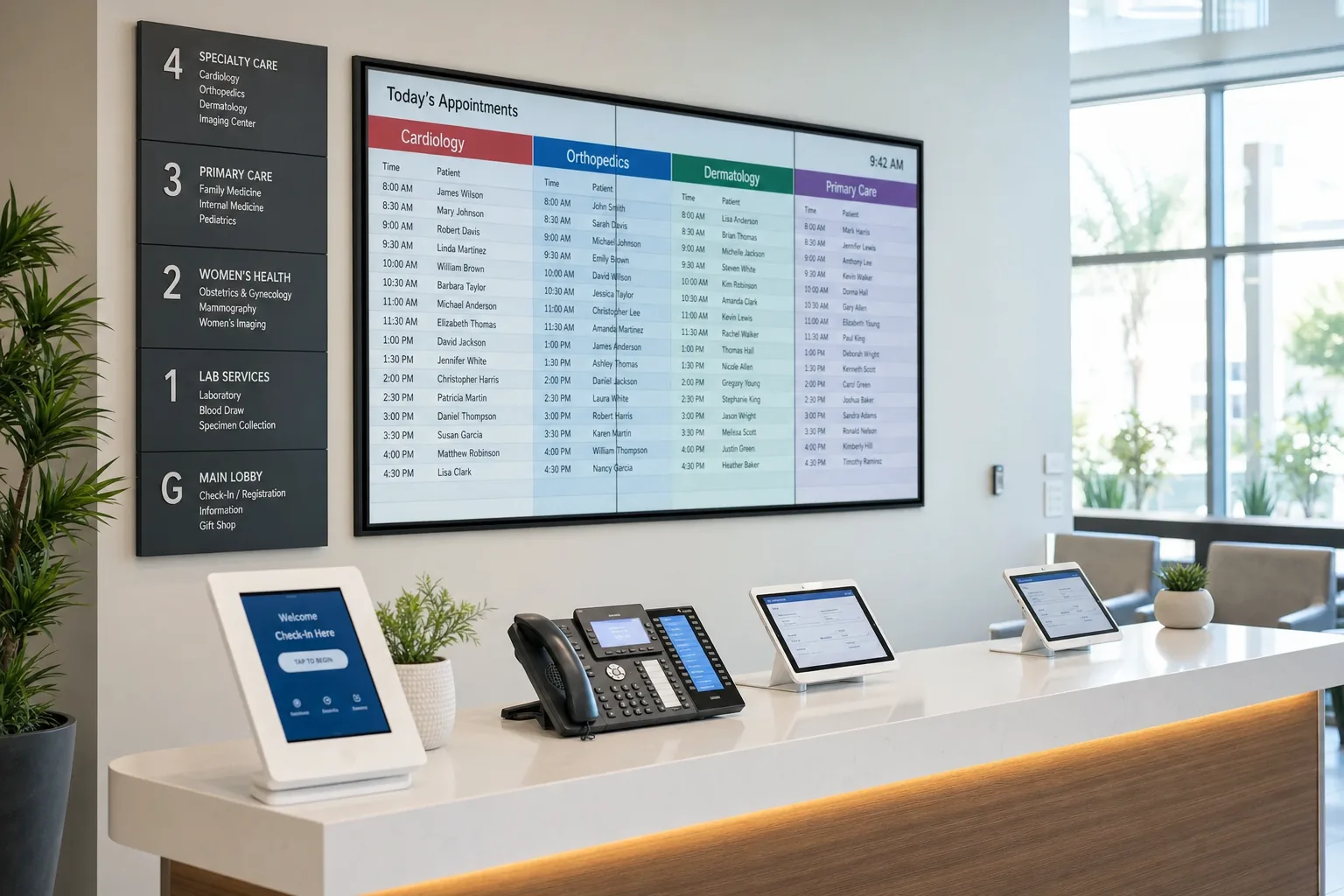
Multi-specialty group scheduling AI solves a problem that appointment scheduling software alone cannot: coordinating patient access across departments that each run different workflows, see different payer mixes, and have different definitions of what a normal appointment looks like.
A 15-physician group practice with orthopedics, cardiology, and primary care under one roof does not have a scheduling problem. It has three scheduling problems that happen to share a phone number and a front desk.
Cardiology patients calling to schedule a stress test have different documentation requirements than orthopedic patients calling to schedule a pre-op consult. Primary care has a same-day sick visit queue that neither cardiology nor orthopedics manages. Referral coordination between departments, a primary care physician sending a patient to the group’s own cardiologist, should be frictionless, but it often is not, because the scheduling systems that work for each department individually do not communicate across them.
Multi-specialty groups that standardize scheduling through AI do not eliminate departmental differences. They create consistent patient access on top of those differences, so patients and referring physicians encounter one functional interface rather than three separate ones.
Why multi-specialty scheduling breaks down
The core problem in multi-specialty group scheduling is that departments optimize locally and the group suffers globally.
Each department designs its scheduling workflow around its own appointment types, provider preferences, and payer requirements. Orthopedics books 30-minute consults and 90-minute procedure consults differently. Cardiology has a triage system for chest pain calls that requires immediate routing. Primary care fills open slots with same-day appointments from a daily release queue. These are appropriate workflows for each specialty.
The problem is at the group level. When a patient calls the main practice number and wants to see the group’s endocrinologist, the front desk staff handling that call may not know the endocrinology department’s scheduling criteria. They route to voicemail. The patient calls back. Two days later, they get an appointment, or they schedule with a different endocrinologist outside the group because the friction was too high.
Referring physician friction is a related problem. When a physician outside the group wants to refer a patient to the group’s cardiology department, that referral needs to land in the right scheduling queue with the right documentation. In multi-specialty groups that have not standardized this workflow, referrals often sit in a general inbox while someone figures out which department owns them.
What AI standardizes across a multi-specialty group
AI scheduling for multi-specialty groups operates at two levels simultaneously: the patient access layer, which is consistent across departments, and the departmental routing layer, which is specialty-specific.
Patient access layer. A patient calling the group’s main number encounters the same AI interface regardless of which department they need. The AI asks about the reason for the call, the relevant department, and the patient’s insurance, and routes the interaction appropriately. From the patient’s perspective, calling the group feels consistent. From the operational perspective, routing logic lives in one system rather than being managed manually by front desk staff who may or may not know each department’s criteria.
Referral intake. Incoming referrals from outside physicians are captured through the AI interaction and routed based on specialty and clinical priority. The referring physician’s office can call the main number, describe the referral, and confirm it has been received and routed, without navigating separate phone trees for each specialty. Referral status can be confirmed through the same AI interface.
Same-day and urgent access. Multi-specialty groups frequently have different same-day access policies by department. Primary care releases open slots daily. Cardiology may have a separate urgent triage queue. Orthopedics may have a post-op urgent access line. AI scheduling can manage all of these simultaneously, applying the correct access policy for each department automatically rather than requiring staff to know and enforce each policy manually.
Cross-department care coordination. When a primary care physician in the group refers a patient to the group’s own cardiologist, that referral should move through the system faster than an external referral; the patient is already in the EHR, the records are accessible, and the referring physician is a colleague. AI scheduling can flag these internal referrals for priority routing and confirm the referral loop to the referring physician without manual follow-up.
The EHR integration advantage for multi-specialty groups on athenahealth
Multi-specialty groups that run all departments on athenaOne are well-positioned to implement scheduling AI with high integration depth. When the AI reads and writes to a single EHR across all departments, the data layer that makes cross-department coordination possible already exists.
The scheduling AI can see all provider availability across all departments in one query. A patient whose primary care visit produces a same-visit referral to endocrinology can be offered an endocrinology appointment at the end of the primary care AI interaction, not two days later after a manual referral process.
For multi-specialty groups with fragmented EHR environments (different specialties on different systems after acquisitions or mergers), this integration advantage does not apply at full depth. The scheduling AI can still standardize the patient-facing interface, but the back-end routing has to accommodate the EHR seams.
What the staffing impact looks like
The patient access center of a 15-physician multi-specialty group typically handles 150 to 250 calls per day. A meaningful percentage of those calls are routing questions that should not require a human: which department handles knee pain, how do I get a referral to cardiology, what does my next appointment involve.
AI scheduling absorbs the routing and scheduling volume so that front desk staff handle the calls that require judgment: complex insurance questions, patient complaints, same-day clinical concerns that need a clinical staff member rather than an administrative one.
For multi-specialty groups that are considering expanding, adding a department, taking on a new practice acquisition, adding a new location, the scheduling infrastructure question is meaningful. Adding a new department to a manual scheduling system means training staff on new workflows, setting up new phone trees, and managing the transition period where both old and new staff handle calls with inconsistent knowledge. Adding a new department to an AI scheduling system means configuring the new department’s routing logic in the AI, which is faster to implement and does not create a patient experience gap during the transition.
Where multi-specialty groups typically start
Multi-specialty groups that have not standardized scheduling AI typically start with one of two use cases: after-hours coverage or referral intake.
After-hours coverage is a common starting point because the problem is discrete and the alternative is an answering service with limited capability. AI after-hours coverage handles appointment scheduling, urgent triage routing, and referral capture at the same quality level as the main-hours operation, without additional staffing cost.
Referral intake is the other common starting point because the coordination failure is visible. When referrals from outside physicians sit in a general inbox for days before being assigned, the group is losing patients to competitors who make referral intake easier. An AI that captures, routes, and confirms referrals within the same call changes how referring physicians perceive the group’s accessibility, and referring physician perception drives patient volume.
What to ask before selecting a vendor
Multi-specialty group administrators evaluating scheduling AI should ask about specialty-specific routing configuration. A system designed for single-specialty practices may not support the routing logic complexity of a multi-specialty environment.
Ask about EHR integration depth. Does the system read and write to athenaOne at the workflow level, or does it move data via file transfer? For multi-specialty groups where cross-department coordination depends on real-time data, file-transfer integration is not sufficient.
Ask about referral workflow support. This is a specific functional requirement that many scheduling AI vendors do not address. Vendors who do address it typically have healthcare-specific configurations rather than generic automation tools.
Ask which languages the agent completes a booking in, not which ones it can greet a caller in. Many multi-specialty groups serve patient populations with significant Spanish-speaking members, and plenty serve more languages than that. Scheduling AI that cannot take the whole interaction end to end in the caller’s language is not suitable for those groups.
Key takeaways
- Multi-specialty groups do not have one scheduling problem. Each department has different workflow logic, and the group-level coordination failure is what AI standardizes.
- AI operates at two levels simultaneously: consistent patient access interface across departments, and specialty-specific routing logic within each department.
- EHR-native integration with athenahealth makes cross-department referral coordination possible within a single AI system, including same-visit referrals from one department to another.
- After-hours coverage and referral intake are the two most common starting points for multi-specialty AI scheduling implementation.
- Expanding the group, adding departments, acquisitions, new locations, is operationally easier when scheduling runs through AI rather than through manually trained staff workflows.
- Vendor selection criteria specific to multi-specialty groups: specialty routing configuration, EHR integration depth, referral workflow support, and Spanish-language capability.
See how Pretty Good AI supports multi-specialty group scheduling with athenahealth integration
Sources:
- Medical Group Management Association. MGMA DataDive Financials and Operations Data. MGMA, 2025.
Ready to reduce missed calls?
15-minute demo. See how an AI team works inside your athenaOne practice.
Schedule a Demo →Written by Kevin Henrikson