Practice Operations
Dialysis Scheduling and Nephrology Prior Auth
Nephrology practices manage dialysis schedules across multiple sites, complex Medicare eligibility, and prior auth for specialty medications. AI voice agents reduce admin burden and patient call volume in athenahealth.
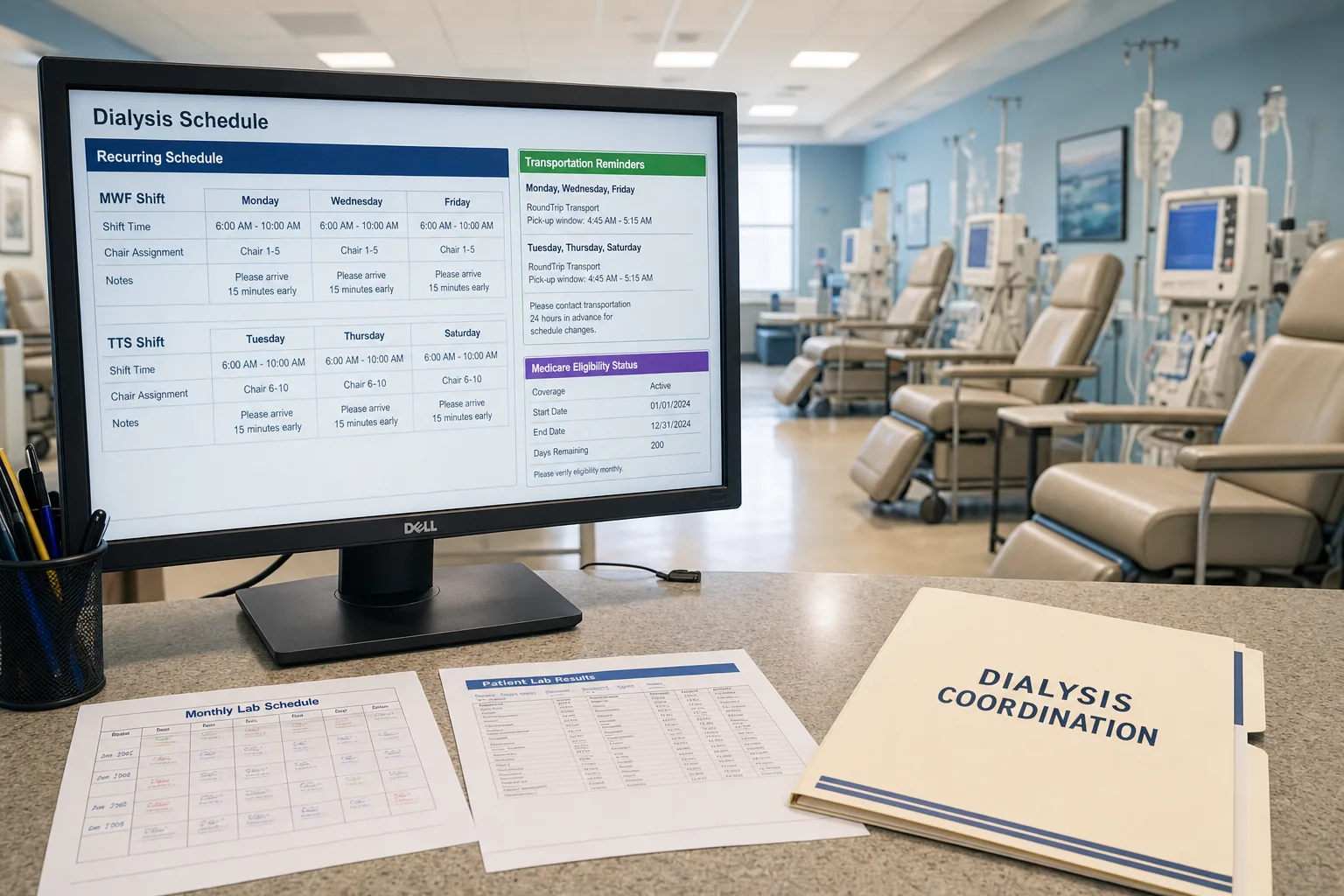
A nephrology practice managing 150 dialysis patients across three clinic sites has a scheduling problem most specialties never face: the schedule isn’t weekly. It’s three times per week, per patient, every week, with no gaps.
Missed dialysis sessions have immediate clinical consequences. Patients who skip or delay a session accumulate fluid and waste products at a rate that becomes dangerous within 24-48 hours. The scheduling and reminder infrastructure in a nephrology practice isn’t just an administrative function - it’s part of the clinical care delivery system.
That intensity, combined with a patient population that is disproportionately older, on Medicare, and managing multiple comorbidities, creates a call volume and coordination burden that outpaces what most nephrology practices can staff for. AI voice agents are handling the routine call layer - appointment reminders, prior auth status, medication refill routing, and patient check-ins - so clinical staff can focus on the patients who genuinely need them.
What makes nephrology scheduling different
Most outpatient specialties schedule patients once or twice per week at most. Nephrology has three separate scheduling problems running simultaneously:
In-center hemodialysis: Patients come to the dialysis center 3 times per week on a fixed schedule. Any disruption - a hospitalization, a missed session, a schedule change - requires immediate coordination across the clinic and the care team. Session confirmation and reminder calls for 100+ active dialysis patients are a daily operational requirement.
Peritoneal dialysis (PD) support: PD patients dialyze at home, but they require regular clinic visits for monitoring, lab review, and supply management. Scheduling these visits around the patient’s home dialysis routine adds coordination complexity.
CKD management appointments: Patients with chronic kidney disease who aren’t yet on dialysis need regular nephrology appointments for disease monitoring, medication adjustment, and preparation for eventual renal replacement therapy. These patients have complex medication regimens and frequent lab requirements.
Managing all three populations simultaneously, across multiple sites, with a predominantly Medicare patient base, is the operational reality of a modern nephrology practice.
The Medicare and Medicaid complexity
Over 80% of dialysis patients are covered by Medicare or Medicare Advantage. This creates specific prior authorization and eligibility requirements that differ from commercial payer workflows.
Medicare Part B pays dialysis facilities for in-center hemodialysis under a bundled per-treatment payment (the ESRD PPS). The nephrologist’s dialysis management is billed separately under the Monthly Capitation Payment, and office visits are billed under the physician fee schedule. The medications administered during dialysis - erythropoiesis-stimulating agents (ESAs), iron, vitamin D analogs - have their own coverage rules, and some drugs that fall outside the bundle require separate prior authorization.
Medicare Advantage plans add another layer: they can impose their own prior authorization requirements on top of traditional Medicare coverage rules. A patient enrolled in an MA plan may need prior auth for dialysis supplies or medications that traditional Medicare covers without prior authorization.
The staff managing these workflows are constantly navigating the gap between what patients expect Medicare to cover and what their specific plan actually covers. Patient calls about denied claims and unexpected bills are a regular part of the call volume.
Where AI reduces nephrology call burden
Dialysis appointment reminders and confirmations
For a practice with 150 hemodialysis patients on a 3x-weekly schedule, that’s 450 appointment instances per week. Confirming those appointments, flagging patients who haven’t confirmed, and handling inbound calls from patients who need to reschedule is a full-time administrative job.
AI handles outbound reminder calls for dialysis sessions with confirmation requests. Patients who confirm are marked in athenahealth. Patients who don’t confirm or who call to reschedule are flagged for staff follow-up. The front desk starts each day knowing which patients need human outreach rather than working through a manual reminder list. Dialysis scheduling is the highest-frequency version of a wider problem, and keeping contact consistent across a whole CKD panel is the same discipline applied to patients who are not yet on a machine.
Medicare and prior auth status calls
When a dialysis patient calls to ask whether their ESA prescription is covered under their Medicare Advantage plan, the answer requires checking the specific plan’s formulary and prior auth status. AI routes these calls to billing with the relevant patient information rather than having the front desk attempt to answer questions that require payer-specific knowledge.
For straightforward prior auth status checks on medications and supplies already in athenahealth, the AI checks current authorization status and gives the patient a direct answer.
CKD patient outreach and lab coordination
CKD patients who are not yet on dialysis often need reminders for lab draws and nephrology follow-up appointments. They have a lower contact frequency with the practice than dialysis patients but require consistent outreach to stay engaged in their care.
AI handles outbound appointment reminders and lab draw reminder calls for CKD patients, and fields inbound calls from patients with questions about their lab results that can be addressed by protocol (routing to the provider for results review versus answering administrative questions about when to go to the lab).
After-hours call triage
Dialysis patients have after-hours clinical questions: what to do if they gained more weight than usual between sessions, symptoms that may indicate fluid overload, questions about whether to skip a session if they’re feeling unwell. These calls need to be triaged - not all of them require immediate provider intervention, but some do.
AI handles the first layer of the call: collecting the patient’s reported symptoms and interdialytic details, applying the practice’s own escalation rules, and routing the calls that hit those rules to the on-call provider. Clinical guidance stays with clinicians. The on-call physician gets flagged for the calls that matter, with the intake already done, instead of fielding every patient question that arises at 9 PM.
The multi-site coordination problem
Nephrology practices that operate across multiple dialysis sites have a coordination problem that single-location practices don’t face: patients sometimes need to dialyze at a different site than their usual location, and tracking which patient is scheduled where on any given day requires real-time coordination.
When a patient calls to ask about session availability at a different site - a common request when they’re traveling or the primary site has a temporary capacity issue - the answer requires checking multiple schedules simultaneously. AI can handle the initial inquiry and routing, checking availability across sites in athenahealth and connecting the patient to the scheduling staff who can confirm the transfer.
The prior auth load for specialty medications
Nephrology’s specialty drug formulary generates a consistent prior auth workload, and dialysis access, ESAs and specialty CKD drugs are where the paperwork concentrates. Key medications requiring authorization in CKD and ESRD patients include:
- Erythropoiesis-stimulating agents (ESAs) for anemia management
- Iron supplementation (IV formulations)
- Calcimimetics (cinacalcet, etelcalcetide) for secondary hyperparathyroidism
- Phosphate binders
- Vitamin D analogs
Each of these has payer-specific coverage rules that vary between traditional Medicare, Medicare Advantage, and commercial payers. The authorization workflow for these medications generates steady inbound call volume from patients whose medications have been denied, are pending approval, or have been changed to a therapeutically equivalent alternative.
AI routes these inbound calls appropriately - to clinical pharmacy for medication questions, to billing for coverage disputes, to the care coordinator for prior auth status - without requiring the front desk to make that determination on every call.
What nephrology administrators get from AI
For a 4-physician nephrology practice managing 150+ active dialysis patients:
Consistent reminder coverage: 450+ weekly dialysis reminders that confirm sessions, flag non-confirmations, and handle reschedule requests without manual daily call lists.
After-hours triage: A patient-facing call system that handles routine after-hours questions and escalates appropriately, without every call reaching the on-call provider.
Prior auth routing: Inbound medication authorization calls routed to the right staff member instead of landing on the front desk.
Multi-site coordination: Initial inquiry handling for cross-site scheduling requests that would otherwise require multiple staff members to coordinate manually.
Key takeaways
- Nephrology practices managing hemodialysis patients face 450+ appointment instances per week for a 150-patient dialysis census - consistent reminder outreach is an operational necessity
- Over 80% of dialysis patients are on Medicare or Medicare Advantage, creating complex prior auth and eligibility workflows for specialty medications
- AI handles dialysis session reminders and confirmations, flagging non-confirmations for staff follow-up without manual daily outreach
- After-hours call handling for dialysis patients is a specific nephrology need - AI captures structured intake and routes by the practice’s own escalation rules, so urgent calls reach the on-call provider fast
- Prior auth status calls for specialty medications (ESAs, iron, calcimimetics) route through AI to the right staff member instead of absorbing front desk capacity
If your staff is running manual dialysis reminder calls across 100+ active patients while also handling prior auth and billing calls, that’s a structural workflow problem that AI can restructure.
See how Pretty Good AI integrates with athenahealth for nephrology practices
Sources:
- USRDS 2024 Annual Data Report, End-Stage Renal Disease: Incidence, Prevalence, Patient Characteristics and Treatment Modalities
- American Medical Association 2024 Prior Authorization Survey: Prior Authorization Reform
Ready to reduce missed calls?
15-minute demo. See how an AI team works inside your athenaOne practice.
Schedule a Demo →Written by Kevin Henrikson