Practice Operations
Nephrology Prior Authorization for Dialysis
Nephrology prior auth is heavy on dialysis access, ESAs, and specialty CKD drugs. AI automates the paperwork and status chasing so patients start therapy sooner.
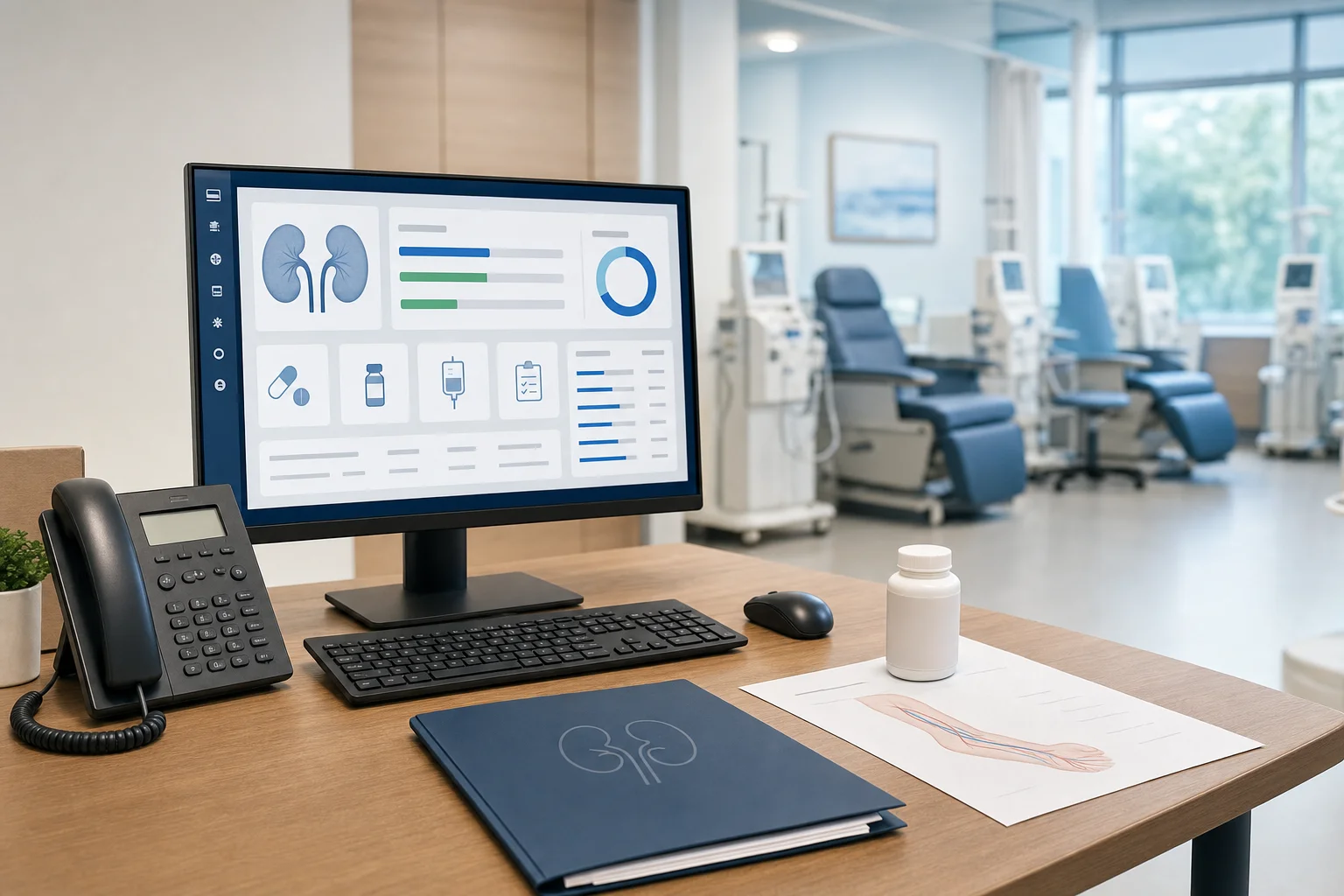
Nephrology prior authorization has a problem that few other specialties share: the treatments that need approval are the ones that keep patients out of the hospital, and the delays land on a population that is already fragile. A CKD patient waiting on an approval for an anemia drug is not waiting on a convenience. A patient who needs dialysis access authorized is on a clock. The stakes make the administrative burden feel heavier than the paperwork alone suggests.
And the paperwork is heavy. Nephrology practices juggle prior authorizations for erythropoiesis-stimulating agents, IV iron, phosphate binders, newer CKD and cardiorenal medications, imaging, and dialysis access procedures. Each carries its own payer rules, documentation requirements, and step-therapy hoops. The result is a front office spending hours a week on forms and hold music instead of patient care.
Why nephrology prior auth is uniquely heavy
Chronic kidney disease is a long-term, medication-intensive condition with a lot of moving parts, and payers scrutinize most of them.
Anemia management with ESAs and IV iron requires documented hemoglobin and iron studies, and payers enforce specific thresholds. Newer agents for CKD and cardiorenal indications often sit behind step therapy that requires proving other drugs were tried first. Phosphate binders and other supportive medications need periodic reauthorization. Vascular access procedures for dialysis, fistula creation, graft placement, catheter management, carry their own authorization requirements and timing pressure. Imaging like renal ultrasound and CT angiography adds another layer.
Every one of these is a separate workflow with separate documentation. And because CKD patients are managed over years, the same patient generates repeat authorizations and reauthorizations continuously. The administrative load is not a one-time cost. It recurs for the life of the treatment relationship.
What the manual process actually costs
The manual prior auth workflow in nephrology follows a familiar and expensive path.
A provider orders an ESA, a specialty medication, or a procedure. A staff member gathers the required documentation, labs, prior treatment history, clinical notes. They log into the payer portal or call the payer, submit the request, and wait. When the payer asks for more information, the staff member digs it out and resubmits. They call to check status. They call again. Eventually an approval, a denial, or a request for peer-to-peer review comes back.
Across a full patient panel, this consumes hours of staff time every week. Studies of physician practices consistently find prior authorization to be one of the top administrative burdens, and specialty practices with high authorization volume feel it most. In nephrology, the cost is not only staff hours. It is delayed therapy for patients whose conditions do not pause while the paperwork moves.
The delay itself has consequences. An anemia patient waiting on an ESA authorization stays symptomatic longer. A patient whose access procedure is held up faces a compressed timeline before they need dialysis. The administrative friction becomes a clinical problem.
What AI can actually automate
AI voice agents and automation integrated with a nephrology EHR change the workflow by taking over the parts that do not require clinical judgment.
The AI can identify when an order needs prior authorization based on the payer and the medication or procedure. It can assemble the required documentation from the chart, pulling the relevant labs, treatment history, and clinical notes that the specific payer rule requires. It can submit the request through the payer’s channel. And it can handle the status chasing: checking on pending authorizations, catching requests for additional information, and flagging denials for staff review, all without a person sitting on hold.
What stays with the practice is the clinical judgment. The AI does not decide medical necessity. It does not write the clinical justification for a peer-to-peer. It assembles, submits, tracks, and escalates. The provider and staff make the clinical calls; the AI removes the clerical work around them.
The categories AI handles well: recognizing which orders need authorization, gathering required documentation from the chart, submitting standardized requests, tracking pending authorizations, and alerting staff to denials and information requests.
The categories AI does not decide: medical necessity, clinical justification, peer-to-peer discussions, and any judgment about whether a given therapy is appropriate.
The workflow, automated
A structured AI prior authorization flow for nephrology works like this.
The provider places an order, an ESA, a specialty CKD medication, IV iron, or a procedure. The AI checks the payer’s rules for that order and determines whether prior authorization is required.
If it is, the AI assembles the documentation the payer rule specifies: recent hemoglobin and iron studies for an anemia agent, prior treatment history for a step-therapy drug, clinical notes for a procedure. It submits the request through the payer channel.
The AI then tracks the request. It checks status on a schedule so no one has to sit on hold. When the payer requests additional information, the AI flags it and, where the data lives in the chart, assembles the response. When an approval comes back, it logs the authorization to the chart and notifies the care team that therapy can proceed. When a denial or peer-to-peer request comes back, it escalates to staff with the full context prepared.
Every step is documented in real time, so the practice always knows the status of every pending authorization without a manual tracking spreadsheet.
The athenahealth integration advantage
For nephrology practices on athenahealth, native EHR integration is what makes prior auth automation reliable.
Without integration, automation works from whatever data is manually entered, which reintroduces the clerical work it was supposed to remove. With athenahealth integration, the AI pulls labs, treatment history, medication lists, and clinical notes directly from the chart. That is the difference between an automation that still needs a staff member to feed it documents and one that assembles the payer-required packet on its own.
Integration also keeps the record clean. Every authorization, submitted, pending, approved, denied, is logged to the patient’s chart automatically. When the provider sees the patient, the authorization status is right there, not buried in a separate portal or a staff member’s inbox. That visibility matters in a specialty where the same patient carries multiple active authorizations at once.
What implementation requires
Deploying AI for nephrology prior authorization requires several things done right.
Payer-rule accuracy. The value of the automation depends on getting the documentation requirements right for each payer and each drug or procedure. The setup phase should map the practice’s top payers and highest-volume authorization types, with rules validated against real cases before go-live.
Clear escalation boundaries. The AI should have crisp rules about what it handles and what it hands to staff. Denials, peer-to-peer requests, and anything requiring clinical judgment go to a person, with full context prepared. Staff should never wonder whether an authorization is being handled by the system or waiting on them.
Staff workflow integration. The automation should fit the existing front-office workflow, not create a parallel one. Staff need a single view of what is pending, what needs their input, and what has been resolved.
Documentation and audit trail. Every action the AI takes should be logged to the chart. For a specialty with high reauthorization volume and payer scrutiny, a clean audit trail protects the practice and speeds future requests.
Why this matters beyond staff hours
The obvious win is reclaimed staff time. A front office that is not spending hours a week on hold with payers can spend that time on patient care, scheduling, and the work that actually needs a person. For a nephrology practice running lean, that is real capacity.
But the deeper win is faster therapy. When authorizations move faster and status never falls through the cracks, patients start treatment sooner. An anemia patient gets their ESA without a two-week delay. A patient needing access gets their procedure authorized on time. In a specialty where administrative delay translates directly into prolonged symptoms and compressed clinical timelines, speeding up prior auth is not just an efficiency play. It is better care.
There is also a financial dimension. Delayed and abandoned authorizations mean delayed and lost revenue. Automation that keeps every request moving and every denial worked reduces the leakage that comes from authorizations that simply get lost in the shuffle.
Key takeaways
- Nephrology prior auth is uniquely heavy because CKD is medication-intensive and the same patients generate continuous reauthorizations for ESAs, IV iron, specialty drugs, and dialysis access
- The manual process consumes hours of staff time weekly and delays therapy for a fragile patient population
- AI integrated with athenahealth automates recognizing, documenting, submitting, and tracking authorizations while leaving clinical judgment to providers
- Denials and peer-to-peer requests escalate to staff with full context prepared
- Every authorization is logged to the chart in real time, giving the practice continuous visibility across multiple active requests
- Payer-rule accuracy and clear escalation boundaries are the keys to a reliable implementation
Nephrology prior authorization volume is not going to shrink as long as CKD care depends on medications and procedures that payers scrutinize. The question is how much of that burden the practice carries by hand. AI automation that assembles documentation, submits requests, and chases status can take the clerical majority off the front office, protect staff capacity, and get patients on therapy sooner.
Sources
Prior authorization and physician practice burden. American Medical Association prior authorization survey overview. https://pubmed.ncbi.nlm.nih.gov/33587049/
Anemia management in chronic kidney disease. Documents ESA and iron therapy monitoring requirements. https://pubmed.ncbi.nlm.nih.gov/23067652/
Internal links
Ready to reduce missed calls?
See how Pretty Good AI handles prior authorization for nephrology practices
Talk to our team →Written by Kevin Henrikson