Practice Operations
OB/GYN Call Volume and Patient Questions
OB/GYN practices field more patient calls per provider than almost any other specialty. Pregnant patients call constantly. AI voice agents integrated with athenaOne handle the structured calls so your staff handles the clinical ones.
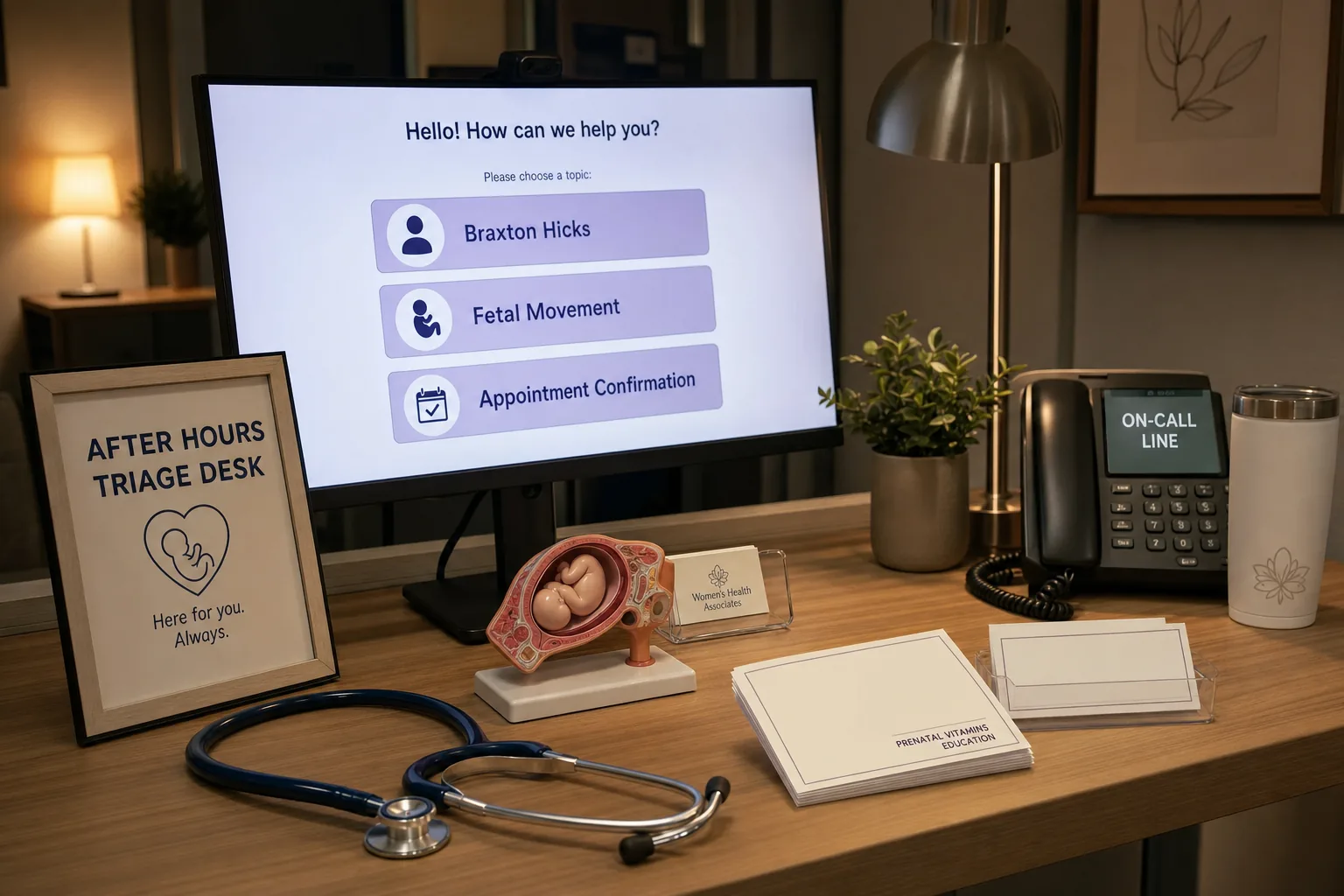
A patient at 28 weeks calls your OB/GYN practice on a Thursday evening. She has had mild cramping for two hours. It is not regular, not severe, and she does not have a fever. She wants to know if this is normal. She wants to know now.
Your answering service takes a message. Your on-call provider gets a callback request at 9:30pm and returns the call at 10:15pm. The patient has been anxious for two and a half hours waiting for an answer that, in most cases, takes 90 seconds to deliver: “Braxton Hicks contractions are normal at this stage. Drink water, rest, and call us if contractions become regular or increase in intensity.”
This is not a clinical failure. This is a workflow failure. The clinical information existed. The pathway to deliver it was broken.
OB/GYN practices have the highest patient-initiated call volume of any primary care or specialty setting. Pregnant patients are medically attentive, appropriately anxious, and calling with questions that span a wide spectrum from genuine emergencies to normal pregnancy symptoms that feel alarming. The on-call provider cannot distinguish between them without a call. The problem is that 70% of those calls do not require provider judgment. They require information delivery.
AI voice agents integrated with athenaOne handle the information-delivery calls. Your on-call provider handles the ones that actually require clinical assessment. Overnight the split matters more, because structured intake and routing by your own escalation rules is what keeps the on-call clinician hearing only what needs them.
Why OB/GYN call volume is uniquely high
Every specialty has after-hours call volume. OB/GYN’s is structurally different for three reasons.
Pregnancy creates a 40-week heightened attention window. An orthopedic patient calls when their pain changes. A pregnant patient calls because every new sensation is evaluated against a mental list of things that could indicate a problem. The call volume is not driven by pathology; it is driven by vigilance, which is appropriate and cannot be educated away.
The patient population includes multiple risk categories. A typical OB/GYN practice is managing low-risk first-time pregnancies, high-risk pregnancies with gestational diabetes or hypertension, post-partum patients, and gynecological patients with no pregnancy involvement. The call routing logic that works for a low-risk 32-week patient is different from the logic that applies to a patient with pre-eclampsia at 34 weeks. AI handles this by routing based on the patient’s documented risk profile in athenaOne.
The consequences of misrouting are high. OB/GYN practices cannot afford a call handling system that routes urgent calls to a general message queue. The AI’s job is not to gatekeep clinical access; it is to capture structured intake and route by the practice’s own escalation rules. True urgency indicators (active labor, bleeding, severe symptoms) route immediately to the on-call provider. Administrative requests are handled end to end; clinical questions are captured with context and queued for callback.
What calls AI handles in an OB/GYN practice
The call categories where AI-assisted handling reduces on-call provider burden without compromising patient safety:
Appointment scheduling and rescheduling. Prenatal appointments follow a predictable schedule, every four weeks until 28 weeks, then every two weeks, then weekly. Scheduling these appointments is not a clinical task. The AI reads provider availability from athenaOne, books the appointment, and sends a confirmation. The patient gets scheduled without waiting on hold.
Lab result status checks. Prenatal bloodwork generates a steady stream of patient inquiries. The AI can confirm that results have been received and flagged for provider review, and direct the patient to their patient portal for results access, without requiring a staff member to pull the chart and check manually.
Clinical question intake and routing. A patient at 20 weeks asking whether it is safe to take ibuprofen is asking a clinical question. The AI captures the question, attaches the gestational age and risk profile already documented in athenaOne, and routes it to the nurse line or provider queue, it does not answer medication questions itself. A patient reporting symptoms is handled the same way: her description is captured in her own words, and the practice’s own escalation rules determine whether she reaches the nurse line now or is offered a next-day appointment. The AI runs no symptom assessment of its own.
Prior authorization routing for procedures. OB/GYN prior authorization volume, ultrasounds, amniocentesis, procedures, creates administrative overhead that hits hardest in the second trimester when most imaging is scheduled. AI handles the administrative coordination: initiating auth requests, checking status, alerting staff when authorization is received, and following up on pending requests without manual tracking.
Post-delivery follow-up scheduling. The six-week post-partum appointment is one of the most commonly missed in women’s health. AI outbound calls, timed to fire at five weeks post-delivery, remind patients and offer to schedule directly, with follow-up if the first attempt goes unanswered.
The after-hours escalation protocol
The clinical safety requirement for OB/GYN AI deployment is a reliable escalation protocol. The AI is not making clinical assessments. It is doing pattern recognition against configured trigger criteria and escalating when those criteria are met.
Standard escalation triggers for OB/GYN include:
- Regular contractions with known due date within four weeks
- Reported bleeding at any gestational age
- Reported decreased fetal movement after 24 weeks
- Fever above 101 in a post-partum patient
- Reported severe headache or visual changes in a patient with documented hypertension
- Any symptom the patient describes as “emergency” or “urgent”
When these triggers are detected, the AI immediately connects the patient to the on-call provider or routes an emergency callback request. No delay, no message queue.
The calls that do not match escalation criteria, the 28-week patient with mild cramping who wants to know whether what she is feeling is normal, are captured with structured intake and queued for a next-day clinical callback, with instructions to call back immediately if anything changes. The AI does not tell her whether it is normal. It makes sure the person who can gets the question, with context, right away.
Sensitive communication and AI
One objection OB/GYN practices raise is whether AI-handled calls are appropriate for the sensitivity of women’s health conversations. This is a legitimate concern that shapes how AI is configured for this setting.
The AI does not handle calls involving pregnancy loss, fetal anomaly news, or difficult diagnosis disclosure. Those calls route to staff or providers directly, always. The AI’s role is in the administrative and informational layer, the high-volume, lower-stakes calls that still require responsive handling.
Tone matters in AI voice agent design. An OB/GYN AI configuration is warmer in phrasing, more patient in pacing, and more explicit in normalizing the patient’s concern before delivering information. “That is a very common question, let me give you the information your provider recommends for that symptom” is different from a flat information-delivery response.
The practices that have deployed AI voice agents in OB/GYN settings report that patient satisfaction with the AI interactions is high specifically because the calls are handled promptly. A patient who gets a response to their 9pm question in 30 seconds, even from an AI, is less anxious than a patient who waits 45 minutes for a callback that arrives after they have already fallen asleep.
Key takeaways for OB/GYN practice administrators
- OB/GYN call volume is structurally higher than other specialties: pregnancy creates a 40-week heightened attention window that drives constant patient contact
- 70% of calls are administrative or intake, not clinical assessment: scheduling, lab status, symptom intake and routing, auth status checks
- Escalation protocols are the clinical safety layer: AI routes urgency triggers immediately, no delay
- Sensitive calls are not handled by AI: pregnancy loss, difficult diagnoses, and anything flagged as emotionally complex routes to staff
- Post-partum follow-up outreach reduces missed appointments: AI outbound calls improve the six-week visit attendance rate
- athenaOne integration means AI knows the patient’s risk profile: routing logic can be calibrated per patient based on documented risk factors
The staffing math
A two-physician OB/GYN practice with 400 active pregnant patients fields an estimated 1,200 to 1,800 patient calls per month during peak pregnancy season. At 5 to 8 minutes per call for staff handling, that is 100 to 240 hours of phone time per month, roughly 1.5 to 3 full-time front desk equivalents, just for call handling.
AI does not eliminate all of that. It handles the 70% that is administrative and informational. The remaining 30%, the clinical calls, the escalations, the complex scheduling situations, stays with staff. But handling 70% of call volume with AI is the difference between a front desk team that is overwhelmed and one that can do its job well.
Sources:
- American College of Obstetricians and Gynecologists, “Telephone Triage Guidelines”
- ACOG Committee Opinion on Communication in Women’s Health Care
- MGMA Stat poll on practice phone workloads, March 2026 (mgma.com/mgma-stat/phones-are-still-a-backlog-costing-medical-practices-time)
See how Pretty Good AI handles patient call volume for OB/GYN practices
Ready to reduce missed calls?
15-minute demo. See how an AI team works inside your athenaOne practice.
Schedule a Demo →Written by Kevin Henrikson