Practice Operations
Prior Auth in Oncology Practices: How AI Cuts the Chemo Approval Backlog
Oncology practices battle prior auth for every chemotherapy cycle, specialty drug, and imaging study. AI voice agents reduce the approval wait and handle status calls without adding staff.
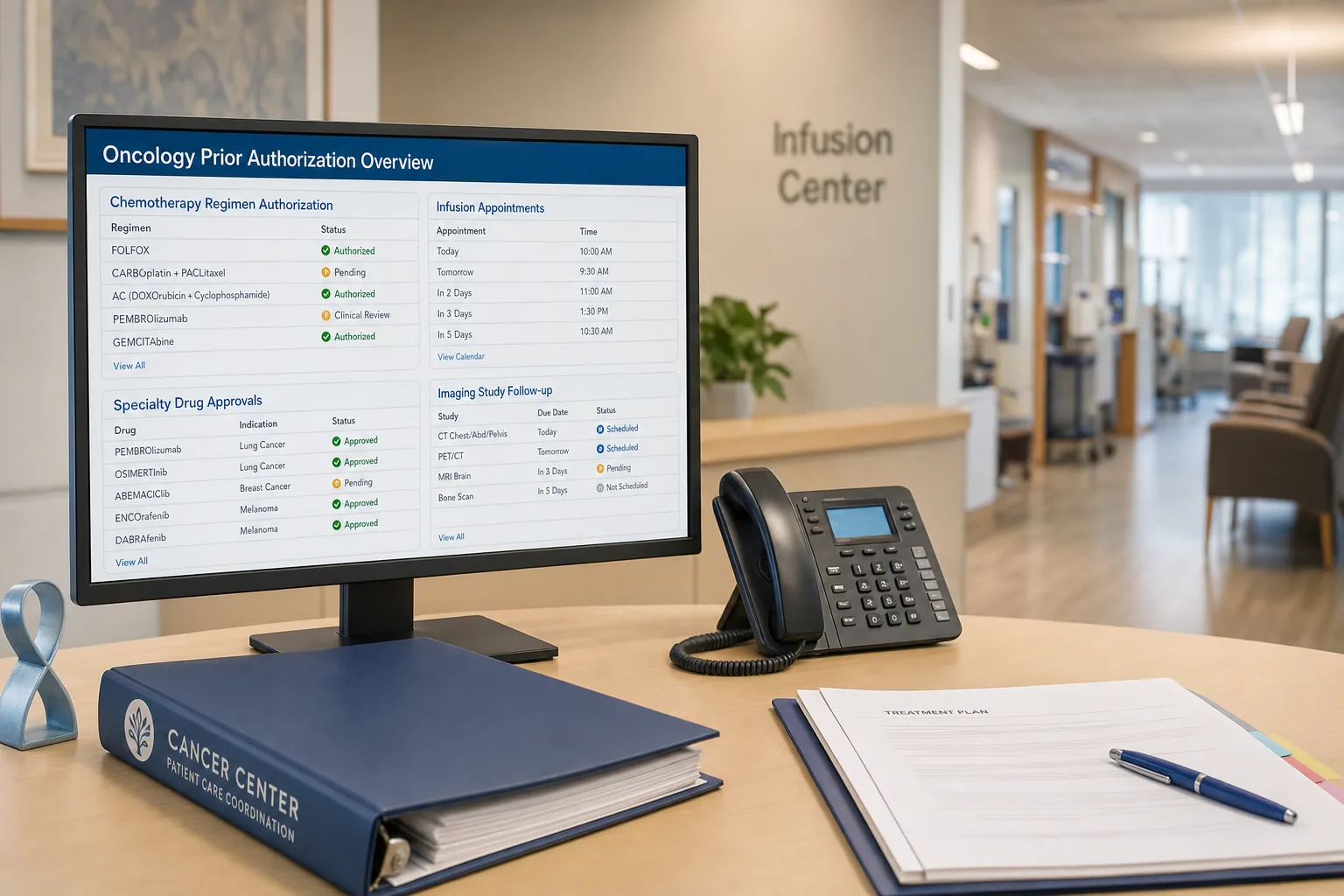
A patient starts a new chemotherapy protocol. Before the first infusion, your team needs prior authorization from the insurer. The payer wants a clinical summary, the cancer staging documentation, the treatment plan signed by the oncologist, and proof that first-line therapies were attempted. The timeline is 3-7 business days. The patient has an infusion appointment in 4.
This is how oncology practices lose weeks fighting paperwork for patients who cannot afford delays.
Prior authorization in oncology isn’t a nuisance. It is a clinical operations problem that touches every treatment cycle, every specialty drug reorder, and every follow-up imaging study. The American Cancer Society has documented that prior auth delays in oncology lead to treatment interruptions, patient anxiety, and in some cases, measurable clinical harm. Yet most oncology practices handle it the same way they did 10 years ago: manually, by phone, with staff pulled from clinical support roles to chase approvals.
AI voice agents don’t approve prior authorizations. But they handle the surrounding workflow that consumes 3-5 staff hours per case: inbound status inquiries, outbound documentation follow-up, patient notification, and appeal triage. That’s where oncology practices are recovering time today.
The prior auth burden specific to oncology
Oncology carries one of the heaviest prior authorization loads in outpatient medicine. Every treatment modality generates its own requirements:
Chemotherapy and infusion drugs: Most commercial payers require prior auth for chemotherapy regimens, even for first-line standard-of-care protocols. Approvals are typically regimen-specific, meaning a protocol change mid-treatment restarts the auth process. Payers also require re-authorization at regular intervals for ongoing treatment.
Specialty and oral oncology drugs: The growth of oral targeted therapies has created a new prior auth layer. Drugs like CDK4/6 inhibitors, EGFR inhibitors, and immunotherapy agents require auth through the pharmacy benefit (not medical benefit), creating a split workflow where oncology staff and specialty pharmacy are both involved.
Imaging and diagnostic studies: PET scans, bone scans, and MRIs for staging and restaging all require prior auth from most commercial payers. These come in bursts: at initial diagnosis, before treatment changes, and at standard restaging intervals.
Radiation therapy: Each radiation course requires prior auth, and payers often request clinical rationale documentation that takes longer to compile than in most other specialties.
The AMA’s 2024 Prior Authorization Survey found that oncology ranked among the top three specialties for the greatest negative impact from prior auth requirements, with 96% of oncologists reporting care delays and 89% reporting treatment abandonment or delay as a direct result.
Where staff time goes in oncology prior auth
A typical prior auth workflow in a 4-physician oncology practice:
- Identification (15 min): Staff identifies the auth requirement and gathers the clinical summary, staging documents, and treatment plan from the EHR
- Submission (20-45 min): Portal submission or fax, depending on payer
- Follow-up calls (15-30 min/day per case): Status checks, peer-to-peer request scheduling, appeals for initial denials
- Patient notification (10 min): Calling the patient to confirm authorization or explain a delay
- Rescheduling (15-30 min if denied or delayed): Adjusting infusion appointments when approvals don’t land in time
For a practice doing 80-100 treatment encounters per week, that’s 15-25 prior auth cases per week in various stages of the workflow. At 60-90 minutes of staff time per active case, you’re looking at 20-40 staff hours per week on prior authorization alone.
That’s one and a half full-time employees doing nothing but auth work.
What AI handles in the oncology prior auth workflow
AI voice agents integrated with athenahealth address the inbound and outbound communication layer of prior auth - the part that consumes the most staff interruptions.
Inbound patient status calls
A cancer patient calls to ask whether their next chemo cycle is approved. This call is not clinical. But it happens multiple times per week per active patient, and in a 4-physician practice with 200+ active patients in treatment, that’s a significant call volume.
The AI checks athenahealth for current prior auth status on the patient’s account, confirms whether the upcoming appointment has an active authorization, and either confirms the appointment or routes the call to billing to address a pending denial. Patients get an answer without pulling a billing specialist off an active appeal.
Outbound authorization reminders
When a prior auth is expiring within 14 days and the patient has upcoming appointments, the AI flags the case for staff to initiate re-authorization before the gap. This is the failure mode that causes infusion appointment cancellations: auth expires, appointment wasn’t rescheduled in time, patient misses a treatment cycle. Proactive expiration alerts prevent this.
Peer-to-peer scheduling support
When payers deny a prior auth and require a peer-to-peer review between your oncologist and the insurer’s medical director, that scheduling call is pure administrative friction. The AI handles the inbound notification, logs the peer-to-peer request in athenahealth, and queues it for provider action - instead of it sitting in a voicemail.
Documentation request routing
When a payer requests additional clinical documentation to support an auth request, that request often arrives by fax or portal message and needs to be routed to the right clinical staff quickly. AI triage routes these inbound requests with urgency flags based on appointment proximity.
The patient communication layer
Oncology patients call frequently. They are anxious. They have a legitimate reason to want real-time information about whether their treatment is proceeding as planned.
Most practices handle this with a phone nurse or MA who fields calls, pulls up the chart, and gives a verbal status update. When that person is pulled into a procedure or on the phone with an insurer, the patient goes to voicemail. In oncology, voicemail feels like abandonment.
AI handles the routine status inquiries - authorization status, appointment confirmations, infusion slot timing - so the clinical staff are available for the calls that actually require clinical judgment. A patient asking if their Taxol infusion is approved next Tuesday doesn’t need a nurse. They need an answer.
The practice gets a documented record of every patient call, the information delivered, and any escalation actions taken - all synced to athenahealth without staff involvement.
What oncology practice administrators get from AI
The operational case isn’t about replacing anyone. The math is simpler: oncology practices are running prior auth workflows that require more administrative capacity than most can hire and retain.
Medical assistants and billing specialists don’t stay in oncology front desk roles for long. The emotional weight is high, the administrative volume is high, and the pay is the same as less demanding settings. Turnover means constant retraining on the auth workflows, which means delays, errors, and more denials.
AI handles the consistent, protocol-driven portion of the workflow - status calls, expiration alerts, inbound routing, patient notification - and doesn’t turn over. The staff who remain focus on the high-judgment work: peer-to-peer scheduling, appeals, and complex payer escalations.
For a 4-physician practice: recapturing 10 hours per week of billing specialist time from routine status calls and patient notifications represents $25,000-$35,000 in annual labor productivity.
The athenahealth connection
athenahealth’s prior auth tracking in athenaOne gives practices a record of auth status per patient per appointment. AI voice agents that integrate directly with athenaOne can read that status in real time during a patient call, without staff having to pull up the chart.
When authorization status changes - approved, denied, pending appeal - the AI can trigger outbound patient notification and update the appointment record. Oncology practices on athenahealth using AI avoid the situation where a patient calls, the MA doesn’t know the auth status, and has to promise a callback that doesn’t come until end of day.
What to look for in AI for oncology
Oncology-specific requirements that differ from general primary care:
- Treatment cycle awareness: Auth requirements differ by infusion cycle, not just by patient. The AI needs to understand which upcoming appointment the patient is calling about
- Emotional tone calibration: Cancer patients are not the same as patients calling about a flu shot. AI handling oncology calls must be calibrated for sensitivity, not efficiency
- HIPAA + BAA coverage: Non-negotiable. All call handling and data access under a signed Business Associate Agreement
- Payer-specific protocol support: Commercial, Medicare Part B, and Part D pharmacy benefit workflows each have different auth processes
- Direct athenahealth integration: Real-time status lookup, not a lag-synced system that shows yesterday’s data
Pretty Good AI is built on athenahealth’s marketplace and handles oncology practice call workflows in production.
Key takeaways
- Oncology carries one of the highest prior auth burdens in outpatient medicine, with authorization required for every chemo regimen, specialty drug, and most imaging studies
- A 4-physician oncology practice generates 15-25 active prior auth cases per week, requiring 20-40 hours of staff time in various stages of the workflow
- AI voice agents handle the inbound status call layer - patients asking if their upcoming infusion is approved - without pulling clinical staff off active work
- Proactive prior auth expiration alerts prevent the failure mode where an authorization lapses before a patient’s next treatment cycle
- Oncology-specific emotional tone calibration is required - generic healthcare AI is not appropriate for cancer patient calls
If your billing team is spending significant hours on prior auth status calls that could be answered by an automated lookup, that’s recoverable time.
See how Pretty Good AI handles oncology practice workflows in athenahealth
Sources:
- American Medical Association 2024 Prior Authorization Survey: Prior Authorization Reform
- American Cancer Society, Cancer Action Network: Prescription Drug Utilization Management Fact Sheet
Ready to reduce missed calls?
15-minute demo. See how voice AI works with your athenaOne practice.
Schedule a Demo →Written by Kevin Henrikson