Practice Operations
Orthopedic Scheduling Automation and Post-Op Calls
Orthopedic practices lose providers' time to scheduling backlogs and post-op call floods. AI automation handles follow-up calls, reminder sequences, and slot optimization.
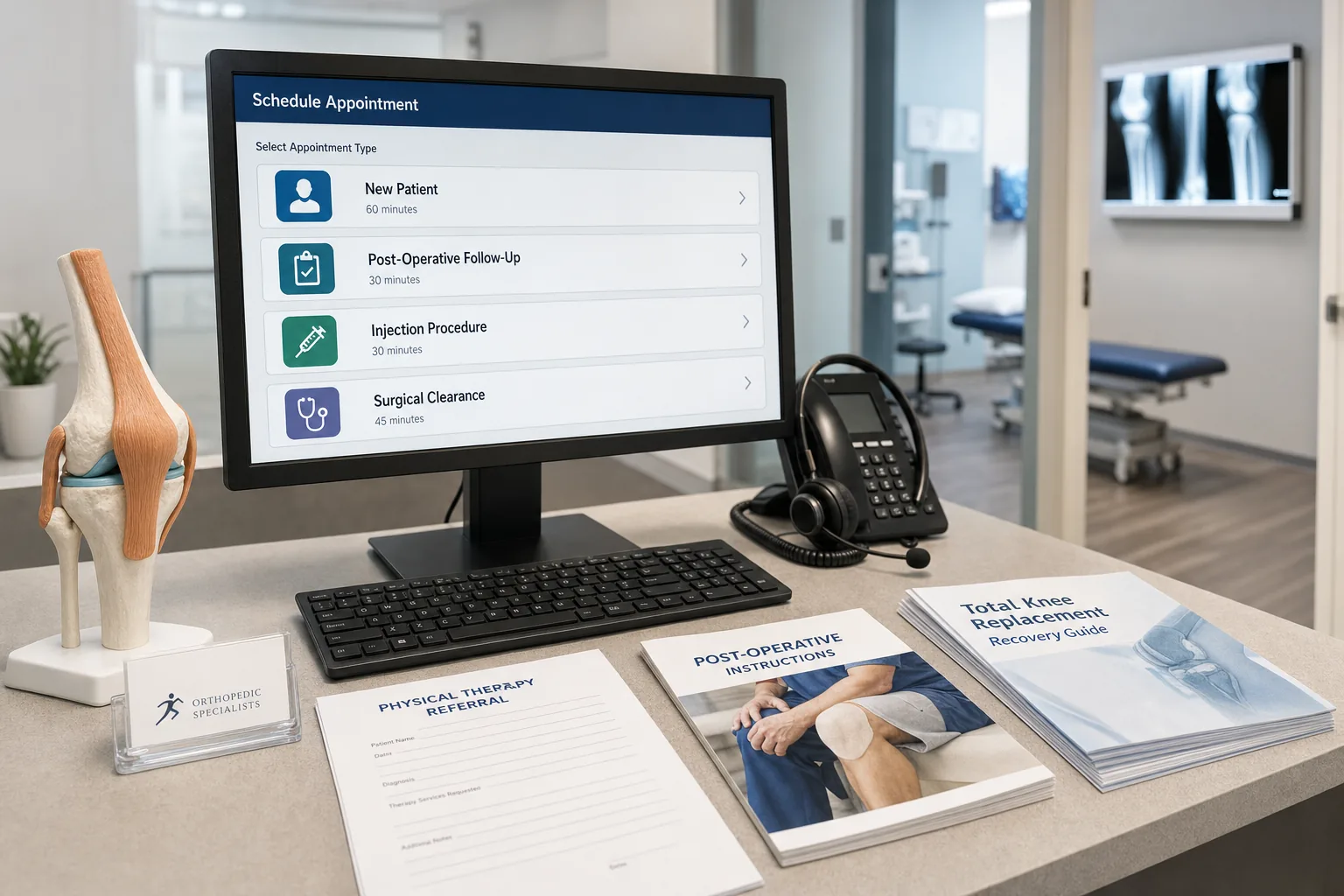
Orthopedic practices have a scheduling problem that compounds itself. New patient demand is high, surgical cases are growing, and post-operative patients generate call volume that few practices have adequately staffed for. The result: your front desk is buried in post-op calls while new patients wait weeks for appointments, and providers are running behind because surgical pre-op coordination fell through the cracks. AI scheduling automation is changing this calculus for orthopedic practices, and the gains are measurable.
Orthopedics has some of the most complex scheduling in outpatient medicine. A single orthopedic surgeon’s weekly schedule might include: new patient consultations, post-op follow-up visits, injection procedures, pre-surgical clearance appointments, and time blocked for surgical cases at an affiliated hospital or ASC. Each appointment type has different duration requirements, prep needs, and follow-up protocols. Coordinating this manually while fielding a constant stream of inbound calls is why orthopedic front desk turnover is chronically high.
This article covers the orthopedic scheduling bottlenecks that are costing practices revenue, how AI automation addresses each one, and what practices typically see in their first 90 days.
The Four Orthopedic Scheduling Bottlenecks
1. Post-op call flood
After a joint replacement, rotator cuff repair, or spinal procedure, patients have questions. A lot of them. Pain level, wound appearance, activity restrictions, medication concerns, and milestone anxiety (“is this swelling normal at day 5?”) generate call volume that peaks in the first two weeks after surgery and continues through the follow-up window.
A busy orthopedic surgeon doing 10-15 surgical cases per week has 100-150 patients in active post-op recovery at any given time. Each of those patients may call multiple times during their recovery. That’s 200-600 inbound calls per week from post-op patients alone, before you’ve touched new patient scheduling, prescription requests, or appointment rescheduling.
2. Surgical case prep coordination
Every surgical case requires pre-op coordination: pre-surgical testing orders, anesthesia clearance for patients with comorbidities, medical optimization for patients on anticoagulants, and day-of-surgery instructions. Coordinating this across patients, surgical facilities, and referring providers by phone is time-intensive and error-prone. Missed pre-op requirements are a primary driver of day-of-surgery case cancellations, which cost $1,500-$3,000 per canceled case in lost facility fees and rescheduling time.
3. New patient wait time
The average new-patient wait for an orthopedic surgery appointment is about 12 days in major metro markets (AMN Healthcare 2025 Survey of Physician Appointment Wait Times). Practices that manage scheduling manually often have wait times at the higher end, not because they lack appointment slots, but because they lack real-time slot optimization. Cancellations don’t get backfilled efficiently. Provider schedules have phantom availability that doesn’t show up in the scheduling system. Patients who call for an urgent consultation because they’re in pain end up waiting three weeks.
4. Post-surgical appointment adherence
Patients who don’t come to their post-surgical follow-up appointments create liability and revenue risk. A patient who skips their 6-week post-op check might have an unreported complication. A patient who doesn’t complete physical therapy follow-ups has worse outcomes. Reminder systems that rely on emails alone miss significant portions of orthopedic patient populations.
How AI Scheduling Automation Addresses Each Bottleneck
Post-op call management:
AI handles the high-volume, protocol-driven calls that make up the majority of post-op inquiries. “Is my swelling normal?” “I missed my pain medication dose this morning, what should I do?” “When can I start walking without the brace?” The agent captures the question, can relay the practice’s documented post-op instructions where configured, and uses the practice’s red-flag screen to route the report. Potential complications such as fever, wound drainage, or pain unresponsive to medication go to the clinical team; emergencies go to 911. The agent does not diagnose or decide the clinical outcome.
This approach doesn’t replace clinical judgment. It filters the questions that require clinical judgment from the ones that don’t. For a 20-case-per-week surgical practice, filtering post-op calls from 400 per week to 40 that need clinical review is a material operational change.
Surgical prep coordination:
AI initiates outbound calls to patients as their surgical date approaches, confirms that pre-op requirements have been completed, and identifies gaps. A patient who hasn’t completed their pre-surgical labs by 5 days before their procedure gets an AI call reminding them and providing the lab order reference. If the patient confirms they haven’t completed labs, the call escalates to a coordinator who can troubleshoot barriers.
Day-of-surgery instruction calls can also be automated: confirming NPO status, confirming arrival time, answering common day-of questions. These calls take 3-5 minutes each. At 15 surgical cases per week, that’s 45-75 minutes of coordinator time per week on day-of confirmation calls. Automated, it’s zero coordinator time.
Slot optimization:
AI-powered scheduling connects to the practice’s scheduling system and actively manages waitlists. When a cancellation occurs, AI immediately identifies patients on the waitlist who match the appointment type and duration, calls them to offer the slot, and books confirmed patients. A cancellation that would have sat vacant for a week gets backfilled in hours. For a practice with 200 appointments per month, even a 5% improvement in backfill rate means 10 more appointments per month, or $1,500-$3,000 in recovered revenue.
Appointment reminder sequences:
Multi-touch reminder sequences for post-surgical follow-up visits catch patients before they slip into non-adherence. Starting 7 days before the follow-up appointment, AI confirms the patient is planning to attend and answers any logistical questions. Three days out, another confirmation call. Day of, a final reminder with parking and arrival instructions. Patients who miss two confirmation attempts escalate to a coordinator for manual outreach.
What to measure in the first 90 days
Publishing a percentage here would be inventing one. What an orthopedic practice can do instead is take a baseline before anything is automated, then read the same four numbers 90 days later against its own starting point.
- Share of post-op calls that reach clinical staff. Count the calls a nurse or provider actually handles, not total call volume. This is the number that decides whether the automation is doing anything, because protocol-driven post-op questions and calls that need a clinician are different work.
- Day-of-surgery cancellations, and the reason code on each. Split the ones traceable to a missed pre-op instruction from the ones that are not. Only the first group is addressable by confirmation calls.
- Days from referral to booked new-patient visit, measured separately for slots created by a cancellation and slots that were always open. Backfill speed only shows up in the first group.
- Post-surgical follow-up attendance by notice period. Follow-ups booked weeks out and follow-ups booked inside a week behave differently, and a blended rate hides which one the reminders moved.
The reason to watch clinical escalation first is that it is the only one of the four that converts into clinician time rather than administrative time. When the protocol-driven share of post-op calls stops reaching a nurse, the recovered hours land with the people whose hours are hardest to buy.
Key Takeaways
- Orthopedic practices face four distinct scheduling bottlenecks: post-op call floods, surgical prep coordination gaps, slow new patient backfill, and poor post-surgical follow-up adherence.
- A practice with 15 weekly surgical cases has 100-150 patients in active recovery, generating 200-600 inbound post-op calls per week.
- AI handles the protocol-driven majority of post-op calls and escalates only calls indicating potential complications.
- A day-of-surgery cancellation carries block time, staff and room cost that is already committed, which is why pre-op confirmation is worth automating before cheaper touches are.
- Slot optimization and waitlist management through AI backfills cancellations in hours rather than days.
- Multi-touch reminder sequences matter most on post-surgical follow-ups booked weeks ahead, where the gap between booking and visit is long enough for the appointment to fall out of the patient’s week.
Orthopedic scheduling complexity is not going to simplify. Surgical volumes keep growing, patient populations are aging, and post-op expectations are higher. Practices that automate the repeatable call and scheduling work now will have a real operational advantage in the next three years.
See how Pretty Good AI handles scheduling automation for orthopedic practices.
Sources:
Ready to reduce missed calls?
See how Pretty Good AI handles scheduling automation for orthopedic practices
Schedule a Demo →Written by Kevin Henrikson