Practice Operations
Physical Therapy Prior Auth and Visit Limits
PT practices spend hours each week getting visit-limit authorizations approved. AI voice agents handle status calls and auth workflows in athenahealth.
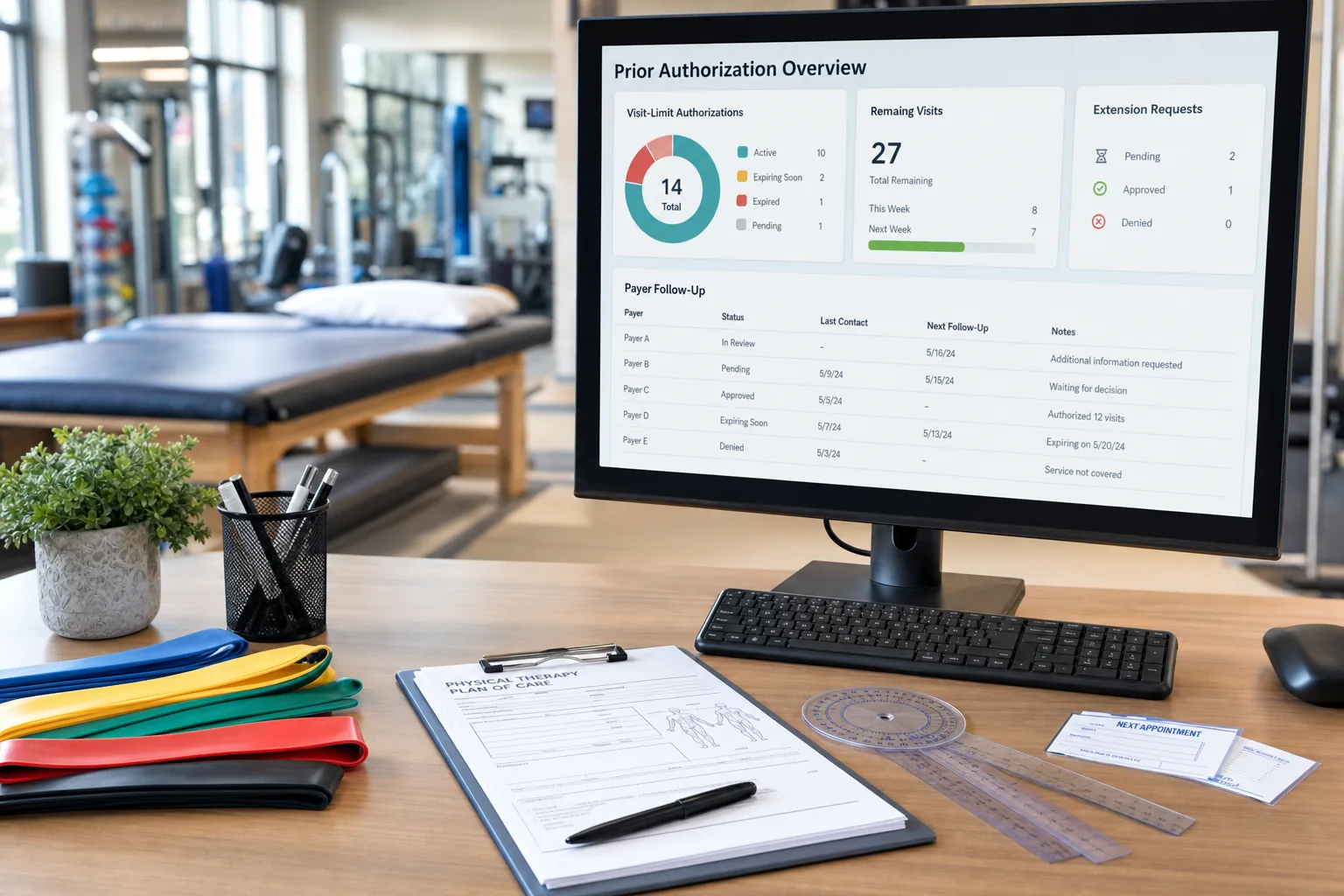
A patient finishes their 8 approved physical therapy visits. They need 6 more to hit their functional goals. Your office manager submits a visit extension request to the insurer on Monday. By Friday, it hasn’t been approved. The patient’s appointment is on Tuesday.
This is the physical therapy prior auth cycle on repeat, across every commercial payer, every week.
Physical therapy practices have a prior authorization problem that is structurally different from most other specialties. It’s not about a single procedure approval. It’s about visit-count management: getting the initial authorization, tracking how many visits have been used, requesting extensions before the patient hits the limit, and managing the appeals when an extension gets denied. For a 3-therapist practice seeing 80-100 patients per week, that’s a continuous, rolling administrative burden that doesn’t peak and drop - it just runs.
The front desk staff in most PT practices have gotten good at managing this manually. The problem is that getting good at something that shouldn’t require this much time still costs you the time. AI voice agents are handling the patient-facing part of this workflow - status inquiries, appointment confirmations, extension update notifications - so staff can focus on the submissions themselves.
The visit-limit auth cycle in physical therapy
PT prior auth works differently from procedural specialties. Rather than getting a single approval for a procedure, PT practices manage authorizations against a visit count that burns down over time.
The typical workflow:
- Initial authorization: Before the first visit, the practice gets approval for a set number of visits (often 6-12 for commercial payers, fewer for some managed care plans)
- Visit tracking: Each visit used counts against the authorized total. Staff track this per patient, per payer, per episode of care
- Extension requests: When a patient approaches their authorized visit limit but still has clinical need, the practice submits an extension request with documentation of progress and functional goals
- Extension denials and appeals: Payers deny extensions at significant rates. Appeals require clinical documentation, progress notes, and sometimes peer-to-peer review
- Gap visits: When an extension isn’t approved in time and the patient shows up for their next appointment, the practice has to decide whether to see them at risk or reschedule
APTA’s 2025 report on administrative burden found that 83% of physical therapists agree that authorization delays have caused patients to stop treatment before achieving functional goals. For PT, patient drop-off is a revenue problem and a clinical problem simultaneously.
Where the call volume hits
Patients calling to check auth status (40% of admin calls)
A patient scheduled for PT Tuesday wants to know if they’re approved for more visits. They call Monday. Staff have to pull up the chart, check the auth record, verify how many visits remain, and give an answer. The call takes 5-8 minutes. It happens across every patient approaching their visit limit.
For a practice with 80 active patients across 3 payers, that’s a significant call volume during the window when authorizations are expiring.
Appointment confirmations with auth status uncertainty (25%)
When a patient’s auth is about to run out and an extension hasn’t been approved, scheduling is in a grey area. The front desk often holds appointments tentatively while waiting for approval confirmation, then has to call patients when the status resolves. This generates multiple calls per patient per extension cycle.
Insurance questions and billing disputes (20%)
Patients whose visits get denied mid-cycle get bills. They call. They want to know why their visits weren’t covered. These calls are time-consuming and emotionally charged.
Post-appointment scheduling (15%)
PT schedules are high-frequency: 2-3 visits per week per patient. Rescheduling calls, reminder calls, and cancellation recovery are a constant background load on the front desk.
What AI handles in a PT practice
Patient authorization status calls
When a patient calls to ask how many visits they have left or whether their extension was approved, the AI checks athenahealth for current authorization status in real time and gives a direct answer. If the extension is approved, it confirms the number of additional visits available. If it’s still pending, it gives the patient an honest update and offers a callback when status changes.
This interaction doesn’t require clinical judgment. It requires access to the authorization record. AI does it in 2-3 minutes instead of 5-8, and it does it consistently without pulling an MA off the schedule.
Proactive expiration alerts to patients
When a patient is within 2 visits of their authorized limit and an extension hasn’t been submitted yet, the AI can trigger a proactive outbound call to let the patient know their auth status and set expectations for whether their next appointment is confirmed. This prevents the Tuesday morning “I didn’t know I was out of visits” conversation.
Appointment reminders with auth context
Standard appointment reminders for PT don’t account for auth status. An AI reminder call that also confirms the patient’s visit count is authorized prevents no-shows caused by patient confusion about coverage.
Post-denial call handling
When a visit extension is denied, patients often call angry and confused. The AI handles the initial call, provides factual information about the denial and the appeals process, and routes to a billing specialist for cases requiring escalation. The front desk doesn’t absorb the emotional volume of every denial notification call. What the denial costs the practice is measured on the billing side, where visit counts, authorization limits, and small-dollar claims set the arithmetic.
The patient drop-off problem
Physical therapy patient drop-off is a significant revenue issue. The average PT episode of care in outpatient settings runs 8-12 visits. Patients who don’t complete their plan of care generate lower revenue per episode and worse clinical outcomes, which affects practice reputation and referral relationships.
The primary causes of drop-off in PT:
- Insurance coverage uncertainty (patient doesn’t know if visits are still covered)
- Authorization gap visits (patient can’t get a confirmed appointment while extension is pending)
- Friction in rescheduling (patient misses a session, doesn’t reschedule, drifts out of care)
AI reduces the first two directly: patients who know their auth status stay engaged. Consistent outbound reminders with auth confirmation reduce the drift caused by missed appointment re-engagement friction.
A practice that reduces drop-off by 2-3 patients per month at 4 remaining visits per episode each generates roughly $380-$520 in recovered revenue per patient - meaningful for a 3-5 therapist practice.
Illustrative model. Figures are assumptions, not measured results.
The scheduling automation angle
PT schedules run at high frequency and change constantly. Patients reschedule, cancel, or request different time slots. Front desk staff in PT practices spend a disproportionate amount of time managing schedule changes for active patients compared to other specialties.
AI voice agents handle inbound scheduling calls - patients calling to reschedule an appointment, check time slot availability, or cancel - and route schedule changes to the booking system without requiring front desk involvement. For a practice with 80 active patients each visiting 2x per week, the scheduling call volume is substantial.
The combination of auth status management and scheduling automation addresses the two largest sources of front desk interruption in a PT practice simultaneously.
The staffing math
A 3-therapist PT practice typically runs with 1-2 front desk staff and an office manager handling billing and auth. Those 2-3 people are managing scheduling for 80+ active patients, handling prior auth for every payer, fielding patient calls, and managing billing.
Adding headcount in PT is expensive relative to revenue per visit. Average PT reimbursement runs roughly $80-$130 per visit from commercial payers, and the admin-to-revenue ratio is already thin. An additional front desk hire at $40,000-$50,000 per year often doesn’t pencil in a small independent practice.
AI voice agents address the patient call volume and appointment management load while staff focus on auth submissions, appeals, and billing - the work that requires healthcare-specific judgment. Price the workload avoided against an additional hire, using visit volume and the number of sites to size the solution.
What to look for in AI for PT practices
Requirements for AI in physical therapy settings:
- Visit count awareness: The AI needs to read authorization records with visit counts, not just binary approved/denied status
- athenahealth integration: Real-time auth status lookup without staff pulling charts
- Scheduling integration: Inbound reschedule and cancellation handling connected to the booking system
- HIPAA compliance: All call handling under a signed Business Associate Agreement
- Outbound campaign support: Ability to run proactive expiration alerts and appointment reminders
Pretty Good AI integrates with athenahealth and handles PT-specific prior auth call workflows in production.
Key takeaways
- Physical therapy prior auth is a rolling, visit-count management problem, not a single-approval workflow - it generates continuous admin overhead throughout each patient episode
- 83% of PTs report that auth delays cause patients to abandon care before reaching functional goals (APTA, 2025)
- AI handles the inbound patient status calls - “how many visits do I have left,” “is my extension approved” - without staff interruption
- Proactive outbound expiration alerts reduce patient confusion and drop-off caused by auth coverage uncertainty
- For small independent PT practices, AI addresses the front desk call burden while the practice measures avoided staff time and recovered access
If your front desk is fielding repeated patient calls about visit authorization status every week, that’s a workflow problem with a direct fix.
See how Pretty Good AI works in athenahealth for PT practices
Sources:
- American Physical Therapy Association, 2025 Administrative Burden Survey: Survey Findings Drive New APTA Advocacy Resources on Administrative Burden
- American Physical Therapy Association: Administrative Burden Advocacy (including prior authorization)
Ready to reduce missed calls?
15-minute demo. See how an AI team works inside your athenaOne practice.
Schedule a Demo →Written by Kevin Henrikson