Practice Operations
AI to Automate Prescription Refill Request Calls
Providers lose 30+ minutes a day to refills. See how AI voice agents automate routine prescription refill calls, phone trees, and faxes.
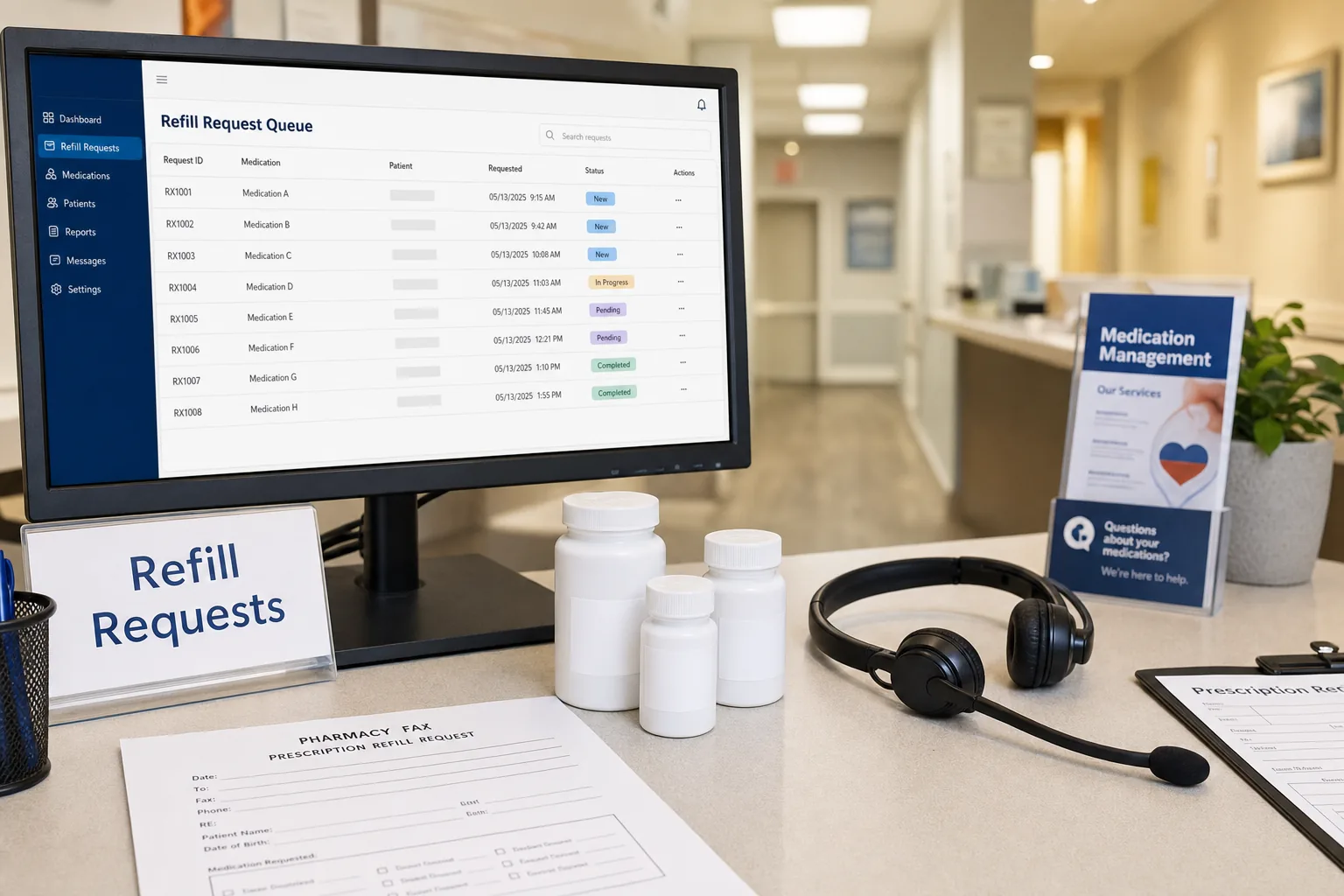
Primary care physicians receive between 10 and 25 prescription refill requests per day.
That’s 30 minutes of physician or medical assistant time spent every single day reviewing requests, calling pharmacies, navigating phone trees, and sending faxes.
For a four-provider practice, that’s 2 hours per day. 10 hours per week. 520 hours per year, more than three months of full-time work dedicated solely to refilling medications.
The figures below are a worked example, not measured benchmarks. Your numbers will vary with call volume, payer mix, and revenue per visit.
The math is brutal. At $80/hour for physician time or $28/hour for MA time, refill management costs practices $35,000-$125,000 annually. And that’s just labor. Add the opportunity cost of appointments that could have been scheduled instead, and the real number is closer to $200,000.
Voice AI changes this. Instead of your staff calling pharmacies, an AI agent handles routine refills autonomously, verifying patient identity, checking last fill dates, confirming pharmacy details, and routing requests to providers only when clinical review is required.
The result: the majority of routine refills processed without human intervention, 30-40 minutes per day recaptured, and zero patient friction.
The refill request bottleneck
Ask any physician what the most costly workflow in their practice is, and they’ll tell you: anything involving the telephone.
Prescription refills are a perfect storm of inefficiency.
High volume is the first problem. Chronic disease management drives refill volume. A patient on metformin, lisinopril, and atorvastatin generates 36 refill requests per year. Multiply that across 2,000 active patients with chronic conditions, and you’re looking at 15,000+ refill requests annually.
Most refills carry low clinical value. The patient has been on the medication for months or years. Labs are stable. There’s no clinical decision to make, just administrative confirmation that yes, they can have another 90-day supply.
Calling pharmacies means navigating automated systems, waiting on hold, and leaving voicemails. When the pharmacy calls back, your staff is with a patient. Phone tag ensues.
Many pharmacies still use fax for refill requests. Staff must print, review, route to the provider, wait for approval, and fax back. Each request touches 3-4 people.
Traditional solutions don’t solve the problem. Patient portals reduce some phone volume, but most patients still call. E-prescribing helps with new scripts but doesn’t automate refill approval workflows.
How voice AI automates prescription refills
Voice AI handles the entire refill workflow without human intervention.
Step 1 is inbound call handling. The patient calls requesting a refill. The AI agent answers, verifies identity (name, date of birth, last four of SSN), and captures medication name, pharmacy location, and last fill date.
Step 2 is EHR lookup. The AI queries your EHR to confirm:
- Active prescription on file
- Remaining refills available
- Last fill date (preventing early refills)
- Provider approval requirements (controlled substances flagged for review)
Step 3 is routine processing. For eligible refills, the AI calls the patient’s pharmacy directly. It navigates the pharmacy phone tree, provides prescription details, and confirms the refill order.
Step 4 is exception routing. If the medication requires provider review (controlled substance, out of refills, overdue labs), the AI creates a task in your EHR with full context and notifies the provider via secure message.
No phone tag. No fax chaos. No staff time wasted calling pharmacies.
The integration requirement
Without bidirectional EHR integration, voice AI for refills is just a fancy answering service. Vendors describe that integration in the same words whether or not it writes back while the caller is still on the line, so it is worth knowing what real-time athena integration actually means before the queue behavior is yours to live with.
Real automation requires the AI to:
- Read medication lists and refill history from your EHR
- Check prescription status and remaining refills
- Write completed refill tasks back to the patient chart
- Trigger provider alerts for exceptions (controlled substances, early refills)
Voice AI for prescription management operates under a Business Associate Agreement (BAA) with full HIPAA compliance. All patient calls are encrypted, transcribed, and logged in the EHR audit trail.
The prescription refill checklist
When evaluating voice AI for prescription refill automation, require these capabilities:
- Bidirectional EHR integration: must read medication lists and write completed tasks
- Patient identity verification: name, DOB, last four SSN minimum
- Pharmacy outbound calling: AI must call pharmacies, not just take messages
- Controlled substance flagging: routes Schedule II-IV meds to provider review
- Early refill detection: prevents refills requested before due date
- Multi-pharmacy support: handles patient’s preferred pharmacy (CVS, Walgreens, local, mail-order)
- HIPAA-compliant: operates under BAA with encrypted call recordings
Generic AI assistants fail here. They can’t navigate pharmacy phone systems, don’t understand medication terminology, and lack the clinical logic to route controlled substances appropriately.
The ROI: remove repeat administrative work
Refill automation is a labor win when it removes the repeated work around each request, not just the initial phone call. The agent captures the medication, dosage, pharmacy and location, current insurance, and refill timing in an organized note so the clinician can approve from complete information instead of calling the patient back for missing details.
It can also absorb repeat status calls: whether the prescription was sent to the pharmacy, whether it was resubmitted, and what remains pending. That gives the practice a clear way to measure the opportunity:
- Refill requests per provider per day
- Staff minutes spent gathering and organizing each request
- Callback and pharmacy phone-tag volume
- Exception requests that still require clinician review
- Patient status calls after submission
The clinical decision stays with the clinician. Voice AI handles the detailed intake, pharmacy communication, and status updates around that decision, while the practice measures the staff time and patient access recovered.
What this means for chronic disease management
Refill automation does two things at once: it cuts admin time and keeps patients on their medications.
When refill requests take 24-48 hours to process, patients run out of medication. They skip doses. HbA1c creeps up. Blood pressure spikes. Preventable complications occur.
Voice AI processes routine refills in under 2 hours. The patient calls at 9am, and by 11am they have a text notification that their prescription is ready for pickup.
Adherence goes up. Outcomes get better. Quality metrics follow.
Implementation: 10-day sprint
Voice AI for prescription refills deploys in ten days.
Week 1 covers integration and training:
- Connect to your EHR’s API (athenaOne)
- Map medication fields and refill workflows
- Train AI on your pharmacy phone numbers and refill policies
- Configure controlled substance routing rules
Week 2 is go-live:
- Run parallel processing (AI + manual) for 100 refills
- Staff review AI accuracy and flag discrepancies
- Flip switch to full automation
Automation rates increase as the system learns pharmacy-specific phone trees and refill request patterns.
Why this matters now
Prescription refill volume is increasing, not decreasing:
- Chronic disease prevalence is rising, putting more patients on long-term medications
- Staffing remains tight, with MGMA data showing front-office turnover hit 40% in 2022 (33% for clinical support staff); turnover has since stabilized, but MA and front desk roles still see elevated churn
- Patient expectations are shifting toward same-day refill processing, not 48-hour callbacks
Practices that automate refill management now get a 12-18 month head start. By the time competitors catch up, you’ll have recaptured thousands of hours and processed tens of thousands of refills without adding staff.
For a planning estimate, a practice can multiply its measured refill minutes by its blended staff rate and compare the result with the exception workload that remains. Add recovered appointment capacity only after measuring how often refill work displaces scheduled patient care. Review the volume and labor assumptions with our team.
Your medical assistants didn’t go into healthcare to spend their days calling CVS. They want to help patients, not navigate pharmacy phone trees.
Let them do the work that actually requires human judgment.
Ready to eliminate your refill management bottleneck? Schedule a 15-minute demo to see voice AI handle real prescription refill calls with your EHR.
Stop Losing 30 Minutes a Day to Refill Requests
Pretty Good AI handles routine prescription refills autonomously, verifying identity, checking fill dates, routing to your provider only when clinical review is needed.
See How It Works →Written by Kevin Henrikson