Practice Operations
Primary Care After-Hours Calls: What AI Actually Handles
Independent primary care practices lose physician time to overnight calls. AI voice agents capture intake, complete admin work, and escalate clinical calls.
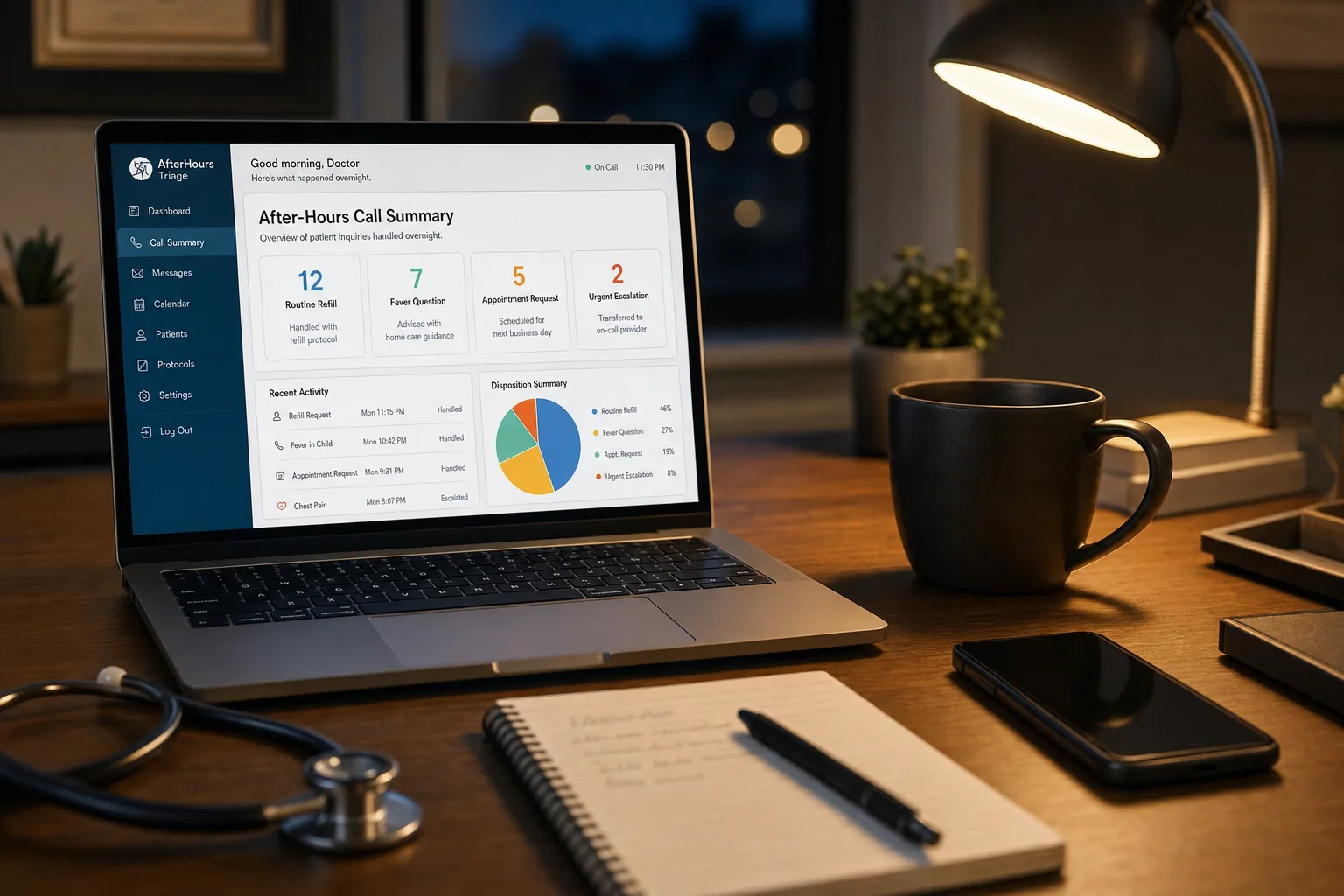
Independent primary care’s after-hours burden has grown sharply since the pandemic, patient portal messages rose 153% between 2020 and 2025, and physicians’ after-hours EHR time keeps climbing, but for a solo or two-physician practice, the after-hours phone line is still the physician’s cell phone. Most of what comes in overnight could be handled without waking the physician. AI voice agents are finally making that separation practical at primary care scale.
The after-hours call problem in independent primary care is different from what hospital systems face. Large systems have nurse triage lines, after-hours care centers, and call centers. Independent practices have the physician’s cell phone. The physician who saw 25 patients today and has 25 more tomorrow takes the call about the 8-year-old with an ear infection at 11pm. They take the call about the patient who ran out of their blood pressure refill. They take the call about the person who Googled their symptom and convinced themselves it was serious.
This article covers what the after-hours call mix actually looks like in independent primary care, what it costs physicians, and how AI intake changes the calculus without adding risk.
What After-Hours Calls Are Really About
Independent primary care after-hours calls cluster into a handful of categories. Understanding the breakdown is the starting point for understanding what AI can and can’t handle.
Prescription refills and medication questions: Patient ran out of medication before their next appointment or has a question about a side effect, missed dose, or timing. The agent captures the request and enters refill needs into the provider-approved workflow; clinical questions go to the practice.
Symptom and clinical questions: Mild fever, sore throat, ear pain, mild GI symptoms, or skin rash. The patient wants a clinical answer; the agent captures the report and routes it to the practice.
Appointment requests and logistical questions: Patient wants an appointment tomorrow. Patient has a question about their upcoming blood draw. Patient wants to know if they need to fast before their procedure. None of these require physician involvement.
Calls that need physician attention: Chest pain, symptoms suggesting potential emergency, medication reactions, mental health crises, patient with documented high-risk conditions reporting a significant change. These need the physician.
The practical implication is that administrative requests can be completed without waking the physician, while clinical questions go to the practice’s clinicians with structured context. The agent does not provide medical guidance.
What It Costs the Physician
The direct cost of after-hours calls is measured in sleep and recovery. A physician who gets 3 calls between 10pm and 7am is not getting 9 hours of uninterrupted sleep. They’re getting fragmented sleep that degrades next-day performance and compounds over time.
Call burden is a real quality-of-life strain for owner-physicians. AMA survey data show the most-cited reasons independent practices sell are payer leverage, access to costly resources, and administrative burden, pressures that only compound when the practice owner is also carrying the after-hours phone every night. AMA burnout research shows that independent physicians who take frequent after-hours calls report significantly higher burnout rates than those with covered after-hours arrangements.
For a practice trying to stay independent, that means after-hours call burden is a retention risk for the physician who owns the practice. It’s not an abstract quality-of-life issue.
The financial math is also real. An independent physician who takes frequent after-hours calls can be fielding hundreds of calls per year. Valued at even a fraction of the physician’s hourly rate, that represents a significant amount of physician time spent on calls that mostly don’t require physician expertise.
How AI Intake Works for Primary Care After-Hours
AI voice intake for primary care after-hours captures the caller’s request 24/7 and routes it according to practice-owned rules.
When a patient calls after hours, the AI:
- Identifies the patient and confirms they’re calling about a medical concern
- Captures structured intake about the request and reported concern
- Routes the request according to practice-owned rules:
- Administrative pathway: Scheduling, rescheduling, records, insurance, or refill requests. The agent completes the supported task or enters it into the provider-approved workflow and logs the call.
- Appointment pathway: The agent captures the request and offers available scheduling options; clinical decisions about where or when the patient should be seen remain with the practice.
- Clinical pathway: The agent screens the reported concern against practice-owned red flags, directs emergencies to 911 or the appropriate emergency service, and routes other clinical questions to the physician with a call summary.
The physician gets woken up for escalation calls only. Escalation calls come with structured context: patient identity, reported concern, timing, and the full intake. The physician can make a fast, informed decision instead of piecing together the situation from a groggy conversation.
All calls, regardless of pathway, are logged with full transcripts and available for physician review in the morning. If a clinical call needs follow-up, the physician can review the transcript and call the patient back.
What AI Does Not Do in Primary Care After-Hours
Primary care after-hours AI should not:
- Override physician documentation about specific patient management
- Handle calls from patients with documented complex conditions without physician awareness (these patients should have direct escalation rules)
- Advise on medication changes beyond confirming documented instructions
- Handle mental health crisis calls without immediate escalation protocols
The conservative principle applies here as strongly as in cardiology. Practice-owned routing sends clinical questions to clinicians rather than holding them. The goal is to remove administrative noise from the physician’s night, not to replace physician judgment.
Practical Implementation Notes
An independent primary care practice deploying AI for after-hours calls typically needs:
Routing design with the physician: Practice-owned rules should define which reported concerns go directly to clinicians and which red flags require emergency routing. The agent screens and captures the report, but does not diagnose, interpret symptoms, or make the clinical decision.
Patient communication about the system: Patients should hear that they have reached an AI intake service, that clinical questions go to the practice, and that the agent can capture their information and connect them to the appropriate workflow.
Physician review cadence: The first few weeks, physicians should review call logs daily to confirm that routing rules send clinical questions to the right team and administrative requests to the right workflow.
Key Takeaways
- Independent primary care’s after-hours burden has grown sharply since the pandemic, portal messages and after-hours EHR time keep climbing, even though call volume itself has stabilized.
- Administrative after-hours calls can be handled with structured intake and administrative support. Clinical calls go to the practice.
- AMA burnout research shows independent physicians with frequent after-hours call burden have significantly higher burnout rates. Reducing unnecessary calls is a retention strategy for solo and small group practices.
- Physician time is often spent collecting information and handling administrative after-hours calls. AI can capture intake and complete supported administrative work.
- AI routes administrative requests and clinical calls according to practice-owned rules. Escalation includes full call context so physicians can respond fast.
- Conservative escalation is non-negotiable. When AI is uncertain, it escalates.
The after-hours call problem in independent primary care has a clear solution. It is not 24/7 staffing or forwarding calls to a generic answering service. It is structured intake, supported administrative work, and clinician-owned escalation with context.
See how Pretty Good AI handles after-hours calls for independent primary care practices.
Sources:
Ready to reduce missed calls?
See how Pretty Good AI handles after-hours calls for independent primary care
Schedule a Demo →Written by Kevin Henrikson