Practice Operations
Endocrinology Prior Auth and GLP-1 Volume
GLP-1 prior auth requests have surged dramatically at endocrinology practices since 2023 alongside the expansion of GLP-1 prescribing. Learn how AI voice agents integrated with athenaOne absorb the call volume without adding staff.
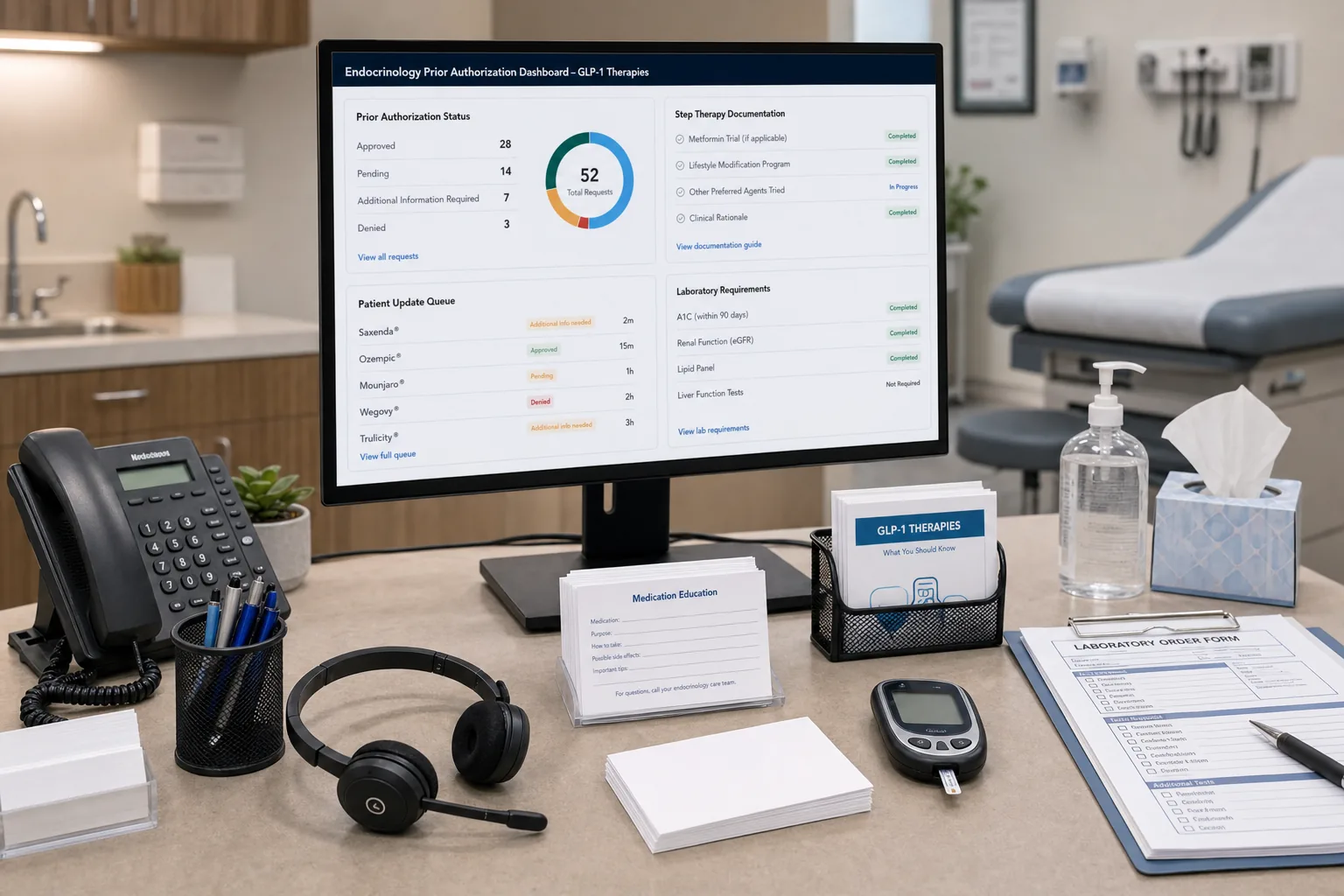
In 2022, a mid-sized endocrinology practice managed maybe five GLP-1 prior authorization requests per week. By late 2024, that number was north of 40. Today, some practices are processing 60 or more per week, and the call volume from patients asking about those approvals has grown at the same rate.
The GLP-1 explosion is the defining administrative event in endocrinology right now. Semaglutide, tirzepatide, and their successors are prescribed across the board, for type 2 diabetes, obesity, and increasingly, cardiometabolic risk management. But insurers, particularly commercial plans and Medicare Advantage, have made GLP-1 authorization one of the most complex and frequently denied categories in the formulary.
That means endocrinology practices are dealing with something they’ve never dealt with at this scale: a prior auth workflow that touches the majority of their patient panel, changes constantly as payer policies evolve, and generates significant inbound call volume from patients who want to know if their medication is covered.
This piece covers what’s driving that burden, why traditional PA workflows are not built for this volume, and what AI voice agents actually change for endocrinology practices on athenahealth.
Why GLP-1 prior auth broke the old workflow
Prior authorization for endocrinology has always existed. Specialty medications for type 1 diabetes, CGM devices, insulin pump supplies: these have required PA for years. The processes were established. Staff knew the payer rules. The volume was manageable.
GLP-1s broke the system in two ways.
First, the volume increase is dramatic. Prescribing rates for GLP-1 receptor agonists roughly doubled between 2022 and 2024, driven by expanded indications and direct-to-consumer advertising. Endocrinology practices absorbed the increase in PA requests while dealing with the same headcount they had before.
Second, payer policies for GLP-1s are uniquely unstable. A plan that covered Ozempic for type 2 diabetes in January may have added a BMI requirement by June. A plan that covered Wegovy for obesity in March may have added a mandatory step therapy requirement by August, requiring proof the patient tried and failed a non-branded GLP-1 first, even if the branded version was clinically indicated from the start. Keeping track of which plan requires what, for which drug, in which diagnosis context, is a real-time research problem that has no parallel in other PA categories.
Staff members who learned the GLP-1 PA rules in Q1 are frequently working with outdated information by Q3. The result is higher initial denial rates, more appeals, and more time per case than any other PA category in the practice.
The CGM layer on top
GLP-1 PA is not the only pressure point. Continuous glucose monitors have their own prior authorization requirements, and those requirements have gotten more complex as CGM use has expanded from type 1 diabetes to type 2 diabetes management and gestational diabetes monitoring.
For a patient on a GLP-1 who also uses a CGM, the practice is managing two separate PA tracks simultaneously. Add in insulin pump supplies, specialty medications for comorbid thyroid conditions, and referral authorizations for complications like diabetic retinopathy, and a typical endocrinology patient panel generates more active PA cases per patient than nearly any other specialty.
What patients are calling about
Endocrinology patients on GLP-1s are a highly engaged patient population. They are managing chronic conditions, paying close attention to what their insurance covers, and motivated to understand the status of their medication authorizations. They call.
The most common inbound call types from GLP-1 patients:
“Did my insurance approve my Wegovy?”, This is the highest-volume PA status call. Patients who have been waiting on authorization want updates.
“My pharmacy said my prior auth was denied, what do I do?”, Denials generate follow-up calls almost immediately. Patients who go to the pharmacy and get told their medication is not covered call the practice to understand what happened and what comes next.
“My doctor changed my medication, does that require a new prior auth?”, Transitions between GLP-1 agents, or from GLP-1 to GIP/GLP-1 dual agonists, frequently trigger new PA requirements. Patients are not always informed of this at the visit.
“I’m almost out of medication and I don’t know if my refill is authorized.”, Patients on monthly GLP-1 prescriptions call three to five days before running out if they haven’t received confirmation that their refill PA is in place.
These calls are structured and informational. The patient wants a status update. They do not need clinical guidance in most cases. But each call still requires a front desk staff member to look up the patient, check the authorization module in athenaOne, and provide an accurate update.
At 20 to 30 of these calls per day, which is typical for an active endocrinology practice, that’s two to three hours of front desk time consumed by PA status communication.
What athenaOne tracks, and what it can’t do autonomously
athenaOne’s authorization management module tracks GLP-1 prior authorizations the same way it tracks any other PA: status, submission history, payer response, expiration date. For practices that have built out their PA workflow in athenaOne, the data is there.
The problem is retrieval and communication. The data being in athenaOne does not make it accessible to the patient calling at 6 PM, or to the CGM supplier calling to confirm authorization before shipping, or to the diabetes educator who wants to know if a patient’s Dexcom G7 is authorized before their upcoming appointment.
Every one of those interactions requires a human to pick up the phone, navigate the system, and relay information that already exists in the record.
How AI voice agents change the math
Pretty Good AI integrates with athenaOne through the athenahealth Marketplace API. The AI has live read access to authorization status, prescription records, and patient demographics. It can answer PA status calls in real time, day or night, no hold time.
For an endocrinology practice, the specific calls the AI handles:
GLP-1 PA status inquiries. When a patient calls asking if their Wegovy or Ozempic is approved, the AI checks the current authorization status in athenaOne and provides a direct answer. If authorization is pending, the AI tells them the expected timeline based on the submission date. If it’s approved, the AI confirms and can provide pharmacy information.
Refill authorization status. For patients calling three to five days before running out of medication, the AI checks the authorization module and either confirms the refill PA is in place or flags the case for the PA team to expedite.
Denial follow-up routing. When a patient calls because their pharmacy told them the authorization was denied, the AI captures the call, creates a follow-up task in athenaOne for the PA team, and sets patient expectations on timeline. The AI does not appeal the denial (that requires human staff), but it captures the contact and routes it correctly.
CGM supply authorization calls. DME suppliers calling to confirm CGM authorization before shipping can get status confirmation from the AI without waiting for a call back from the practice.
The AI does not handle PA submissions or appeals. It handles the communication volume around the PA workflow, the calls that drain staff time without advancing any case.
What the front desk actually recovers
For a practice handling 25 PA status calls per day, moving the majority of those calls to AI frees up hours of front desk time that staff can redirect to the denial queue. At six minutes per call, even a modest reduction in status call volume translates to meaningful time recovered each day.
Across a week, that time adds up, enough to reassign staff capacity from reactive call handling to proactive PA queue work.
PA specialists who get that time back report one consistent benefit: they can work the denial queue faster. Initial GLP-1 denial rates are steep: IQVIA data show insurers denied 62% of new obesity GLP-1 prescriptions in 2024, and first-submission approval rates for Wegovy run roughly 30%, depending on diagnosis and BMI documentation. Roughly half of appealed branded-drug denials are ultimately approved, and each denial that gets appealed quickly increases the chance of successful reversal. Staff who are not constantly interrupted to answer status calls appeal more denials faster.
The financial effect is not trivial. GLP-1 list prices run roughly $935 to $1,349 per month depending on the drug, though 2025-2026 direct-to-consumer programs now offer cash-pay options as low as $149-$499. For patients relying on insurance coverage, a reversed denial on a three-month supply still represents thousands of dollars in medication cost the patient can access, and a patient who successfully gets their medication covered stays in the practice. One who hits a denial dead end and can’t get answers may not.
Setup on athenaOne
Connecting Pretty Good AI to an endocrinology practice on athenahealth takes four to six weeks. Configuration covers the practice’s specific GLP-1 formulary context, the most common payer combinations in the patient panel, call handling protocols, and escalation rules.
After go-live, practices typically see AI call handling stabilize at a large share of routine calls. GLP-1 status calls specifically, because they are structured and answerable from athenaOne data, tend to reach the higher end of that range.
The PA team’s submission and appeals workflow does not change. The AI runs parallel to it, absorbing the communication layer.
Key takeaways
- GLP-1 prior auth requests have increased dramatically since 2023, with payer policies changing faster than staff can track
- CGM authorization, insulin pump supplies, and specialty medications layer on top, creating one of the highest PA volumes per patient of any specialty
- Typical inbound PA call volume at an active endocrinology practice: 20 to 30 calls per day
- The most common call types are status updates and denial follow-ups, structured, informational, answerable from athenaOne data
- AI voice agents handle these calls in real time, freeing front desk staff from routine status calls each day
- The staff time recovered goes toward denial appeals, where the financial return is thousands of dollars in recovered medication cost per reversed GLP-1 denial
- AI handles communication; PA submissions and appeals remain with human staff
The GLP-1 PA burden is not going away. Payer policies are tightening, not loosening. The practices that manage it well will be the ones that remove the communication overhead from the equation, and let their PA team focus on the work that actually requires judgment.
See how Pretty Good AI integrates with athenaOne
Sources: American Medical Association, 2024 Prior Authorization Physician Survey; IQVIA Institute, “The Use of Medicines in the U.S.,” 2024; athenahealth Marketplace integration documentation; CMS formulary data, Medicare Part D GLP-1 coverage criteria.
Ready to reduce missed calls?
15-minute demo. See how an AI team works inside your athenaOne practice.
Schedule a Demo →Written by Kevin Henrikson