Practice Operations
Neurology Prior Auth and the MRI Approval Bottleneck
Neurology practices face some of the heaviest prior auth burdens for MRIs, EEGs, and specialty medications of any outpatient specialty. AI voice agents integrated with athenaOne cut the administrative load without adding staff.
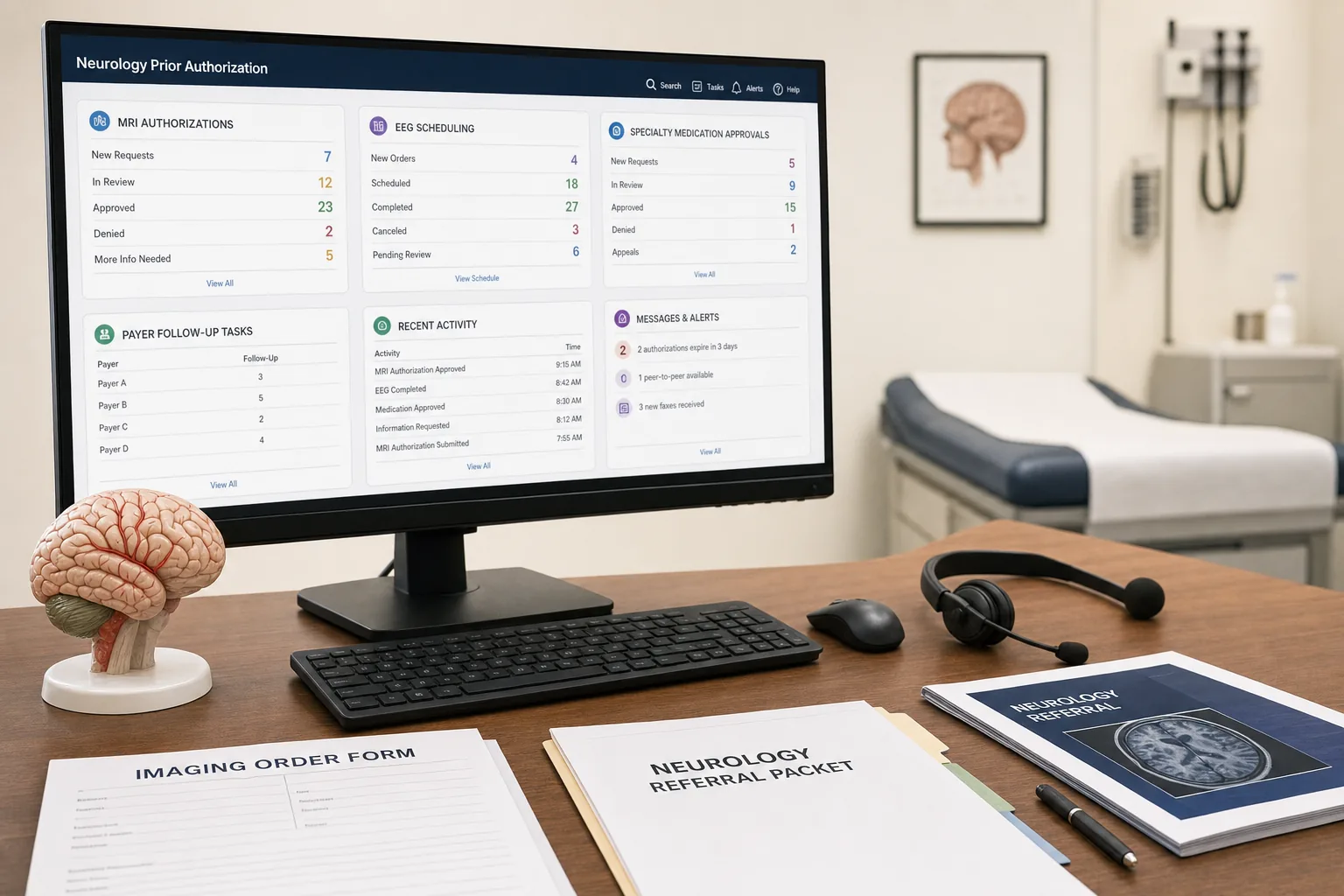
A neurology patient calls on Tuesday. Their neurologist ordered an MRI three weeks ago. The patient’s insurer denied it, requesting additional documentation. Your office manager submitted the documentation last week. The patient wants to know where the approval stands. Your prior auth coordinator is handling two other calls. The MRI scheduler at the imaging center is waiting on the approval before they’ll book the slot.
This is a neurology practice workflow problem. It is not an EHR problem or a staffing problem, though it looks like both. It is a volume and complexity problem that is specific to neurology.
No other specialty deals with the same combination of high-cost imaging (MRIs running $1,500 to $4,500 per scan), specialty medications with strict prior auth criteria (disease-modifying therapies for MS, anti-seizure medications, biologics for migraine), and a patient population with chronic conditions that requires repeated authorizations for ongoing care. Neurology prior auth is its own category of administrative burden.
What makes neurology prior auth harder than other specialties
The prior authorization burden in neurology has three drivers that compound each other.
MRI volume is high and prior auth requirements are aggressive. Neurologists order MRIs for initial diagnosis, treatment monitoring, and follow-up care across a broad range of conditions. Insurers have developed strict medical necessity criteria for neurological MRIs, and the criteria vary by plan. A scan that is clearly appropriate for a patient with multiple sclerosis may require different documentation than the same scan for a patient with new-onset headaches. Each plan has its own form, its own portal, and its own turnaround window.
Specialty medication prior auth is complex and recurring. Disease-modifying therapies for MS, anti-VEGF treatments for certain neurological conditions, and biologics for chronic migraine require prior authorizations that typically need to be renewed annually. A neurology practice managing 20 MS patients on DMTs is managing 20 annual renewal cycles, each requiring documentation of treatment response, side effect profile, and continuing medical necessity. These are not simple checkboxes.
Patients call because they are waiting on care. A cardiology patient waiting on a prior auth is waiting on an elective procedure in many cases. A neurology patient waiting on an MRI or a medication auth is often waiting on care that affects their daily functioning. They call more often than patients in other specialties. Each call is a status inquiry that requires pulling up the prior auth case, checking the payer portal, and giving the patient an update that may or may not be satisfying.
According to the American Medical Association, physicians spend an average of nearly two business days per week on prior authorization tasks. In neurology practices, the time is weighted toward imaging and specialty medication auths, which are consistently among the highest-complexity cases.
Where the workflow breaks down in athenaOne
athenaOne includes a prior authorization management module that tracks auth requests, documents status, and integrates with payer portals for some insurers. For neurology practices, this is a meaningful capability. The problem is that athenaOne manages the tracking; it does not handle the inbound call volume that prior auth generates.
When a patient calls to ask about their MRI authorization status, a staff member must pull up the case in athenaOne, check the current status with the payer, and communicate that status to the patient. If the payer portal shows no update, the staff member has to decide whether to call the payer, send a follow-up on the portal, or tell the patient to check back in 48 hours.
This is a time-consuming workflow. In a neurology practice seeing 50 to 80 patients per week, prior auth status calls can represent 20 to 30% of total inbound call volume. Each call takes five to ten minutes of staff time. The math adds up.
The prior auth coordination problem in neurology is not that practices lack a system for tracking auths. It is that the system requires human staff to handle every patient touchpoint in the process, and patient touchpoints in neurology are frequent.
How AI handles the prior auth communication workflow
AI voice agents integrated with athenaOne handle the communication layer of prior auth without adding staff. The AI answers inbound calls, accesses the patient’s prior auth status from athenaOne, and gives the patient an accurate update, the same update a staff member would give, without waiting on hold.
The patient calling about their MRI authorization reaches the AI. The AI pulls up the case in athenaOne, reads the current status, and communicates it to the patient. If the auth is approved, the AI can help the patient schedule the imaging appointment. If it is pending, the AI can tell the patient the expected timeline and offer to send a text or voicemail update when the status changes. If the auth was denied and is in appeals, the AI routes the call to a clinical staff member who needs to handle the conversation.
Outbound communication is the other half of the workflow. Prior auth processes require status follow-up that eats staff time even when the patient is not calling in. The AI handles outbound notification calls to patients when authorizations are approved or denied, so staff are not making 15 callback calls at the end of each day.
For the medication renewal workflow, the AI can trigger outreach to patients at the appropriate point in the renewal cycle, confirming that the patient is still on the medication, flagging that a prior auth renewal is upcoming, and collecting any updated information the payer requires. This removes the administrative overhead of tracking which patients have renewals due and initiating contact.
The athenaOne integration for neurology workflows
Pretty Good AI’s integration with athenaOne through the Marketplace API covers the data flows that neurology prior auth requires.
The AI reads prior auth case status from athenaOne in real time. When a patient calls, the AI accesses the current state of their authorization cases and can communicate accurate status without a staff member pulling up the record.
The AI writes updates back to athenaOne. When a patient provides new information relevant to their auth case, the AI logs it. When the AI sends an outbound notification to a patient, that communication is recorded in the patient record.
For imaging referrals, the AI can access the referral and associated auth status together, so a patient calling about both their referral and their imaging authorization is getting a complete picture in a single call.
The AI does not make clinical decisions. It does not assess medical necessity or determine what documentation is required. What it does is handle the communication load so that clinical and administrative staff are spending their time on the cases that require judgment, not on status calls that require information retrieval.
What this changes for a neurology practice
The operational impact of reducing prior auth status calls falls primarily on two groups.
Front desk and prior auth coordinators get time back. A neurology practice where 25% of inbound calls are prior auth status inquiries is spending a meaningful share of its staff capacity on calls that do not require clinical judgment. Moving those calls to AI frees up coordinator time for the prior auth work that requires human attention: assembling peer-to-peer review documentation, navigating complex denial appeals, coordinating between the specialist and the payer’s medical director.
Patients get faster information. A patient who can call at 7am and get an accurate prior auth status update without waiting for office hours to open is a less anxious patient. For a neurology population that may include patients with MS, epilepsy, or chronic migraine (conditions where treatment delays have real functional consequences), this matters.
The prior auth problem in neurology is not going away. Insurer utilization management requirements are not getting looser. But the communication overhead around those requirements does not have to fall on staff who have better things to do.
Practical takeaways
- Neurology carries a higher prior auth burden than most specialties because of MRI volume, specialty medication complexity, and frequent patient status calls.
- Prior auth status calls can represent 20 to 30% of inbound call volume at a neurology practice. They require information retrieval, not clinical judgment.
- AI voice agents integrated with athenaOne handle these calls by accessing real-time auth status from the patient record and communicating it to the patient.
- Outbound notification for approvals, denials, and medication renewal reminders reduces staff time spent on proactive status follow-up.
- Staff time freed from status calls goes to prior auth work that requires human judgment: peer-to-peer documentation, complex appeals, payer escalations.
- Neurology practices typically see meaningful reductions in inbound call volume within the first 60 days of AI deployment, with prior auth status calls driving most of the improvement.
The authorization process is not getting simpler. The question is whether the communication overhead around it has to remain a staff burden.
If your neurology practice is running on athenaOne and your prior auth coordinators are spending their days on status calls instead of appeals, see how Pretty Good AI integrates with athenaOne. The AI handles the calls your staff should not have to take. Your staff handles the work that actually requires them.
Sources
Ready to reduce missed calls?
15-minute demo. See how an AI team works inside your athenaOne practice.
Schedule a Demo →Written by Kevin Henrikson