Practice Operations
Prior Authorization is Broken. Here's How AI Voice Fixes It.
The AMA reports 13 hours per week on prior authorizations. See how voice AI automates follow-up, reduces denials, and helps practices measure results.
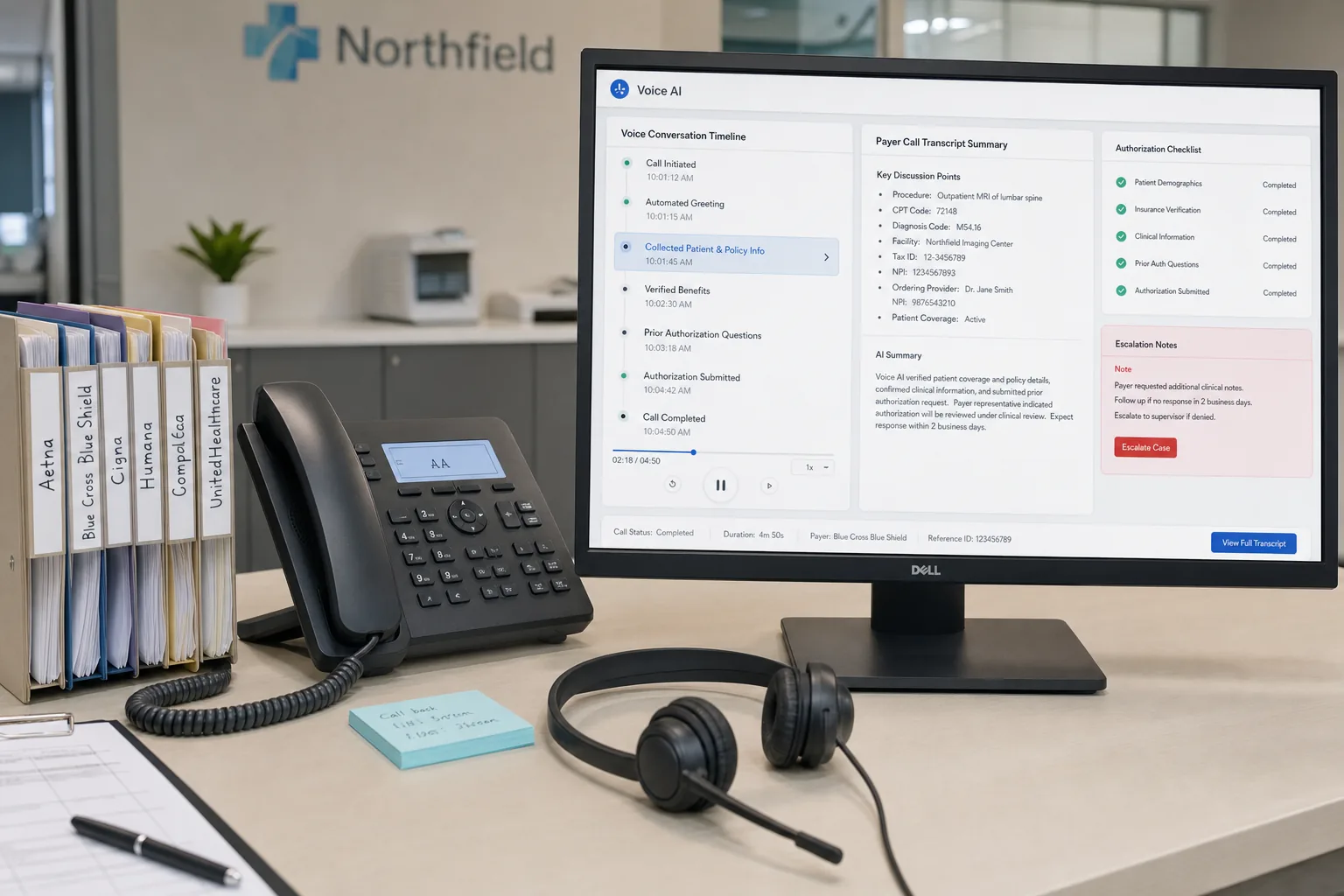
Prior authorization was supposed to control costs. Instead, it’s drowning practices in paperwork and delaying patient care.
The average medical practice spends 13 hours per week, per physician on prior authorizations, a figure the AMA’s 2024 Prior Authorization Physician Survey notes includes both physicians and their staff. At $35/hour for administrative staff, that’s roughly $23,000 per physician annually just managing insurance approvals.
And it’s getting worse. 95% of physicians report that prior authorization delays access to necessary care (2025 AMA Prior Authorization Physician Survey), and 80% of denials are later overturned on appeal, meaning most rejections shouldn’t have happened in the first place.
The manual process is broken:
- Staff spend long stretches on hold with insurance companies (35% of practices spend upwards of 35 minutes on average per request, MGMA)
- Fax machines (yes, still) send incomplete forms
- Follow-ups fall through the cracks
- Patients wait weeks for approvals while conditions worsen
- Practices eat the cost of appeals and resubmissions
Voice AI is changing this. Not by replacing clinical judgment, but by automating the administrative burden that shouldn’t exist in 2026.
Want to see this in action? Schedule a 15-minute workflow demo
The current state: death by a thousand faxes
Here’s what prior auth looks like at most practices today:
- Step 1: Patient needs a procedure or medication flagged for prior auth
- Step 2: Front desk staff manually fills out a form (often incomplete)
- Step 3: Form is faxed to insurance company
- Step 4: Staff calls to confirm receipt (35% of practices spend upwards of 35 minutes on average per request, MGMA)
- Step 5: Insurance processes request (turnaround: 3-7 business days)
- Step 6: If denied, staff appeals (which adds additional time)
- Step 7: Patient finally gets care, or gives up and pays out-of-pocket
This process repeats 30-40 times per week for a mid-sized practice. Some specialties (orthopedics, pain management, cardiology) see 100+ prior auths monthly.
The real costs:
The figures below are a worked example, not measured benchmarks. Your numbers will vary with call volume, payer mix, and revenue per visit.
- Direct labor: $26K-$45K per physician annually
- Denied claims: $5K-$15K in appeals and resubmissions
- Patient attrition: assume some share of patients abandon treatment after long delays; use your own no-show and cancellation data
- Staff burnout: prior auth is consistently cited by staff as one of the most frustrating parts of the job
You can’t hire your way out of this. The system is the problem.
How AI voice automation works
Voice AI doesn’t just speed up the broken process, it redesigns it.
Automated submission
When a prior auth is needed (triggered by CPT codes like 73721 for a knee MRI or J0135 for a Humira injection), the AI agent:
- Pulls clinical data from your EHR (ICD-10 diagnosis codes, CPT codes, clinical notes)
- Populates payer-specific forms automatically from structured EHR data, eliminating manual transcription errors
- Submits via the payer’s preferred channel (portal, fax, or API)
- Confirms receipt within minutes
Result: Zero manual data entry. Zero incomplete forms. Zero fax failures.
Intelligent follow-up
The AI doesn’t just submit and forget. It:
- Calls the payer to verify receipt and expected turnaround
- Checks status daily until approval or denial
- Escalates urgent cases (surgery within 48 hours, urgent medications)
- Logs all interactions in your EHR automatically
Result: No more lost submissions. No more guessing when you’ll hear back.
Automated appeals
If a prior auth is denied, the AI:
- Captures the denial reason and reference number
- Assembles the documentation your staff need to respond
- Drafts the peer-to-peer request or written appeal for clinician review
- Submits on your clinical team’s approval, within 24 hours (before the trail goes cold)
Result: appeals go out on time with the documentation attached, instead of expiring in a queue. The AMA survey figure above is the reason that matters: most denials that are appealed are overturned.
Real-time status for patients
Your front desk staff, and patients, get instant visibility:
- “Your prior auth was submitted this morning and confirmed received”
- “Insurance is processing, expected decision by Friday”
- “Approved! You can schedule your procedure”
Result: Patients stop calling for updates. Staff stop playing phone tag with payers.
See how this works for your specialty
The ROI: measure the labor your practice can remove
Prior authorization is not one workload. It includes submitting medical and procedure authorizations, checking the status of existing authorizations, and handling the follow-up, denials, and resubmissions around both. Status-check calls alone can consume a large share of staff time because each one means another payer phone tree, portal lookup, or patient callback.
The cleanest business case starts with a practice time study:
- Hours spent each week on medical prior auth submissions
- Hours spent on procedure authorizations and documentation requests
- Hours spent checking existing authorization status and answering patient calls
- Denials, appeals, and resubmissions that require staff follow-up
Voice AI can remove the repetitive communication and tracking work while routing clinical documentation and judgment to the practice. Compare the measured staff time released, authorization turnaround, and denial follow-up against your own labor cost and payer mix rather than relying on a universal savings total. Discuss the workflow with our team.
Integration: how it actually works
The workflow requires connections between your EHR, insurance payers, and voice AI.
EHR integration
Direct read/write access to:
- Patient demographics and insurance eligibility
- Clinical documentation (H&P, progress notes, orders)
- Diagnosis and procedure codes (ICD-10, CPT)
- Prior auth tracking fields
Pretty Good AI builds this integration for athenaOne, and only athenaOne. One EHR, engineered properly, is what makes the read/write access above dependable instead of approximate.
Payer connectivity
Each insurance company has different requirements:
- Portal-based: AI logs in and navigates payer portals (Blue Cross, Aetna, Cigna)
- API-based: Direct integration for payers with modern infrastructure (UnitedHealthcare, Humana)
- Fax/phone hybrid: AI handles legacy channels when necessary
The AI learns each payer’s quirks, which fields are required, what documentation they want, how to escalate urgent cases.
HIPAA compliance
All interactions are:
- Encrypted end-to-end (TLS 1.3)
- Logged for audit trails
- BAA-covered. The Pretty Good AI platform has attained HITRUST i1 certification. Pretty Good AI signs a HIPAA Business Associate Agreement (BAA) before any patient data is touched. SOC 2 Type II and ISO 27001 audit reports are available upon request.
- Role-based access controls
No patient data is used for training. All voice recordings are transcribed and stored under HIPAA safeguards.
What about complex cases?
AI handles the routine prior auths without staff involvement. How large that share is depends on your payer mix and specialty, and it is one of the first numbers we measure with you. Complex cases get routed to staff with:
- Pre-filled forms, with the remaining fields flagged for staff
- Suggested clinical documentation
- Payer-specific tips based on past approvals
The goal isn’t to replace clinical judgment; it’s to remove administrative friction so your staff can focus on cases that actually need human expertise.
Implementation: what to expect
- EHR integration and payer credential setup
- A supervised test batch of prior auths, reviewed with your staff
- Production rollout with monitoring
- Optimization based on your denial patterns
Most practices are live in 3 to 6 weeks.
The bigger picture
Prior authorization is just one workflow. But it shows what AI voice can do in healthcare operations.
If an AI can navigate insurance bureaucracy, the most dysfunctional corner of healthcare, it can handle:
- Insurance verification and eligibility checks
- Referral coordination
- Benefits explanation
- Claims status inquiries
- Patient payment plans
- Scheduling and no-show reduction
Practices losing revenue to missed calls face the related missed-calls problem that voice AI also solves.
The pattern is the same: take the administrative burden off human staff so they can focus on patient care.
Getting started
If your practice is drowning in prior auths, start here:
- Audit your current process: track how many hours per week staff spend on prior auth
- Calculate your cost: $35/hour x hours = your baseline
- Identify your biggest pain: is it denials? Delays? Staff turnover?
- Start with one high-volume provider: measure the hours and follow-up work released before full rollout
The bottom line
Prior authorization won’t disappear. Insurance companies have no incentive to make it easier.
But you don’t have to accept the status quo. Voice AI can take the routine administrative burden off your staff, get appeals out on time, and get patients into treatment faster.
The question isn’t whether to automate prior auth. It’s how much longer you’ll let your staff burn out on fax machines.
Ready to automate your prior auth workflow?
See How It Works in Your Practice
A 15-minute live demo shows voice AI handling a real patient call, scheduling, insurance verification, and EHR lookup. No slides, no pitch deck.
Book a 15-Minute Demo →Written by Kevin Henrikson