Practice Operations
Provider Schedule Optimization for Practices
Scheduling micro-gaps leave provider capacity unused. Learn how AI can analyze appointment patterns, fill cancellations, and protect provider time over time.
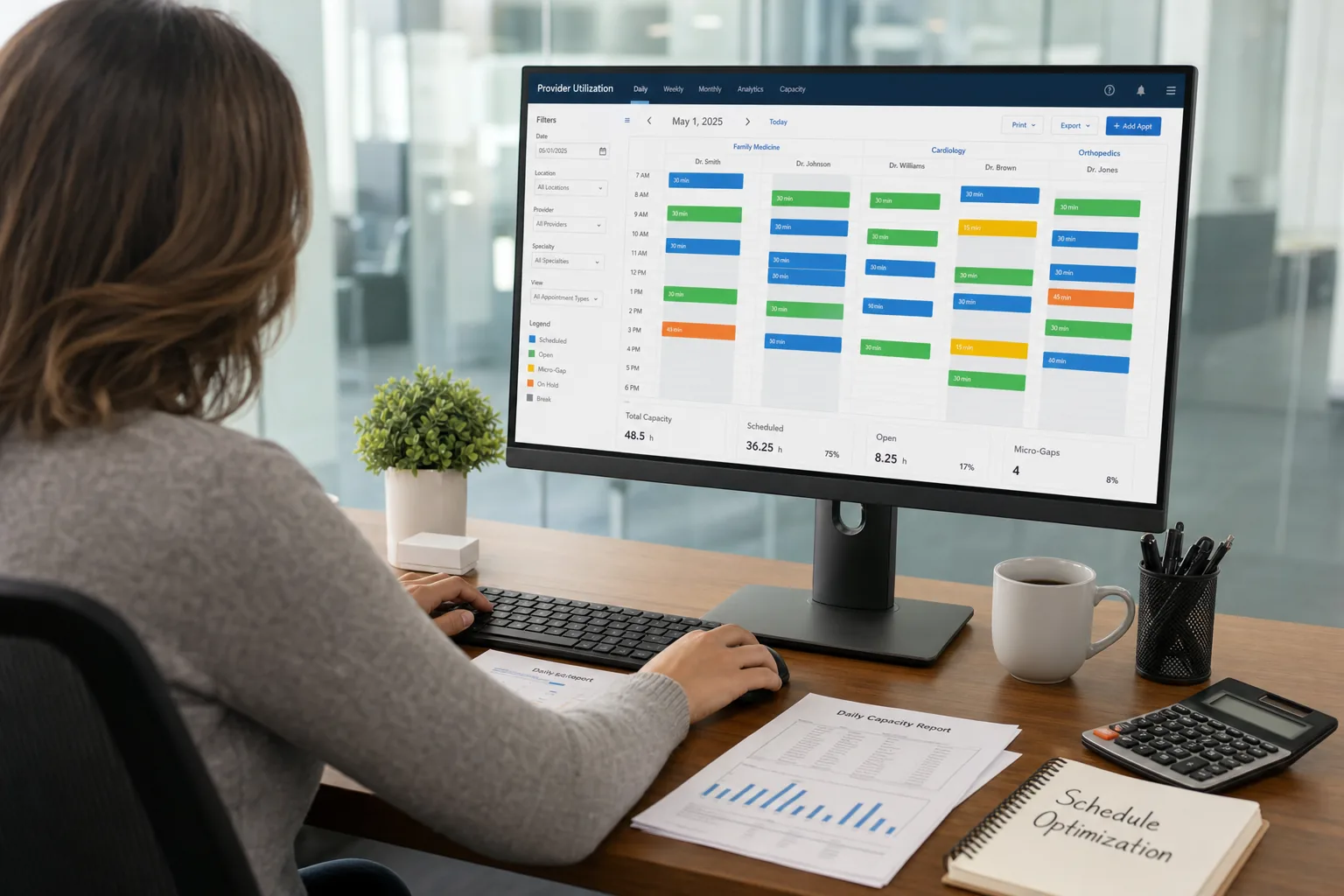
It’s Thursday at 3:15 PM. Dr. Martinez’s last patient just checked out. Her schedule shows she’s booked until 6:00 PM, but her actual appointments ended 2 hours and 45 minutes ago.
Why? Because her calendar is riddled with 8-minute gaps, 12-minute holes, and awkward 23-minute spaces, what schedulers call “micro-gaps,” that your front desk couldn’t fill. They’re not standard appointment sizes. They don’t fit the templates. Manual schedulers call them “dead air.”
Dr. Martinez calls them “early Thursdays.”
Your practice calls them normal.
They’re not normal. They’re expensive.
Many practices operate well below full provider capacity, which means hours every week of paid provider time with no patients.
The cost: $93,000 to $180,000 per provider, per year, in lost revenue.
For a 5-provider practice, that’s up to $900,000 annually. Right there on your calendar.
This is the micro-gap problem. And manual scheduling cannot solve it.
Why schedulers can’t Tetris fast enough
Your front desk staff are not the problem. The cognitive load is.
A scheduler answering a call has 30 seconds to decide. They must:
- Check 5+ provider schedules
- Match appointment type to duration
- Consider patient preference, insurance, location
- Avoid double-booking
- Make the call (while 3 more calls wait)
At 300 scheduling calls per day, that’s 300 split-second decisions made under pressure.
The result is simple: schedulers default to first-available, not best-available. They book the obvious slot, not the optimal slot. They under-utilize to avoid conflicts. They leave gaps because filling an 11-minute hole with a 15-minute appointment creates downstream chaos.
It’s not poor training. It’s impossible math.
Manual scheduling creates five specific problems:
- Template rigidity: EHR templates assume all “follow-ups” take exactly 15 minutes (they don’t)
- No backfill system: When a 2:30pm cancellation creates a gap, there’s no way to systematically find and contact waitlist patients who could fill it
- Cognitive overload: Staff cannot optimize 5 schedules at once while answering phones
- Fear of overbooking: Better to leave a slot empty than risk double-booking and upsetting a provider
- Template drift: “Annual physicals” scheduled for 30 minutes consistently run 42 minutes, but nobody updates the template (so the 3pm appointment starts at 3:17pm all week)
The pattern is common: a practice can be fully booked for weeks while providers leave early each day. Patients complain they cannot get appointments, while providers complain about downtime. Everyone can be right.
That’s the micro-gap problem in one sentence.
How AI recovers the lost hours
Pretty Good AI’s Scheduling tool doesn’t just automate booking. It optimizes capacity through four methods manual schedulers can’t execute:
1. Micro-gap filling
AI scans all provider schedules at once (not one by one like humans must). It finds odd-sized gaps (7 min, 11 min, 22 min) and matches them to appointment types that actually fit.
A quick med check that takes 8 minutes? AI routes to that 10-minute gap at 2:18pm instead of taking a standard 15-minute slot. That 15-minute slot stays open for an appointment that actually needs it.
Result: more appointments fit into the same schedule without extending hours. How many depends on your template mix; the model below shows how to estimate it.
2. Template balancing
AI tracks how long appointments actually take (not how long they’re scheduled for). When “new patient consults” consistently run 38 minutes but templates allocate 30, the system flags it.
Recommendation: Adjust templates now, or accept that your afternoon will run 30 minutes behind by 3pm.
Most practices discover their templates haven’t been updated in 4-7 years. They’re scheduling based on 2018 workflows. Learn more about why voice AI needs EHR integration to work.
3. Smart overbooking
AI analyzes no-show rates by:
The figures below are a worked example, not measured benchmarks. Your numbers will vary with call volume, payer mix, and revenue per visit.
- Appointment type (new patients typically no-show far more often than established patients)
- Day of week
- Patient demographics (age, insurance, previous no-show history)
Then it selectively overbooks low-risk slots.
Not aggressive overbooking that creates lobby chaos. Precise, data-driven capacity recovery that acknowledges reality: some patients will cancel, and your schedule should expect it.
Practices can compare empty slots caused by no-shows before and after smart overbooking. See how reducing no-shows protects capacity.
4. Automated waitlist backfill
When a cancellation hits, AI immediately:
- Finds waitlist patients who match appointment type, provider, time window
- Reaches out via voice or SMS: “Dr. Lee has an opening tomorrow at 2:30pm. Want it?”
- Books confirmed patients in real-time
No staff time required. No manual list-checking. Cancellation at 4:47pm? Slot filled by 5:03pm.
Manual waitlist management fills a minority of canceled slots, because staff do not have time to call ten people. Automated backfill contacts them all at once; the fill rate is the metric to compare against your baseline.
The result should be measured against your own baseline. For a worked example, assume five providers each recover five hours per week, a blended capacity value of $300 per hour, and 48 working weeks:
5 providers × 5 hours/week × $300/hour × 48 weeks = $360,000 illustrative annual opportunity
Illustrative model: a 30-provider specialty practice
This is a worked model, not a measured customer result. Assume a 30-provider specialty group on athenaOne with these starting assumptions:
Assumed starting point:
- Provider capacity: 78% (typical for specialty care)
- 4.2 hours per provider per week in unfilled micro-gaps
- Waitlist managed manually (30% fill rate on cancellations)
- Templates causing 15-20 minute delays by afternoon
Assumed outcome after 90 days:
- Provider capacity: 89%
- Micro-gaps down to 1.8 hours per provider per week
- Waitlist backfill: 68% fill rate (automated)
- Template adjustments reduced delays to under 5 minutes
Money impact:
- 30 providers x 11% capacity gain x 40 hours/week x $300/hour x 48 weeks = $1.9M illustrative first-year opportunity
Who gets the most value?
Scheduling AI delivers highest ROI for practices with:
- High call volume (200+ patient calls/day): more decisions mean more optimization opportunities
- Multiple providers (5+): larger search space for micro-gap matching
- High no-show rates (12%+): smart overbooking recovers more lost capacity
- Specialty workflows: variable appointment durations (neurology, pain management, GI, ortho)
- Multi-location setup: centralized queue + cross-location backfill
- Growth goals: need to scale revenue without adding providers or staff Learn how growing practices use AI instead of hiring
If your practice already runs at 92%+ provider capacity with minimal no-shows, Scheduling AI offers less upside.
But if you’re in the 70-85% range (where most specialty practices sit), you’re losing $100K-$200K per provider per year.
This only works with live EHR connection
Scheduling AI requires live, two-way EHR connection. Here’s why:
- Read access: AI must see current schedules, past appointment durations, cancellation patterns, patient data, provider preferences
- Write access: AI must book appointments, update waitlists, flag template issues
- Real-time sync: If data is stale (>5 minutes old), micro-gap filling breaks (slots get double-booked or missed)
- Audit trail: Every AI decision must log to EHR for compliance and staff review
Pretty Good AI connects directly to athenaOne. No middleware. No delay. Systems that sit outside your EHR and treat it like a black box cannot optimize capacity. Read why EHR integration is non-negotiable for voice AI.
Bolt-on scheduling tools can automate booking into available slots. But they cannot optimize capacity. You get a faster version of the same broken process.
What happens to your schedulers?
Scheduling AI does not replace front desk staff. It shifts them from low-value work (finding open slots, calling waitlists) to high-value work (handling complex cases, managing provider preferences, solving patient problems).
Practices can track:
- Routine scheduling calls handled without manual intervention
- Staff focus on exceptions: multi-provider procedures, special accommodations, insurance issues, difficult situations
- Lower burnout: track staff workload and retention as routine scheduling work moves into automation. See how AI can support staff
AI doesn’t eliminate scheduling jobs. It makes them tolerable.
What to expect during setup
Most practices go live in 3 to 6 weeks:
- EHR connection tested, workflow mapping with your team, staff training
- First workflow live on a subset of calls; template recommendations surface
- Expand the workflows in scope and activate micro-gap filling
Measure capacity changes and return on investment against your baseline as the workflow expands.
The bottom line
Your EHR’s scheduling tool is a digital calendar. It books appointments. It does not optimize capacity.
That’s like using Excel as a calculator and ignoring every other feature. It works. But you’re leaving most of the value on the table.
Scheduling AI analyzes thousands of scheduling decisions per week, spots patterns human schedulers cannot see, and systematically recovers capacity hiding in micro-gaps.
For a 5-provider practice, the worked example above puts the illustrative opportunity in the hundreds of thousands of dollars per year; your own baseline decides the real number.
The question isn’t whether you can afford Scheduling AI.
It’s whether you can afford to keep paying providers for empty hours.
See How It Works in Your Practice
A 15-minute live demo shows voice AI handling a real patient call, scheduling, insurance verification, and EHR lookup. No slides, no pitch deck.
Book a 15-Minute Demo →Written by Kevin Henrikson