Practice Operations
Pulmonology After-Hours Call Intake and Triage
Pulmonology after-hours calls range from CPAP questions to clinical concerns. AI voice agents capture structured intake and escalate calls to clinicians.
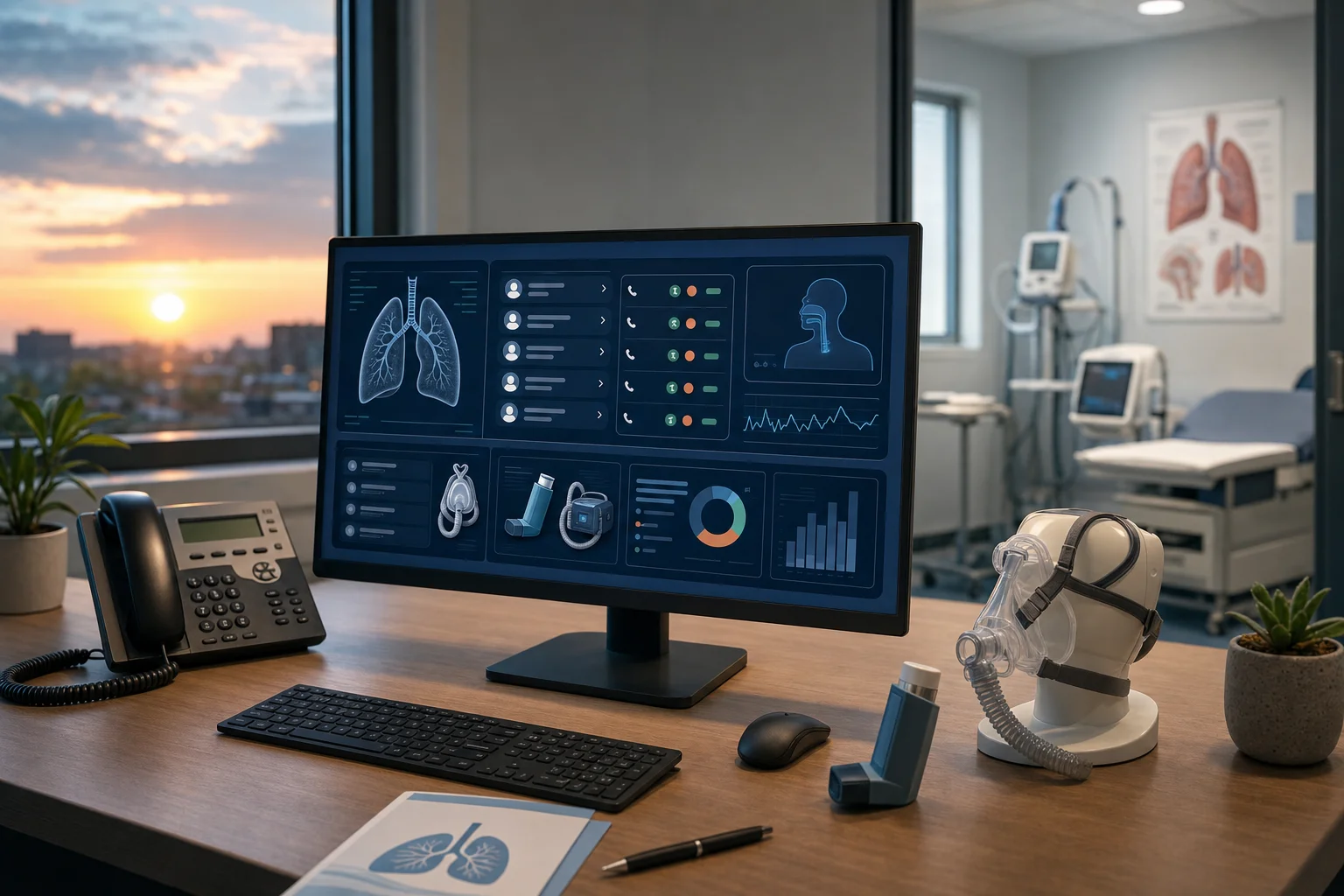
Pulmonology after-hours calls sit on a fault line. A COPD patient calls at midnight because they feel more short of breath than usual. That could be a normal bad night with a chronic condition, or it could be an exacerbation heading toward respiratory failure. The words the patient uses, “I can’t catch my breath”, sound the same either way. The difference is in the details, and sorting those details after hours is exactly where most practices struggle.
The call volume is dominated by manageable questions: CPAP problems, inhaler technique, medication timing, oxygen equipment. But breathing is the one symptom where a delayed response can turn deadly fast. Any after-hours system for pulmonology has to handle the routine majority efficiently while never missing the patient who is actually decompensating.
Why pulmonology after-hours volume is different
Respiratory conditions are chronic, symptomatic, and anxiety-provoking at night. Lying flat makes breathing harder. Cough worsens in the dark. CPAP masks leak, machines alarm, and sleep apnea patients wake up frustrated at 2 a.m. COPD and asthma patients live with a baseline level of breathlessness and have to constantly judge whether tonight is worse than usual.
That judgment belongs to clinicians. Patients call because they need a response, and without structured intake a leaking CPAP question lands in the same queue as a potentially serious clinical call.
The clinical stakes are high. Respiratory distress can escalate quickly. That single fact means a pulmonology after-hours system cannot lean toward reassurance by default. It has to be built to catch the decompensating patient every time, while still handling the equipment questions without waking the on-call physician.
What pulmonology after-hours calls actually look like
The call mix breaks into four groups.
Equipment and device calls are the largest and most routine. CPAP and BiPAP mask fit, leaks, pressure discomfort, machine alarms, humidifier issues, and supply reorders. Home oxygen concentrator questions. Nebulizer troubleshooting. These are logistical, well-documented, and almost never require a physician after hours.
Medication and inhaler questions are the second group. Inhaler technique, rescue-versus-maintenance confusion, missed doses of controller medications, questions about prednisone tapers, or whether it is time to start a rescue course. Some need clinical input; many are answerable from the patient’s documented care plan.
Symptom-check calls are where the judgment lives. “I’m more short of breath than usual.” “My cough is worse.” “My chest feels tight.” These require structured questioning to place them on the spectrum from stable-chronic to acute-exacerbation. This is the group that cannot be handled generically.
Calls that need urgent escalation are the minority by count but the reason the system exists. Severe or rapidly worsening breathlessness, chest pain, blue lips or fingertips, confusion, oxygen saturation dropping on a home monitor, inability to speak in full sentences. These need a clinician immediately, and the risk is that they arrive undifferentiated alongside the CPAP question.
Why answering services fail respiratory patients
Most practices cover after hours with an answering service or direct on-call physician routing. Answering services fail respiratory patients because they have no chart access and no pulmonary context.
When a COPD patient calls about worsening shortness of breath, the answering service does not know their baseline, their oxygen requirement, whether they have a rescue action plan, or how many exacerbations they have had this year. Without that, “more short of breath than usual” is impossible to interpret. So the service either escalates everything, burying the on-call physician in CPAP questions, or falls back on generic guidance that under-serves the patient who is genuinely decompensating.
For a symptom where minutes matter, a generic answering service is not just inefficient. It is a safety gap, and none of the caller’s context is documented where the care team will see it the next day.
What AI can actually handle
AI voice agents integrated with a pulmonology EHR change the equation because they know the patient before the call starts.
When a patient calls at midnight short of breath, the agent identifies them against athenaOne and captures what they report in a structured intake. It checks the practice’s red-flag screen, routes emergency indicators to 911 or the appropriate emergency service, and sends other clinical concerns to the on-call clinician. It does not diagnose or decide the clinical outcome.
“I’ll capture what you’re reporting and connect this to the on-call team. What happened, when did it start, and what should the clinician know before they call you back?”
Those questions capture the caller’s account and screen for practice-defined red flags. The agent does not walk anyone through rescue steps; clinical concerns are escalated with a structured summary.
The categories AI handles well are equipment logistics, appointment and records requests, and refill requests entered into the provider-approved workflow. Clinical questions go to the practice’s clinicians.
The categories AI does not decide: anything suggesting respiratory decompensation. Severe breathlessness, chest pain, cyanosis, confusion, falling oxygen saturation, inability to speak in sentences. These route to on-call coverage immediately with a structured summary prepared.
The escalation path
A structured AI intake for pulmonology after-hours works like this.
The patient calls. The agent identifies them against athenaOne, captures the reported concern and timing, and prepares the chart context for the practice’s clinicians.
Structured intake begins. What are you calling about? When did it start? What has changed? The agent records the answers and checks practice-owned red flags without interpreting symptoms or making a clinical decision.
Administrative requests can be completed or routed and logged to the chart. Any clinical concern is escalated to the practice’s clinicians rather than held for a morning callback.
Any clinical concern is connected to on-call coverage with a structured summary: patient name, what they reported, when it started, and the full conversation. The clinician makes the clinical decision.
The athenahealth integration advantage
For pulmonology practices on athenahealth, native EHR integration makes a useful breathing-call handoff possible.
Without integration, an AI agent works from whatever is passed at call setup. With athenahealth integration, it can identify the patient, attach the structured intake to the chart, and give the pulmonologist relevant context before the callback. The clinician decides what the report means and what happens next.
Integration also closes a documentation gap. Every after-hours interaction, AI-handled or escalated, is logged back to the chart. When the patient comes in for their next visit, the pulmonologist can see they called about worsening breathlessness, what they reported, and how the call was routed. Continuity between after-hours contact and clinic follow-up is a known weak point in chronic respiratory care. Automatic charting closes it.
What implementation requires
Deploying AI for pulmonology after-hours coverage requires several things done right.
Practice-owned routing. Breathing complaints are not the place for aggressive automation. Pulmonologists who take call should define the red-flag screen and routing rules; emergencies go to 911 or the appropriate emergency service, and other clinical questions escalate to the practice.
Physician buy-in before go-live. The on-call pulmonologist needs to trust the structured handoff and practice-owned routing. The setup phase should include physicians reviewing and approving the workflow before any patient is routed through the system.
Transparency with patients. Patients should know they are speaking with an AI that asks structured questions and connects them to a clinician for anything urgent. Respiratory patients are anxious for good reason; clarity builds cooperation.
Morning review as a standard step. Every after-hours call should queue for care-team review the next morning. This creates accountability, catches edge cases, and improves the protocol over time.
Why this matters beyond call volume
The on-call burden in pulmonology is real, and the mix of routine equipment calls and genuine emergencies makes it draining. A system that handles CPAP and inhaler questions without a page keeps the on-call physician sharp for the exacerbation that calls at 3 a.m. That is a safety argument as much as a quality-of-life one.
The documentation benefit compounds. When a patient calls about a CPAP leak, that interaction is on the chart before the next visit. The pulmonologist can address recurring equipment problems proactively instead of hearing about them for the first time months later. Better continuity and better equipment follow-up.
Answering services deliver none of that. The physician still gets paged, and the interaction disappears.
Key takeaways
- Pulmonology after-hours calls range from routine CPAP and equipment questions to clinical concerns that require a clinician
- Answering services cannot create a useful respiratory handoff because they lack the patient’s chart context
- AI integrated with athenahealth identifies the patient and gives the pulmonologist relevant respiratory context before the callback
- Clinical questions route to on-call physicians with a full structured summary prepared
- Every interaction is charted in real time, closing the continuity gap in chronic respiratory care
- Practice-owned routing rules and pulmonologist sign-off before go-live are non-negotiable in this setting
Pulmonology after-hours call volume is not going away as long as patients manage chronic respiratory disease at home. AI intake can handle equipment logistics and administrative requests while routing clinical concerns to the on-call pulmonologist with structured context.
Sources
- Global Initiative for Chronic Obstructive Lung Disease, 2025 GOLD Report: evidence-based strategy for COPD diagnosis, management, and prevention. https://goldcopd.org/2025-gold-report/
Internal links
Ready to reduce missed calls?
See how Pretty Good AI handles after-hours calls for pulmonology practices
Talk to our team →Written by Kevin Henrikson