Practice Operations
Pulmonology Prior Auth for Respiratory Drugs
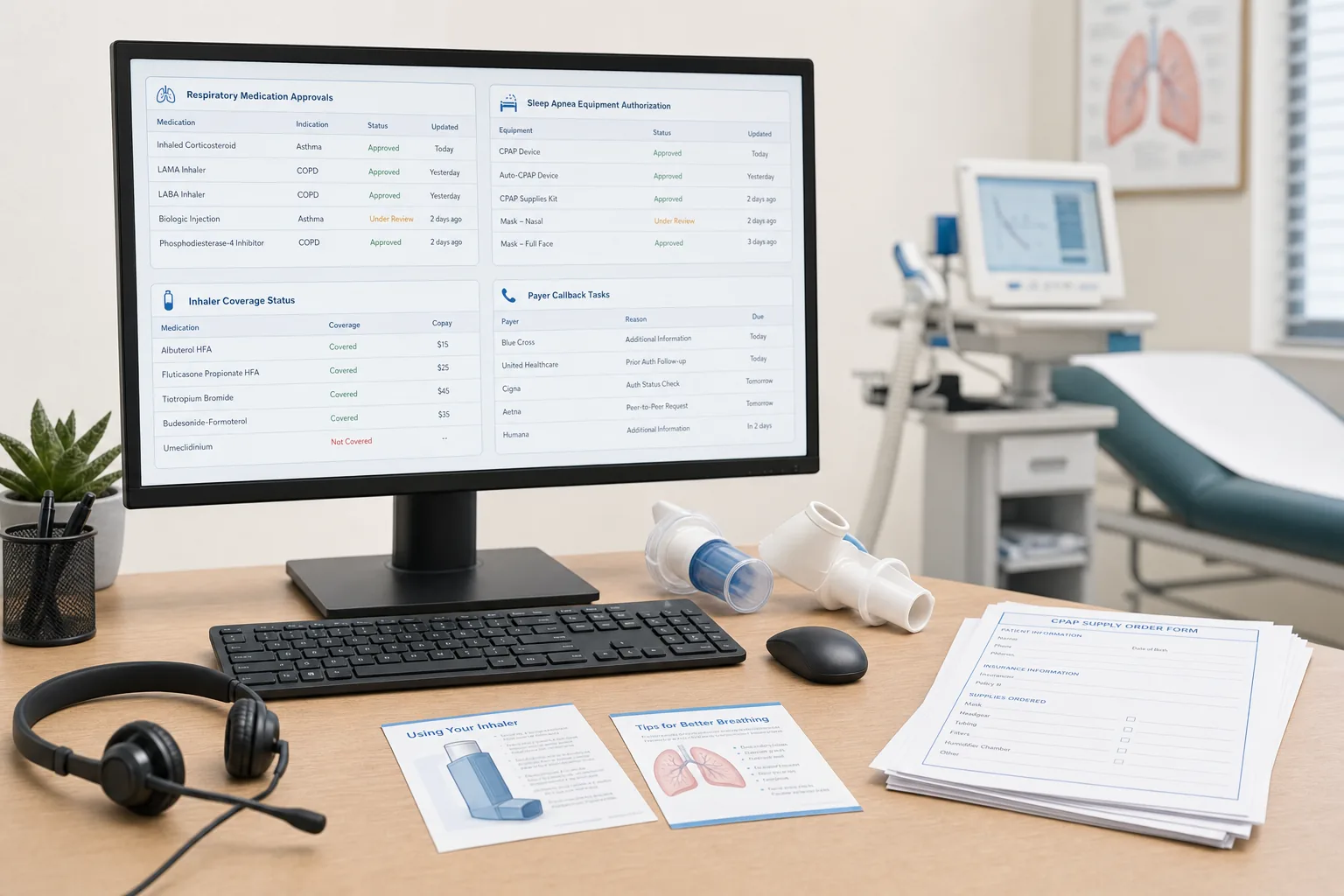
Pulmonology practices battle prior auth for inhalers, biologics, and sleep apnea equipment while managing high-call-volume COPD and asthma patients. AI voice agents reduce the authorization burden and handle patient calls in athenahealth.
A pulmonology patient with severe asthma needs to start a biologic therapy. The medication typically lists between $30,000 and $60,000 annually; payer analyses put average biologic cost for severe asthma at roughly $36,000-$40,000 per patient per year. The insurer wants documentation of IgE levels, eosinophil counts, failed step-therapy with two previous controller medications, and the prescribing physician’s clinical rationale. The prior auth timeline is 7-14 business days.
Your billing specialist submits the request. The patient calls twice a week to ask if it’s approved. The insurance company loses the fax once. You resubmit. Two weeks later, the approval lands. The patient has been symptomatic for a month waiting.
This is pulmonology prior authorization at its worst. And it’s not the exception - it’s the standard experience for practices prescribing biologics, specialty inhalers, and home respiratory equipment for their sickest patients.
Pulmonology practices carry a prior authorization burden that comes from two directions: the high cost of respiratory biologics that require extensive step-therapy documentation, and the steady volume of authorization requests for inhalers, sleep apnea equipment, and pulmonary function testing that are routine in volume but still require staff time. AI voice agents are handling the inbound patient communication layer around prior authorization - status calls, documentation requests, appeal follow-up routing - so staff can focus on the submissions themselves.
The prior auth picture in pulmonology
Pulmonology’s prior authorization requirements come from three distinct categories:
Biologic therapies for severe asthma
The biologic class for severe asthma (dupilumab, mepolizumab, omalizumab, benralizumab) represents some of the most documentation-intensive prior authorization in outpatient medicine. Payers require:
- Biomarker documentation (IgE, eosinophil counts, FeNO where applicable)
- Step-therapy failure documentation (typically 2+ controller medications at maximum tolerated dose)
- Asthma control questionnaire or spirometry results
- Emergency department visits or hospitalization history
- The specific biologic and dosing regimen with clinical rationale
A single biologic prior auth can take 2-4 hours of staff time to compile and submit. Denials and appeals add another 2-3 hours per case. For a pulmonology practice prescribing 10-15 biologics per year, that’s 40-80 staff hours annually on biologic prior auth alone.
Inhaler prior authorization and step therapy
Commercial payers impose step therapy requirements on specialty inhalers. A patient who needs a specific LAMA/LABA combination may first need documentation of failure with cheaper alternatives - even if the prescribing physician has clinical reasons to start with the preferred agent.
ICS/LABA combinations, LAMA agents, and rescue inhalers with preferred-brand tiers all generate prior auth requests that, individually, take 20-30 minutes each. For a practice with 300+ active COPD and asthma patients, inhaler prior auth is a persistent background workload.
CPAP and home respiratory equipment
When pulmonologists diagnose and manage obstructive sleep apnea, the prescription for CPAP equipment requires prior authorization based on sleep study documentation. Home oxygen therapy and home nebulizer equipment have their own documentation requirements. Medicare requires a one-time CPAP adherence check between days 31 and 91 and home oxygen recertification at 3 or 12 months depending on the qualifying group; many commercial and Medicaid plans issue home-equipment authorizations in limited increments that must be renewed on the plan’s schedule.
The patient call problem in pulmonology
Pulmonology patients - particularly those with COPD, severe asthma, and pulmonary fibrosis - call their practices frequently. The conditions are chronic, fluctuating, and anxiety-generating. Patients want to know whether their medication is approved, whether the exacerbation they’re experiencing warrants an ER visit, and how to manage symptom changes between office visits.
Prior auth status calls are the highest volume administrative inquiry. A patient prescribed a biologic calls every few days to ask if it’s been approved. AI checks athenahealth for current authorization status and gives a direct answer. If it’s pending an appeal, the AI provides the status and offers a billing callback.
Symptom screening calls require a more careful practice-owned workflow. COPD and asthma patients calling with acute symptom changes can be screened against red flags supplied by the practice - increasing dyspnea and reduced peak flow are different from mild symptom variation. AI captures the details, routes emergency indicators to 911 or the appropriate emergency service, and sends other clinical concerns to the on-call provider while handling routine status calls without clinical staff involvement. It does not diagnose or decide the clinical outcome.
CPAP and equipment questions are largely protocol-driveable. Patients calling with CPAP mask fit issues, humidity settings, or pressure adjustment questions can be routed to the respiratory therapist or equipment vendor through an AI screening and routing flow.
Where AI fits in the pulmonology prior auth workflow
AI doesn’t write the biologic prior auth submissions. That requires clinical judgment and knowledge of payer-specific requirements that is legitimate specialist work.
AI handles the surrounding communication:
Inbound patient status calls When a patient calls asking whether their dupilumab prescription is approved, that answer is in athenahealth. The AI checks the auth record and gives the patient a status update. For pending cases, it offers a timeline estimate and a billing callback for complex situations. Staff handling the actual submissions aren’t interrupted by every status inquiry.
Documentation request routing When a payer requests additional documentation to support a prior auth - more common in respiratory biologics than in most specialties - that request needs to reach the right clinical staff quickly. AI handles the inbound notification, logs it in athenahealth with an urgency flag based on patient appointment proximity, and queues it for clinical staff action.
Reauthorization expiration alerts CPAP equipment reauthorizations, home oxygen reauthorizations, and some biologic reauthorizations require renewal on a schedule. AI tracks authorization expiration dates in athenahealth and triggers outbound staff alerts when renewals fall due, preventing the gap where a patient’s equipment authorization lapses and coverage interrupts.
Post-denial patient notification When a prior auth is denied, the patient needs to be notified and the appeals process needs to be explained. AI handles the initial outbound notification call, provides factual information about the denial and the next steps, and routes patients with questions about the appeal to billing.
The COPD patient population
COPD patients represent a high-contact population in pulmonology. They have exacerbations, medication side effects, and anxiety about their disease trajectory. They are often older, may have limited comfort with patient portals, and prefer phone contact.
The call patterns from COPD patients:
- Exacerbation calls (“I’m more short of breath than usual”)
- Medication refill requests (particularly for rescue inhalers and oral corticosteroids)
- Prior auth status for inhalers and biologics
- Questions about activity and diet during exacerbation
- Follow-up scheduling after hospitalizations
AI handles the administrative and screening layers of these calls, separating reports that match practice-defined red flags from calls that need billing or scheduling response - without requiring front desk staff to make that judgment for every inbound call during peak hours. Clinical decisions remain with the practice.
What pulmonology practices get from AI
For a 3-physician pulmonology practice with 300+ active COPD and asthma patients:
Prior auth status call deflection: The single highest-volume administrative inquiry in pulmonology - “is my medication approved?” - handled through AI lookup without staff interruption.
Biologic prior auth workflow support: Documentation request routing and patient notification around biologic prior auth reduces the communication overhead that surrounds each high-stakes submission.
COPD symptom screening support: A practice-owned red-flag screen that separates emergency and urgent symptom calls from routine administrative calls, so clinical staff focus on the calls that need them.
CPAP and equipment call routing: Home respiratory equipment questions route appropriately without front desk triage on every call.
Key takeaways
- Pulmonology prior auth comes from three distinct tracks: respiratory biologics (high documentation burden), inhaler step therapy (high volume), and home respiratory equipment (recurring reauthorizations)
- COPD and asthma patients call frequently for prior auth status updates - AI handles the lookup and status delivery without staff interruption
- Documentation request routing for biologic denials needs to happen quickly - AI screening with practice-defined urgency flags based on appointment proximity reduces the risk of missed deadlines
- CPAP reauthorization expirations are preventable with proactive tracking and alerts - AI manages this in athenahealth before gaps occur
- A 3-physician pulmonology practice managing 300+ chronic respiratory patients needs a screening and routing system that separates urgent symptom calls from administrative calls consistently
If your billing staff is handling both biologic prior auth submissions and the daily patient status calls around those submissions, you’re pulling the same people in two directions simultaneously.
See how Pretty Good AI handles pulmonology practice workflows in athenahealth
Sources:
- American Medical Association 2024 Prior Authorization Survey: Prior Authorization Reform
- American Thoracic Society: Improving the Affordability of Prescription Medications for People with Chronic Respiratory Disease
Ready to reduce missed calls?
15-minute demo. See how an AI team works inside your athenaOne practice.
Schedule a Demo →Written by Kevin Henrikson