Practice Operations
Rheumatology Infusion Scheduling With AI
Scheduling an infusion in a rheumatology practice requires three separate approvals to land at the same time. AI voice agents coordinate the sequencing so appointments actually happen.
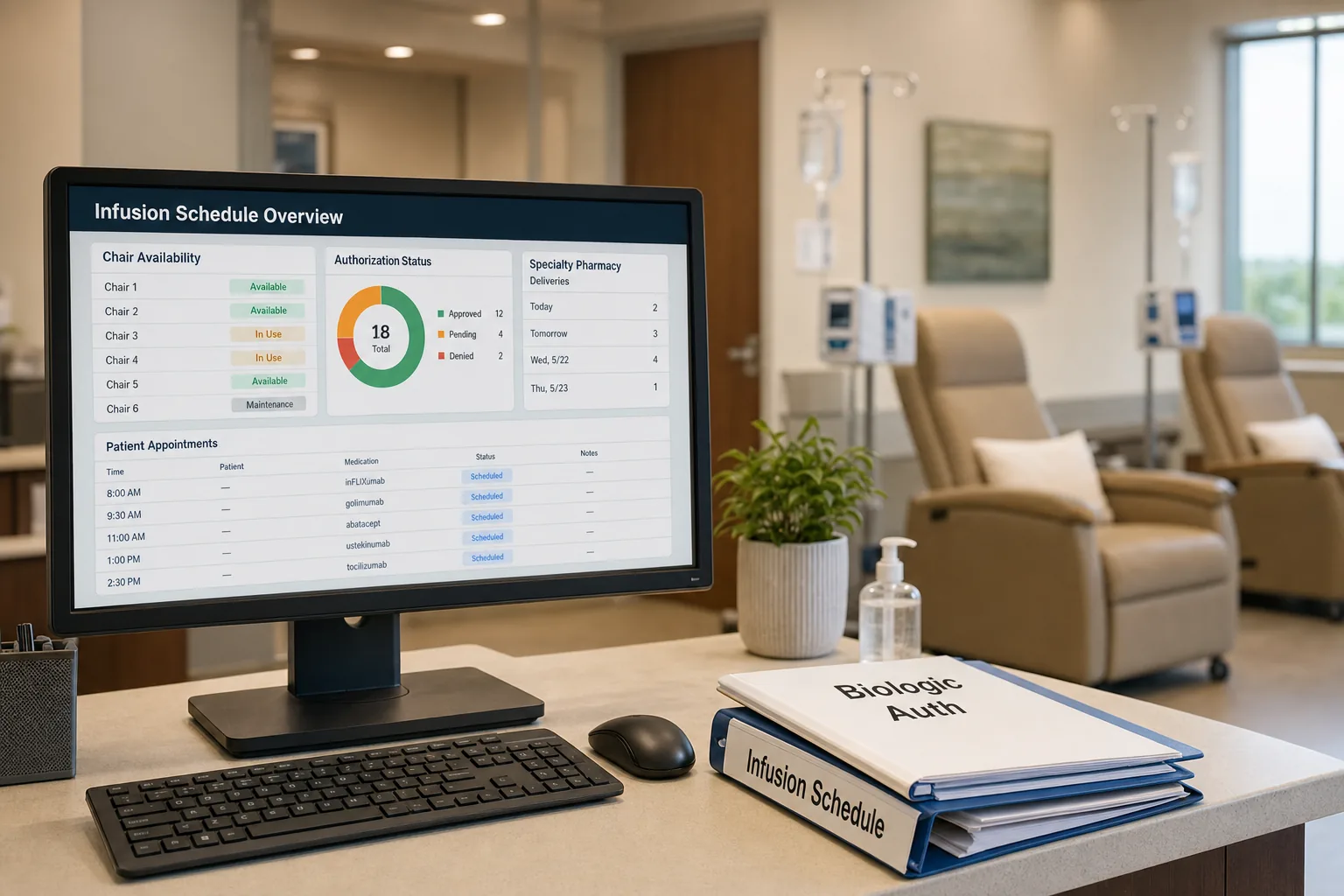
A rheumatologist approves a patient for IV abatacept. The prior auth comes through from the payer. Now the practice needs to schedule the infusion. That should take one phone call. In most rheumatology practices, it takes four or five, spread across two weeks. Everything upstream of that call is its own project, covered in tracking biologic approvals, step therapy documentation and payer follow-up.
The medication authorization is in athenaOne. But the infusion suite authorization is a separate request to a separate payer department, and it has not been submitted yet. The specialty pharmacy needs five to seven business days of lead time to have the medication on hand. The infusion suite has two chairs and runs Tuesday and Thursday mornings only. The patient works days and can only come in after 3pm.
None of those pieces talk to each other. A front desk coordinator is the only thing connecting them. When she’s out sick, the infusion gets pushed another two weeks.
This is not a niche problem. Every rheumatology practice that runs in-office infusions deals with some version of this every week. The medication pipeline, the authorization pipeline, and the scheduling pipeline run independently of each other, and a bottleneck in any one of them collapses the whole appointment.
AI does not fix the payer system. It fixes the coordination layer that sits on top of it.
Why infusion scheduling is harder than standard appointment scheduling
A standard rheumatology appointment requires one thing to go right: an available slot and a confirmed patient. An infusion appointment requires three things to go right simultaneously.
Medication authorization must be approved before pharmacy ordering begins. Specialty pharmacies require the authorization number before they will process the order. You cannot order the medication speculatively and hope the auth comes through in time. If the auth is approved on Monday and you need an infusion the following Tuesday, the pharmacy order window is already at risk.
Pharmacy lead time is non-negotiable. Most specialty pharmacies need five to seven business days to process and deliver a biologic medication. Abatacept, tocilizumab, belimumab: these are not drugs you pull from a shelf. The order has to go in as soon as the auth is confirmed, which means your scheduling workflow has to automatically trigger the pharmacy order the moment the auth lands in athenaOne.
Infusion suite capacity is fixed and often limited. A practice with two infusion chairs and a half-day infusion schedule four days a week has a hard ceiling on how many patients it can run. If three patients need to be scheduled in the same week and two chairs are already committed, one patient waits. That is a clinical and revenue problem, patients on biologics who cannot get timely infusions may switch medications, switch practices, or simply stop treatment.
When these three constraints are not managed as a system, the result is a scheduling queue that backs up regardless of how efficient the front desk is. The constraints exist. The question is whether a person is managing them or software is.
The window problem
The infusion scheduling window is narrower than most practices realize.
Consider a patient whose biologic authorization expires on June 30. The renewal was submitted 45 days out, which is standard. The payer takes a week to process, CMS rules effective in 2026 cap standard decisions at 7 calendar days for Medicare Advantage and Medicaid plans, though commercial timelines can still stretch to two weeks. Authorization approved on June 9. The pharmacy needs seven days. The medication arrives June 16. The infusion suite is booked solid through June 27. The first available slot is June 29, one day before the authorization expires.
If anything goes wrong between June 16 and June 29, the patient cancels, the infusion coordinator is unavailable to confirm, the authorization number was entered incorrectly in the pharmacy order, the appointment does not happen before the authorization expires. The practice then has to request an emergency extension, a process that takes days the patient does not have.
This is not a hypothetical. It is the standard failure mode in infusion scheduling when the coordination is manual.
AI collapses the window by compressing the time between “authorization approved” and “pharmacy order placed” to minutes rather than hours or days. The moment an authorization is marked approved in athenaOne, the AI triggers the pharmacy order workflow and alerts the infusion coordinator to book the chair. The patient is contacted to confirm the appointment the same day. The window stops being a crisis management problem and becomes a predictable pipeline.
What AI manages in rheumatology infusion scheduling
The coordination tasks that AI handles in an integrated rheumatology scheduling workflow:
Authorization-to-pharmacy order triggering. When a biologic authorization is approved in athenaOne, the AI creates a task in the infusion coordinator’s queue with the patient name, authorization number, medication name, expiration date, and a prompt to initiate the pharmacy order. No manual monitoring of the authorization queue required.
Infusion chair capacity management. AI tracks the infusion suite schedule in real time against pending infusion appointments. When a new infusion needs to be booked, it presents available slots that fit both the patient’s availability and the medication’s delivery date, rather than leaving the coordinator to cross-reference three calendars manually.
Patient outreach for scheduling. Once the pharmacy delivery date is confirmed, the AI calls or texts the patient to schedule the infusion appointment. The outreach includes the date range of available slots, the expected duration, and any pre-infusion instructions. The patient confirms or requests an alternative. Confirmation is logged in athenaOne automatically.
Same-day reminders and prep calls. IV infusion patients often need reminders about hydration requirements, what to eat beforehand, and where to park. The AI makes outbound prep calls the day before and the morning of the infusion. These calls currently fall to front desk staff who are also handling incoming calls, refill requests, and scheduling changes. Automation handles the volume without adding headcount.
Rescheduling coordination. When a patient cancels an infusion, the AI does not just remove the appointment from the schedule. It logs the cancellation, flags whether the medication order needs to be held or adjusted with the pharmacy, and presents the next available slot for rebooking. Medication waste and missed doses both carry clinical and financial costs. The AI treats a cancellation as a task to resolve, not just an event to record.
Post-infusion follow-up calls. Patients who receive IV biologics often experience side effects in the hours after treatment, fatigue, mild reactions, questions about what to watch for. Standard of care in most practices includes a 24-hour follow-up call. These calls are often skipped when staff is stretched. AI makes them consistently.
The authorization renewal calendar
Infusion patients are on indefinite medication cycles. A patient who starts abatacept in January 2025 will need a new authorization in January 2026, then January 2027. The authorization is not a one-time event; it is a recurring administrative task that compounds with each new infusion patient you add to the practice.
A rheumatology practice with 40 active infusion patients is managing 40 authorization renewal cycles, each with its own expiration date, payer-specific requirements, and renewal submission window. If renewal submissions are managed manually, the risk of a gap between authorization expiration and renewal approval grows with each patient added to the infusion program.
AI manages the renewal calendar automatically. Every active infusion patient has an authorization expiration date in athenaOne. The AI monitors those dates and initiates the renewal workflow 45 to 60 days before expiration, pulling the relevant clinical documentation, flagging the responsible staff member, and tracking submission confirmation. No patient misses an infusion because a renewal slipped through the gap.
The phone call volume problem
Infusion patients call. A lot.
They call to ask if their authorization has been approved. They call to confirm the infusion appointment. They call the morning of the infusion with questions about whether they should eat first. They call the day after with questions about fatigue and whether the reaction they are experiencing is normal.
In a practice with 40 active infusion patients running two infusion days per week, that is a consistent inbound call volume that has nothing to do with scheduling new appointments or handling clinical questions. It is status calls: patients who want to know where they are in a process that currently has no automated update mechanism.
AI handles this with outbound proactive communication. When the authorization is approved, the AI calls the patient. When the pharmacy confirms delivery, the AI calls the patient. When the appointment is confirmed, the AI calls the patient. When the infusion is tomorrow, the AI calls the patient.
The patient still has the option to call in. But most of them do not, because they already know what they need to know.
What this looks like in practice
A rheumatology practice with three physicians and an eight-chair infusion suite can run 12 to 15 infusion appointments per day when the scheduling workflow is functioning well. When it is not, when the coordinator is managing the auth-to-pharmacy-to-scheduling pipeline manually across multiple payers and multiple patients, eight to ten appointments is more realistic, and several of those involve scrambled rescheduling from prior failures.
The administrative bottleneck is not a staffing problem in most cases. It is a coordination problem. The data is in athenaOne. The pharmacy has an ordering system. The patient is available. The chair is available. The problem is that nobody is watching all three things at once.
AI watches all three things at once. When one piece changes, it triggers the next step automatically. The coordinator’s job shifts from tracking and chasing to reviewing and approving, work that requires judgment, not time.
Key takeaways for rheumatology practice administrators
- Infusion scheduling requires three approvals to align simultaneously: medication auth, facility auth, and pharmacy lead time. Manual coordination fails when any one of them slips.
- The authorization-to-pharmacy order window is often less than one day to meet a desired infusion date. AI triggers the order the moment auth is confirmed.
- Renewal management scales poorly with patient volume: 40 active infusion patients means 40 independent renewal calendars. AI tracks all of them.
- Post-infusion follow-up calls are standard of care but often get skipped when staff is stretched. AI makes them consistently.
- Proactive patient communication eliminates most inbound status calls: patients call less when the practice calls them first.
- The scheduling capacity ceiling is a coordination ceiling, not a staffing ceiling: automation raises the ceiling without adding headcount.
The infusion program growth question
Many rheumatology practices have the clinical capability to run more infusions than they currently do. The limiting factor is not physician capacity or infusion suite capacity; it is the administrative bandwidth to manage the authorization, pharmacy, and scheduling pipeline at higher volume.
Practices that have automated the coordination layer find that their infusion program scales without proportional increases in front desk staff. The ceiling goes up because the bottleneck was never the chairs.
If your infusion schedule is limited by your coordinator’s ability to track all the moving pieces, that is a solvable problem. The pieces are all in athenaOne. AI just needs to be watching them.
See how Pretty Good AI’s athenaOne integration works for rheumatology infusion scheduling
Ready to reduce missed calls?
15-minute demo. See how an AI team works inside your athenaOne practice.
Schedule a Demo →Written by Kevin Henrikson