Practice Operations
Rural Health Clinic Scheduling and Provider Gaps
Rural health clinics face chronic provider shortages and high no-show rates. AI scheduling keeps slots filled without administrative staff you cannot hire.
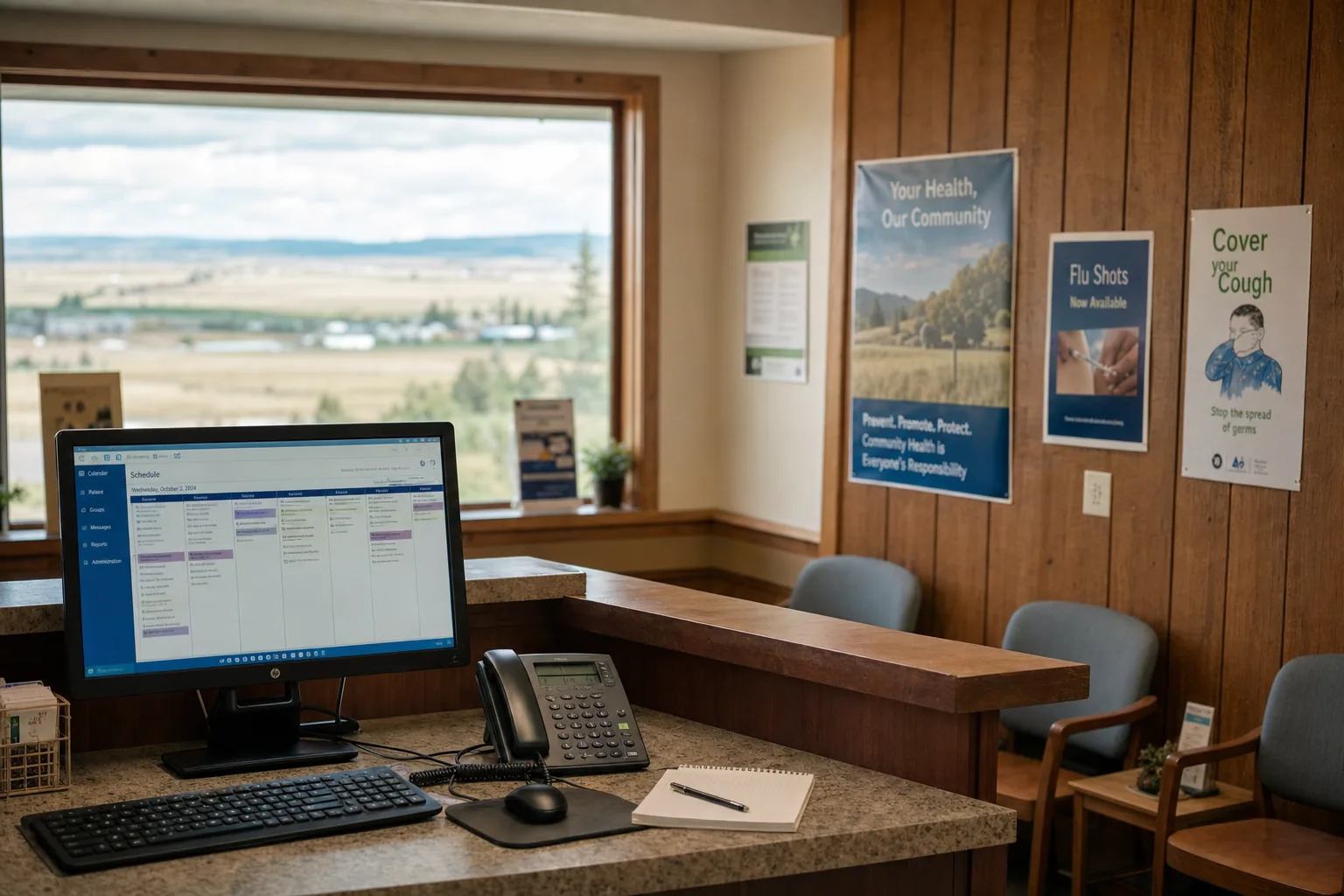
Rural health clinic scheduling AI addresses a problem that money alone cannot fix: running a scheduling operation when you cannot hire the people to staff it. Scheduling is one slice of it, and the wider question for a small clinic is which front-office work should never need a headcount at all.
Rural health clinics and critical access hospitals operate under staffing constraints that urban and suburban practices do not face. The administrative workforce simply is not there. A primary care clinic in a rural county with 8,000 residents may have one or two front desk staff covering all phone intake, scheduling, insurance verification, and patient check-in, simultaneously. When one person calls in sick, the other handles everything alone. When both are occupied with in-clinic patients, the phones go unanswered.
The problem compounds because the consequences of scheduling failures in rural health are worse than in urban settings. A patient who misses an appointment and cannot reschedule by phone may not try again. In a county where the next nearest primary care provider is 45 minutes away, a missed connection with the local clinic means no care, not a switch to a competitor. No-show rates in rural clinics are frequently higher than in urban practices, partly because of transportation barriers that scheduling systems cannot address, and partly because scheduling friction itself produces non-adherence.
Rural health clinic scheduling AI does not solve the provider shortage. It does change what your existing administrative capacity can handle.
The staffing math in rural health
Rural health clinics are not understaffed because administrators choose to underinvest. They are understaffed because the administrative labor market in rural areas is thin and the economics of rural practice do not support the salary levels required to compete with urban employers.
The National Rural Health Association has documented persistent shortages across clinical and administrative roles in rural health settings. For administrative roles specifically, the turnover rate is high even when positions can be filled, rural clinic front desk positions are often part-time or do not offer benefits at the level urban employers provide.
The result is that rural clinics do more administrative work per staff member than urban practices, with less redundancy when staff leave. A scheduling coordinator who manages appointments, answers the phone, handles insurance questions, and checks in walk-in patients is not doing any of those tasks well. They are triaging across all of them continuously.
AI scheduling does not replace that coordinator. It takes the phone work off their plate so they can focus on the in-person interactions where physical presence matters.
What AI handles in rural clinic scheduling
Rural health clinic scheduling AI handles the same categories of work it handles in urban settings, but the operational impact differs because the starting capacity is lower.
Inbound appointment scheduling. Patients calling to schedule routine primary care visits, medication management appointments, and annual wellness visits do not need a human to access the provider’s schedule and book a slot. AI reads availability from the practice management system and books the appointment, sending confirmation by phone or text based on patient preference. For a two-person front desk team handling 80 calls per day, offloading 30% of calls to AI scheduling changes the character of their workday.
Appointment reminders and confirmation. Rural clinic no-show rates are often driven by patients who forget appointments, patients who face transportation barriers that emerge between scheduling and the appointment date, and patients whose contact information is out of date. Automated outbound reminder calls, made by AI the day before and morning of, reduce no-shows from the forgetting category and create an opportunity to reschedule for patients who identify a barrier in advance.
After-hours call handling. Rural clinics frequently lack after-hours coverage beyond an answering service. An answering service takes a message. AI takes a message and does more: it can answer questions about clinic hours, apply the clinic’s own red-flag rules to route emergencies to 911 or the nearest emergency room, capture the patient’s concern in detail for the on-call clinician to triage, and schedule the next available appointment at the end of the call.
Outreach for overdue care. Chronic disease management in rural health depends on patients returning for follow-up care on schedule. A patient with diabetes who was supposed to return in three months and has not scheduled can be reached by AI outbound call, confirming availability, checking on barriers, and scheduling without a staff member making the call manually. For a rural clinic managing 300 active chronic disease patients with two front desk staff, this outreach would otherwise not happen.
The no-show problem specifically
Rural health clinics often have no-show rates in the 20-30% range, compared to the 12-18% range more common in urban primary care. Some of that gap reflects transportation barriers that AI cannot address. But a portion reflects scheduling friction that AI can reduce directly.
Patients who schedule appointments far in advance forget them. Patients who receive no reminder before a next-day appointment may miss it. Patients who try to cancel but cannot reach the clinic let the appointment lapse rather than rescheduling. AI addresses all three patterns: automated reminders with rescheduling options, cancellation handling that immediately offers alternative slots, and outbound follow-up for patients whose appointment passed without a visit record.
Reducing no-shows by even 5 percentage points in a rural clinic running at capacity changes the revenue picture materially. A clinic with 40 scheduled appointments per day at an average visit value of $150 recovers $300 per day in previously-lost visit revenue for every 5% no-show reduction. Over a full year, that is over $70,000 in recovered revenue from a scheduling workflow change.
What matters for rural health AI scheduling specifically
Rural clinic scheduling AI requirements differ from urban practice requirements in a few specific ways.
Low-bandwidth reliability. Rural broadband infrastructure is inconsistent. Cloud-based tools that fail when connectivity degrades create operational gaps in clinics that cannot afford them. AI scheduling systems used in rural settings need to function under degraded connectivity conditions or maintain local caching of critical scheduling data.
Landline and limited-smartphone patient populations. Urban AI scheduling tools often assume patients have smartphones for text-based confirmation. Rural patient populations skew older and may have landlines or basic phones without text capability. AI scheduling for rural health needs reliable phone-based interaction that does not depend on text or app-based confirmation.
Multi-role staff support. In rural clinics where the front desk staff also handles billing, prior auth, and check-in, the AI scheduling system needs to integrate with those functions rather than creating a separate system that requires separate management. EHR-native integration with athenahealth means scheduling AI works within the system the clinic already uses rather than adding a parallel tool that staff must switch between.
Spanish-language capability. Many rural health clinics serve significant Spanish-speaking patient populations. AI scheduling that cannot conduct a full appointment booking conversation in Spanish is not suitable for rural health contexts where bilingual administrative staff are often unavailable.
The EHR integration question
For rural health clinics on athenahealth, and athena has significant market penetration in the federally qualified health center and rural health clinic market, native scheduling AI integration changes what is possible.
When AI reads provider availability directly from athenaOne, the appointments it books are immediately visible to clinical staff. There is no lag, no reconciliation step, and no possibility of double-booking that a separate scheduling system would create. When a patient calls to cancel, the AI updates the schedule in real time and the slot becomes available for other bookings.
For rural clinics with one-person administrative coverage on any given day, that tight integration is not a nice-to-have. It is the difference between a scheduling system that helps and one that creates additional work to manage.
Key takeaways
- Rural clinic scheduling AI addresses the same problem as urban scheduling AI but with lower starting administrative capacity, which means the operational impact per staff member is higher.
- The primary rural scheduling failure modes, missed calls, forgetting-related no-shows, lack of after-hours coverage, limited chronic disease outreach, are all addressable through AI without additional headcount.
- No-show reduction at rural clinic rates translates to material revenue recovery. Every 5 percentage point reduction in a clinic running 40 appointments per day at $150 average visit value recovers over $70,000 annually.
- Rural-specific requirements matter: low-bandwidth reliability, landline/phone-only patient populations, Spanish-language capability, and EHR-native integration rather than standalone tools.
- AI does not replace rural clinic administrative staff. It changes what existing staff can accomplish within the same hours.
See how Pretty Good AI supports rural health clinic scheduling with athenahealth integration
Sources:
- National Rural Health Association. Rural Health Fact Sheet. NRHA, 2024.
- Telehealth Resource Center. Artificial Intelligence in Rural Health. TTAC, 2024.
Ready to reduce missed calls?
15-minute demo. See how an AI team works inside your athenaOne practice.
Schedule a Demo →Written by Kevin Henrikson