Practice Operations
Smart Overbooking to Recover Unused Capacity
Late cancellations and no-shows leave appointment capacity unused. Learn how smart overbooking and waitlists can fill gaps while protecting patient trust.
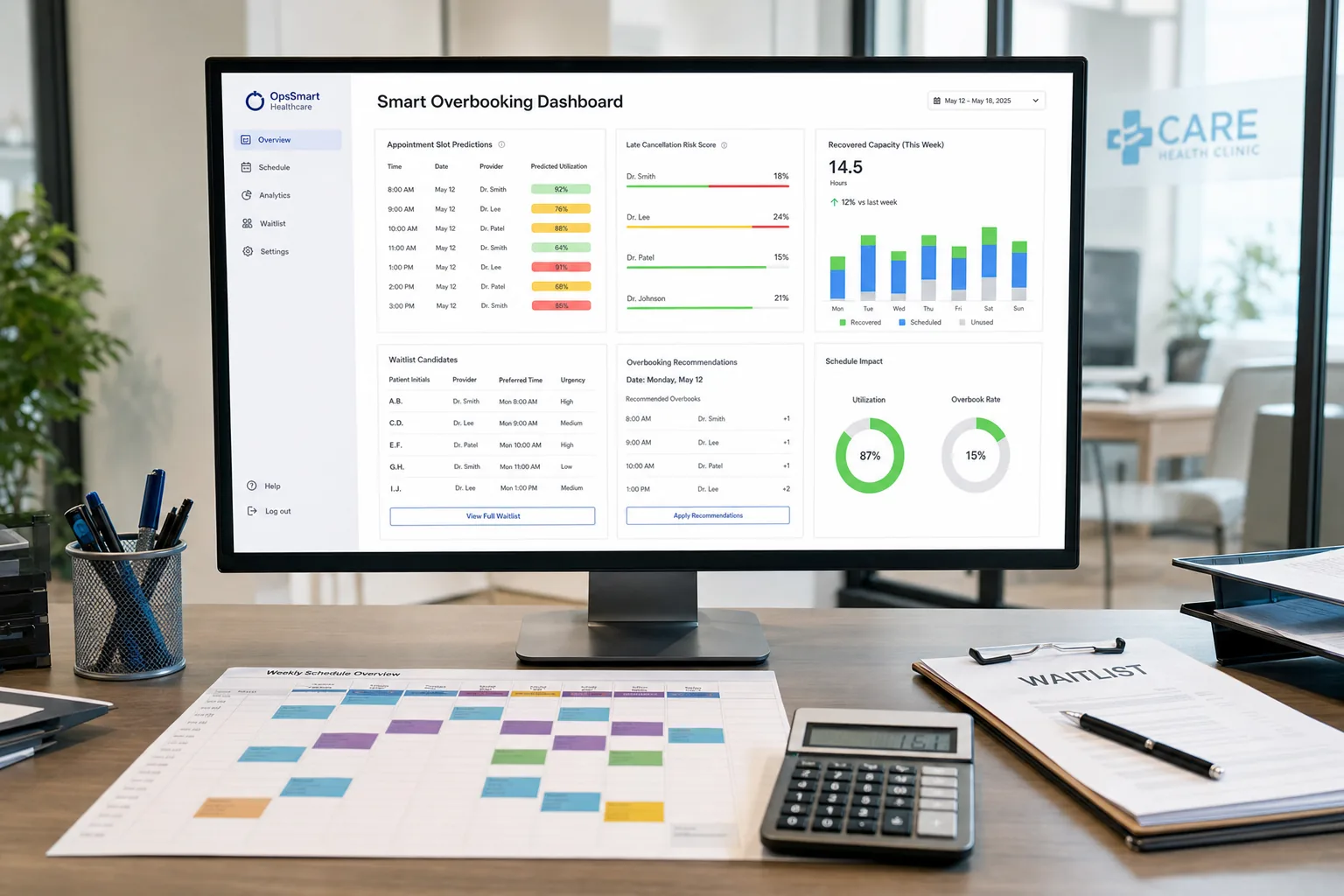
Every Monday morning, Dr. Sarah Chen opens her practice schedule and sees the same problem: 15-20 empty appointment slots by end of week. Patients cancel. Patients no-show. The slots sit empty because there’s not enough time to fill them.
That’s $6,000 walking out the door every single week.
She tried manual overbooking. It created chaos: double-booked slots, angry patients waiting 45 minutes, staff apologizing all day.
The six-figure annual revenue leak continued.
Here’s what most practices miss: empty slots aren’t random. They’re predictable. And AI can fill them without the chaos.
The Math Every Practice Admin Knows
Medical practices lose 15-20% of scheduled slots to cancellations and no-shows. For a typical 5-provider practice, that’s:
- 750 weekly slots total
- 113 empty slots per week
- $400 average visit value
- $45,000 lost every week
That’s $2.3 million per year in revenue walking away.
Traditional solutions all fail:
- Manual overbooking creates double-booked chaos
- Aggressive overbooking leads to long wait times
- Conservative approach leaves money on the table
Why? Because you’re using last month’s data to predict today’s cancellations.
Why Your Current Overbooking Strategy Fails
Most practices use simple rules like “Book 15% extra on Mondays.”
This approach has three fatal flaws:
1. Every Slot Is Different
Monday morning psychiatry appointments have different no-show patterns than Friday afternoon follow-ups. Static rules treat them the same.
2. Patient Behavior Changes
Mrs. Johnson used to be reliable. She never missed. Now she’s missing 40% of appointments because her transportation changed.
Your system doesn’t know that.
3. Provider Schedules Vary
Dr. Kim’s schedule runs 15% empty. Dr. Patel is always overbooked. Manual overbooking can’t account for this.
How AI Schedule Optimization Works
Modern systems use three strategies to recover lost capacity:
1. Smart Overbooking Based on Patterns
Instead of static rules, AI tracks:
- New patient vs. follow-up no-show rates
- Day and time patterns
- Individual patient history
- Weather and seasonal factors
- Insurance type patterns
Result: The system predicts which slots will open up. You can safely overbook without chaos.
2. Micro-Gap Filling
Every schedule has 5-15 minute gaps. Early check-ins. Quick turnarounds. Cancellations that don’t fit standard slot lengths.
These gaps are invisible in traditional scheduling.
AI finds patients who:
- Need short visits (refill checks, quick follow-ups)
- Live nearby (can arrive on short notice)
- Have flexible schedules
These patients automatically get offered the micro-gaps.
Illustrative impact: in the model below we assume a practice recovers several previously invisible slots per provider per week. Measure your own.
3. Smart Waitlist Backfill
When a patient cancels, most practices:
- Manually review the waitlist
- Call patients one by one
- Leave voicemails
- Wait for callbacks
- The slot often stays empty
AI waitlist systems:
- Instantly find the best-fit patients (location, availability, appointment type)
- Contact multiple patients at once (phone, text, patient portal)
- Auto-book the first confirmed response
- Only notify staff when manual help is needed
What changes: the fill attempt starts within minutes and reaches several patients at once, instead of one voicemail at a time. Fill rate is the metric to track against your manual baseline.
The Revenue Math
Here’s what happens when a typical 5-provider specialty practice implements schedule optimization:
Current state:
The figures below are a worked example, not measured benchmarks. Your numbers will vary with call volume, payer mix, and revenue per visit.
- 5 providers × 30 slots/day × 5 days = 750 weekly slots
- 15% lost to no-shows = 113 empty slots per week
- $400 average visit value
- Lost revenue: $45,000/week = $2.3M/year
Three mechanisms act on that lost capacity, and they act on different parts of it:
- Smart overbooking works on slots lost to no-shows, where the pattern is predictable enough to double-book against.
- Micro-gap filling works on the fragments between appointments that are too small to book manually but not too small to book at all.
- Waitlist backfill works on cancellations, and almost all of its value is in the same-day ones.
How much each recovers in your practice depends on which of the three is actually your problem, and that is worth establishing before you evaluate anything. A practice bleeding capacity to same-day cancellations and a practice bleeding it to chronic no-shows need different things, and a single recovery percentage covering both is a number nobody can stand behind. Price each recovered slot at your own average visit value; the section at the end of this page walks the arithmetic with every input stated.
The Patient Experience Problem
Critical rule: Aggressive overbooking destroys patient trust.
Bad implementation looks like:
- 45-minute wait room delays
- Rushed appointments
- Staff apologizing for “running behind”
- Angry Google reviews
Smart overbooking prevents this with three safeguards:
Safety Guardrails
The system enforces limits based on real data:
- Never overbook more than historical no-show rates predict
- Auto-reduces overbooking when actual show rates beat predictions
- Respects provider buffer time preferences
Real-Time Adjustments
As patients check in, the system recalculates:
- “All 3 patients showed for Dr. Kim’s 2pm block—reduce overbooking for rest of day”
- “2 of 3 patients no-showed this morning—increase afternoon overbooking”
Better Patient Experience
When done correctly, patients see:
- Shorter wait times (fewer unexpected gaps)
- More available appointments
- Faster waitlist movement
They never see the optimization happening.
What It Takes to Implement
Timeline: 30-60 days from start to results
Phase 1: Data Collection (weeks 1-2)
- Connect to your EHR scheduling system
- Analyze 90+ days of appointment history
- Find no-show patterns and triggers
Phase 2: Model Training (weeks 3-4)
- Build prediction models for each provider
- Test accuracy against real data
- Set policy guardrails with practice input
Phase 3: Pilot & Refinement (weeks 5-8)
- Start with 1-2 providers
- Monitor results daily
- Adjust based on performance
- Expand to full practice
Staff Impact: Minimal
- No workflow changes
- Works inside existing EHR
- Staff can override AI anytime
When This Doesn’t Work
Schedule optimization isn’t right for everyone:
Low volume practices If you schedule fewer than 200 appointments per week, sample sizes are too small. Manual overbooking might be better.
Single-provider practices Benefits are smaller (though waitlist automation still helps). Real ROI starts at 3+ providers.
Already at 100% capacity If you’re running at 95%+ utilization with no empty slots, you need more providers, not better scheduling.
Unpredictable specialties Emergency services and urgent care have different dynamics. Standard overbooking logic doesn’t apply.
Why Most Attempts Fail: EHR Integration
Here’s the implementation trap:
Without real-time EHR integration:
- AI can’t see live appointment status
- Predictions go stale within hours
- Staff must manually sync two systems
- Result: limited improvement, because the system is always working from stale data
With native EHR integration:
- Two-way data flow (read and write)
- Real-time schedule updates
- Auto-booking without staff help
- Result: the recovered capacity is bounded by your no-show baseline and open demand, not by data lag
For athenaOne users, this means working with an official Marketplace partner. These partners have native API access. Avoid bolt-on tools that scrape your patient portal.
Beyond Overbooking: The Full Platform
Smart overbooking is one piece. The full platform includes:
Template Balancing
AI recommends schedule adjustments:
- Move new patient slots to high-demand windows
- Rebalance follow-up vs. procedure slots based on actual mix
- Adjust slot lengths based on provider-specific times
Prior Auth Alignment
Match appointment timing to insurance approval:
- Delay scheduling until prior auth is approved (avoid reschedules)
- Auto-reschedule when auth is denied
- Track payer timelines to predict safe booking windows
Demand Forecasting
Predict capacity needs 2-4 weeks ahead:
- Seasonal patterns (flu season, allergy season)
- New patient referral trends
- Insurance coverage changes
Combined, these strategies recover capacity you are already paying for. In the illustration below that is equivalent to adding a provider without hiring one.
ROI Calculation
Illustrative model, not a measured customer result. Every input is an assumption to replace with your own data.
Conservative scenario (5-provider specialty practice):
Investment:
- Setup time: 40 staff hours
- Ongoing management: 2-4 hours/week
Returns (50% capacity recovery):
- 48 additional slots/week
- $400 average visit value
- Revenue: $19,000/week = $990K/year
Business case: Compare recovered appointment capacity with setup and ongoing management, then discuss the workflow with our team.
Even at 30% capacity recovery, the recovered revenue can materially outweigh the staff time involved. Measure the result against your own baseline.
Whatever the recoverable share turns out to be in your practice, the loss is running weekly and compounding quietly, which is the argument for measuring it now rather than at budget time.
What Practices Report
Commonwealth Pain & Spine: Commonwealth Pain & Spine, a 35-location specialty group with 130 providers, runs on Pretty Good AI. We handle more than 100,000 patient calls a month for them. The AI handles about 70% from start to finish. One in eight bookings now comes in after hours, when the office used to be closed. Commonwealth also runs our referral management on athenaOne: inbound fax referrals, a provider referral portal, and automated patient self-referral that books the first visit. Patients can request an appointment online around the clock.
Customer-reported results. Your numbers will vary by workflow, staffing, seasonality and call mix.
Common Questions
Is schedule optimization HIPAA compliant?
Yes. Patient data stays within your EHR. Predictions use appointment history only (no external data). Systems must be HIPAA-compliant and covered by BAA.
How does AI calculate patient reliability?
From appointment history within your EHR. No external data. No credit scores. Just: Did they show up for past appointments? The calculation happens inside HIPAA-compliant guardrails.
What if the AI is wrong?
Staff can override any recommendation. The system learns from overrides. If predictions are consistently wrong, the model retrains automatically.
Will patients know they’re talking to AI?
For phone-based waitlist backfill, yes, transparency is required. For schedule optimization, patients just see more available appointments and shorter wait times.
Getting Started
If you’re losing 15%+ capacity to no-shows and cancellations:
Step 1: Audit Your Schedule Leak
- Pull 90 days of appointment data from your EHR
- Calculate actual show rates by appointment type, day, and provider
- Estimate annual revenue loss
Step 2: Check Integration Requirements
- Verify your EHR has scheduling API access
- Confirm ability to read and write appointments through software
- Ensure HIPAA-compliant data handling
Step 3: Start With Waitlist Automation
Before touching overbooking, prove ROI with low-risk waitlist:
- Automate same-day cancellation filling
- Measure fill rates (manual vs. automated)
- Validate patient experience
Step 4: Start Smart Overbooking With Guardrails
- Choose 1-2 high-volume providers
- Set conservative guardrails (max 10% overbooking)
- Monitor for 4-6 weeks before expanding
The Bottom Line
Empty appointment slots are predictable. They’re recoverable. They’re not just bad luck.
Traditional overbooking fails because it uses static rules. AI schedule optimization succeeds because it learns patterns, adapts in real-time, and protects patient experience.
For practices losing a meaningful share of revenue to schedule leaks, the recoverable amount depends on your provider count, appointment volume and no-show baseline; the model above shows how to estimate it.
The question isn’t whether to implement schedule optimization.
It’s whether you can afford not to.
Ready to reduce missed calls?
15-minute demo. See how an AI team works inside your athenaOne practice.
Schedule a Demo →Written by Kevin Henrikson