Practice Operations
Telehealth Prior Authorization and Coverage
Telehealth practices deal with a prior authorization environment that changes faster than any other care setting. AI integrated with athenaOne tracks payer-specific telehealth coverage rules and automates the verification that is currently eating staff time.
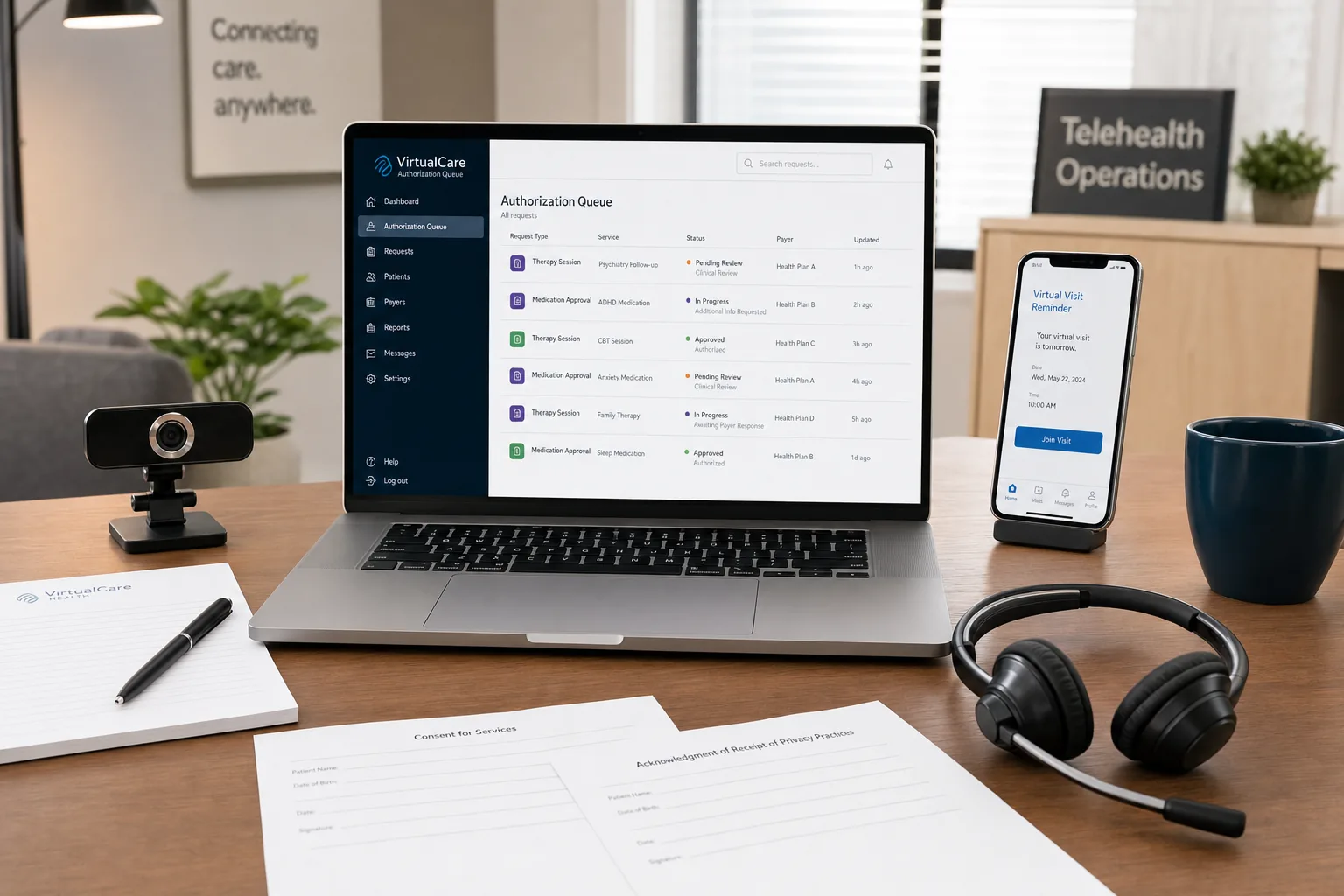
Telehealth prior authorization sits at the intersection of two things that move fast and rarely in sync: payer coverage policy and state telehealth regulations.
A commercial plan that covered 90-day telehealth visits without prior auth during the public health emergency may have reverted to a 10-visit limit that triggers a prior auth request on visit 11. A Medicaid plan in one state may cover behavioral health telehealth without prior auth while the same plan in an adjacent state requires one. A self-insured employer plan may define telehealth visit parity differently than the underlying carrier.
The rules are not consistent. They change with policy cycles. And they often are not updated in the payer’s provider manual until months after they take effect.
For a telehealth practice with a multi-state patient population, the prior auth environment is harder to manage than for an in-person practice with a defined local payer mix. The staff member who knows the UnitedHealthcare telehealth auth rules for California does not automatically know them for patients with UnitedHealthcare plans issued in Texas.
AI does not change the rules. It tracks them, applies them to the right patients, and initiates the authorization workflow before the visit, not after the claim is denied.
The telehealth coverage complexity problem
Telehealth coverage has never been standardized across payers, and the years since the public health emergency ended have not made it simpler. Multiple rule sets apply simultaneously to most telehealth practices.
Federal vs. state parity rules. Telehealth parity for commercial insurers is set by state law, not by federal statute. Most states require commercial plans to cover telehealth services that would be covered in person, and roughly half go further and require payment parity, but each of those laws carries significant exceptions and carve-outs, and self-insured employer plans sit largely outside their reach. Federal Consolidated Appropriations Act extensions govern Medicare telehealth flexibilities, not commercial coverage. The exceptions vary by state and by plan type: what qualifies as a covered telehealth visit under state parity law in New York is not the same as what qualifies in Ohio.
Medicare and Medicaid telehealth coverage. Medicare telehealth coverage has expanded significantly since 2020, but prior auth requirements still apply for certain service categories. Medicaid telehealth coverage varies by state Medicaid program, fee schedule, and the specific service being delivered. A telehealth practice with Medicaid patients across multiple states has multiple distinct prior auth rule sets to manage.
Behavioral health vs. medical telehealth. Many payers treat behavioral health telehealth differently from medical telehealth. Behavioral health sessions may be covered under mental health parity without requiring prior auth while the same payer requires auth for a medical telehealth visit above a threshold number of visits. A practice that delivers both types of care needs to apply different rules to different patients with the same insurance plan.
Visit limits and threshold triggering. Some plans set visit thresholds that trigger prior authorization once exceeded. A plan may cover 20 telehealth visits per year without prior auth, then require auth for visits 21 and beyond. Tracking which patients are approaching their threshold and initiating authorization proactively is a data management problem at scale.
What happens without proactive prior auth management
The typical failure mode is claims-triggered: a patient has visit 21 on a 20-visit plan, the claim is submitted, the payer denies it for lack of prior authorization. The practice receives the denial 30 to 45 days after the visit. Staff has to appeal, obtain retroactive authorization if the payer allows it, and resubmit the claim. Many retroactive authorization requests are denied outright. The practice absorbs the write-off.
The patient, who may have been using telehealth consistently and had no idea their plan had a visit limit, receives an unexpected bill. That patient calls the practice to find out why they are being billed for something that was previously covered. The staff member who answers the call has to explain a payer rule the patient has never heard of, applied retroactively to a visit that already happened.
This failure mode is entirely preventable. It requires knowing the patient’s visit count against their plan’s threshold before the visit occurs, which requires tracking visit counts by payer rule, not by visit date.
What AI handles in telehealth prior authorization
Payer-specific coverage rule tracking. For each payer in the practice’s mix, AI maintains the current telehealth coverage rules, which services require prior auth, at what visit threshold, under what clinical conditions. When payer rules change, the AI rule set is updated. Staff does not maintain a manual spreadsheet of telehealth coverage rules across 15 payers.
Visit count monitoring and threshold alerts. For each patient, AI tracks the count of telehealth visits against their plan’s applicable threshold. When a patient approaches the threshold, the AI initiates the prior auth workflow before the limit is reached, typically two to three visits in advance. The authorization is in place before the threshold visit occurs, not after the claim is denied.
Pre-visit coverage verification. Before each scheduled telehealth appointment, AI verifies that the patient’s current coverage includes telehealth services, that prior auth is in place if required, and that the service type being delivered is covered under the patient’s plan. Coverage verification happens automatically at the time of scheduling, not the morning of the appointment.
State-specific rule application. For practices with patients in multiple states, AI applies the relevant state parity rules and Medicaid program requirements to each patient’s coverage verification. A patient with a Medicaid plan in one state gets the rule set for that state’s Medicaid program. The practice does not need a staff member who knows telehealth coverage rules for every state where patients are located.
Retroactive auth prevention. The goal of proactive prior auth management is to have authorization in place before the visit, not to obtain it retroactively after a denial. AI initiates auth requests at least 5 to 10 business days before the threshold visit, leaving enough time for the payer to process the request under standard timelines.
Denial routing and appeal support. When a telehealth claim is denied for lack of prior auth, AI identifies whether the denial is administratively correctable (retroactive auth was possible, auth was in place but not submitted correctly) or requires a formal appeal, and routes it with the relevant documentation.
The behavioral health telehealth layer
Telehealth practices delivering behavioral health services face a specific additional complexity. Mental health parity laws require most commercial insurers to cover mental health and substance use disorder services at parity with medical services, but the prior auth requirements for behavioral health telehealth often lag the parity requirements in practice.
A patient in outpatient behavioral health therapy via telehealth may be on a plan that theoretically covers the sessions at parity but requires prior authorization for sessions beyond a certain number per year. Tracking those authorizations, which expire, which require clinical documentation to renew, which payers are known to deny renewals at high rates, is a workflow that compounds with each patient added to the panel.
AI tracks behavioral health authorization status separately from medical authorization status, because the rules are different. When a behavioral health telehealth authorization is approaching expiration, the renewal workflow initiates automatically. When a renewal is denied, it routes to clinical staff for appeal documentation.
The telehealth coverage communication problem
Patients who use telehealth for ongoing care often do not know what their coverage limits are. They know their copay. They do not know that their plan covers 20 telehealth visits per year, that they have used 18, and that visits 21 and 22 will require prior authorization to be covered.
When that information is communicated to the patient proactively, before the threshold is reached, not after the claim is denied, the patient has the opportunity to adjust their care plan, seek an exception through their employer plan, or understand the cost implications before they occur.
AI handles this communication. When a patient’s visit count approaches the threshold, the AI sends a notice explaining that upcoming visits may require prior authorization, that the practice is initiating the authorization process, and what the patient should expect. The patient is not blindsided.
What telehealth practices report about payer rule volatility
Payer rules for telehealth have changed significantly every year since 2020. They will continue to change as state and federal telehealth policy evolves. Practices that manage these rules manually are restaffing the knowledge problem with each policy cycle.
The staff member who spent six months learning the telehealth coverage rules for the practice’s top five payers needs to update that knowledge every time a payer issues a policy update, which happens on no predictable schedule and is often not communicated directly to providers.
AI-managed payer rule tracking means policy updates are incorporated into the workflow without requiring a staff member to catch up on each change. The practice’s coverage verification logic updates with the rules, not with the staff member’s awareness of the rules.
Key takeaways for telehealth practice administrators
- Telehealth coverage rules vary by payer, state, service type, and visit threshold: managing them manually across a multi-state patient population is not a sustainable workflow
- Visit limit tracking is a data problem, not a call problem: AI tracks visit counts by payer rule and initiates auth before the threshold is hit
- Pre-visit coverage verification prevents retroactive denial: verifying coverage at scheduling, not morning-of, is the only reliable prevention
- Behavioral health and medical telehealth have different rule sets: AI applies them separately, because the payer treats them separately
- Proactive patient communication about coverage limits prevents surprise billing: patients informed in advance behave differently than patients who discover the issue on an EOB
- Payer rule volatility is structural, not temporary: telehealth coverage policy will continue to change, and manual tracking cannot keep pace
The policy stability question
Telehealth coverage policy is not going to stabilize in the near term. Medicare’s telehealth flexibilities have been extended repeatedly on short cycles, most recently through December 31, 2027, but the long-term coverage framework is still being negotiated at the federal and state levels. Payers are adjusting their telehealth coverage policies on their own cycles, not on the provider’s schedule.
A telehealth practice built on manual coverage tracking is building on sand. Every policy cycle requires someone to rebuild the knowledge base from scratch. AI-managed rule tracking means the workflow adapts to policy changes without requiring a staffing response each time.
Sources
Ready to reduce missed calls?
15-minute demo. See how an AI team works inside your athenaOne practice.
Schedule a Demo →Written by Kevin Henrikson