Practice Operations
Telehealth Scheduling and the No-Show Flood
Telehealth practices lose more revenue to no-shows than in-person clinics. AI voice agents handle reminders, rescheduling, and platform link delivery at scale.
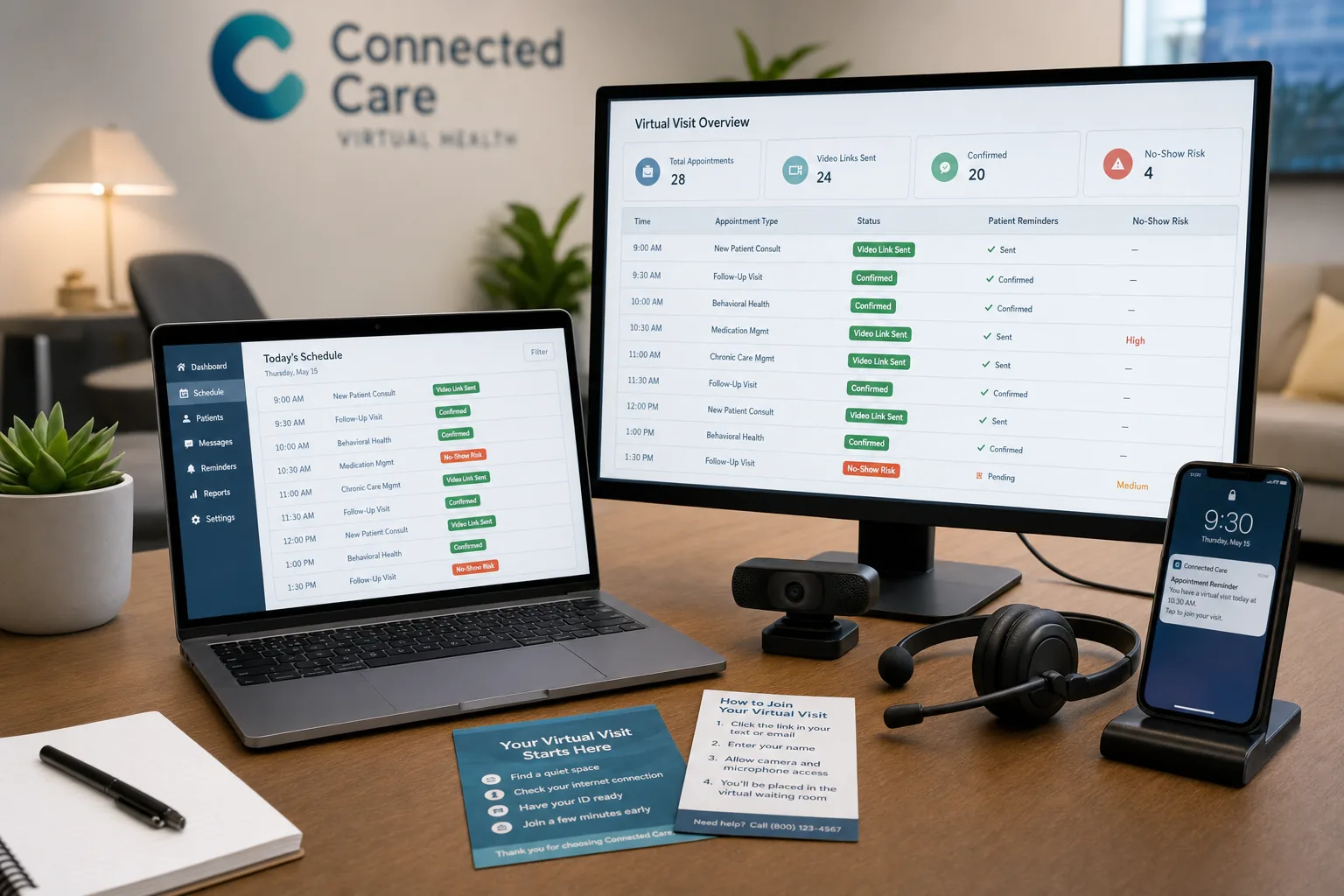
Telehealth practices have a scheduling problem that doesn’t get discussed enough: most published comparisons actually find telehealth no-show rates at or below in-person rates, but for a telehealth-first practice, every missed visit is a total loss, and the revenue they lose compounds because there’s no walk-in buffer. When a patient skips a telehealth appointment, that slot is gone. AI is helping telehealth-first practices fix this through smarter reminder sequences, faster rescheduling, and automated platform link delivery that actually reaches patients.
The telehealth scheduling problem isn’t that patients don’t want virtual care. Utilization has stayed well above pre-pandemic levels across behavioral health, primary care, and chronic disease management. The problem is operationally specific: telehealth appointments have more friction points than in-person visits, and each friction point is a potential no-show.
This article breaks down where telehealth scheduling breaks down, what it actually costs, and how AI voice agents are reducing no-show rates without adding staff.
The Three Friction Points Unique to Telehealth Scheduling
In-person clinics have one primary no-show driver: the patient forgot or decided not to come. Telehealth practices have three additional friction points that in-person clinics don’t deal with.
Platform confusion: Patients who haven’t used your telehealth platform before don’t know where to go. Your reminder emails have links. Those emails go to spam, or the patient can’t find them the morning of the visit. They don’t call until 10 minutes after the appointment was supposed to start, by which point the provider has moved on.
Technical problems: Audio not working, camera not enabling, login issues with the patient portal. For patients who are less comfortable with technology (often older patients with chronic conditions, who make up a disproportionate share of telehealth users), these problems feel insurmountable without help. They don’t troubleshoot. They hang up. That failure has a shape worth studying on its own in the telehealth visit nobody can connect to.
Insurance confusion: Telehealth coverage varies by plan and by state. A patient who thinks their appointment is covered finds out it isn’t when the billing team calls after the visit. For practices that bill for telehealth at all, patients who aren’t sure about coverage are more likely to reschedule indefinitely rather than show up and deal with the bill. The rules underneath that confusion move faster here than in any other setting, which is the subject of tracking payer-specific telehealth coverage and authorization.
What No-Shows Cost a Telehealth Practice
A telehealth practice with 20 providers and 80 appointments per provider per month has roughly 1,600 monthly appointment slots. Assume a 15% no-show rate, published telehealth no-show rates range from under 5% to over 20% depending on specialty and patient mix, and that’s 240 empty slots per month.
At typical commercial reimbursement around $100-200 per telehealth visit, 240 empty slots can represent tens of thousands in monthly lost revenue. Even a modest reduction in no-show rate for a 20-provider practice can recover significant monthly revenue. That’s the math that makes scheduling AI worth evaluating.
The staffing implication compounds the revenue loss. Practices that try to close the no-show gap by calling patients manually need coordinators making 300-400 reminder calls per week. At a typical call duration of 3-4 minutes per patient, that’s 15-27 hours of coordinator time per week just on reminder calls.
What AI Voice Agents Handle in Telehealth Scheduling
AI voice agents address the friction points that drive telehealth no-shows. Here’s what they do concretely:
Multi-touch reminder sequences: Starting 72 hours before the appointment, AI sends automated voice reminders with confirmation requests. A patient who doesn’t confirm gets a second call at 24 hours. No confirmation at 24 hours triggers an escalation to live staff for manual outreach. This sequence catches more patients than a single reminder email and gives your team time to backfill the slot if needed.
Platform link delivery by voice: Rather than relying on email links that go to spam, AI calls the patient the morning of the appointment and asks if they have their access link. If the patient says no, AI offers to deliver it by text or walk them through finding it. This one step alone addresses the most common reason for last-minute no-shows.
Technical support handoff: When a patient calls with a technical problem during their appointment window, AI triages the call. Simple issues (link delivery, browser recommendation) can be handled by AI directly. Complex issues (audio/video troubleshooting) get routed immediately to a coordinator with context on what the patient has already tried.
Rescheduling on demand: Patients who want to reschedule can do it over the phone with AI, without waiting on hold for a coordinator. AI checks real-time availability, books the new slot, and sends a confirmation. Same-day reschedule requests that previously sat in voicemail until the appointment time passed can now be handled in under two minutes.
Insurance verification before the visit: For patients flagged as new or with coverage changes, AI can initiate eligibility checks before the appointment and call the patient if there’s a coverage question that needs to be resolved before the visit. This prevents the post-visit billing surprise that leads patients to dispute charges and avoid future appointments.
How This Differs from Standard Appointment Reminder Systems
Standard appointment reminder systems send text or email notifications on a fixed schedule. They don’t handle inbound responses, can’t troubleshoot, and can’t do real-time rescheduling.
AI voice agents are conversational. A patient who calls back after a reminder gets a two-way interaction. The AI can answer questions about the appointment, update insurance information, reschedule if needed, or transfer to a live coordinator for complex situations. The difference is the interaction model: text reminders are broadcast, AI voice is a conversation.
For telehealth practices, the conversational capability matters more than for in-person clinics because the questions patients have are more varied. “Where’s my link?” “Will my insurance cover this?” “My camera isn’t working.” These questions require a response, not just a notification.
Implementation Expectations
A telehealth practice deploying AI for scheduling typically sees measurable no-show reduction within 30-60 days. The setup work involves:
- Configuring reminder sequences and timing for your patient mix
- Connecting AI to your scheduling system for real-time availability
- Setting escalation rules for which call types go to coordinators
- Integrating with your telehealth platform for link delivery
The most impactful configuration decision is the 24-hour escalation rule. Practices that define a clear threshold (for example, “any patient who hasn’t confirmed by noon the day before escalates to live outreach”) see faster no-show rate improvement than those that leave escalation vague.
The change management side is lighter for telehealth practices than for practices with complex front desk workflows, because telehealth coordinators are already accustomed to working through technology rather than in-person.
Key Takeaways
- Most published comparisons find telehealth no-show rates at or below in-person rates, but the lack of a walk-in buffer still creates a structural revenue drain for telehealth-first practices when a slot goes empty.
- The three telehealth-specific friction points are platform confusion, technical problems, and insurance uncertainty. All three are addressable with AI.
- Even a modest reduction in no-show rate for a 20-provider practice can recover significant annual revenue.
- AI voice agents differ from reminder systems by handling inbound responses, rescheduling, and technical support handoff.
- Multi-touch reminder sequences with a defined 24-hour escalation rule drive the largest no-show reduction.
- Most practices see measurable results within 30-60 days of implementation.
The fundamental shift with AI scheduling for telehealth is from broadcast (send a reminder and hope) to conversation (engage the patient and handle whatever comes back). That shift is what actually moves the no-show needle.
See how Pretty Good AI handles scheduling for telehealth-first practices.
Sources:
Ready to reduce missed calls?
See how Pretty Good AI handles scheduling for telehealth-first practices
Schedule a Demo →Written by Kevin Henrikson