ROI Analysis
The $60K Training Tax: Why Medical Practices Bleed Money Every Time Someone Quits
Medical front desk training takes 6 months and costs $18K per hire. See how voice AI eliminates the training bottleneck in 30 days.

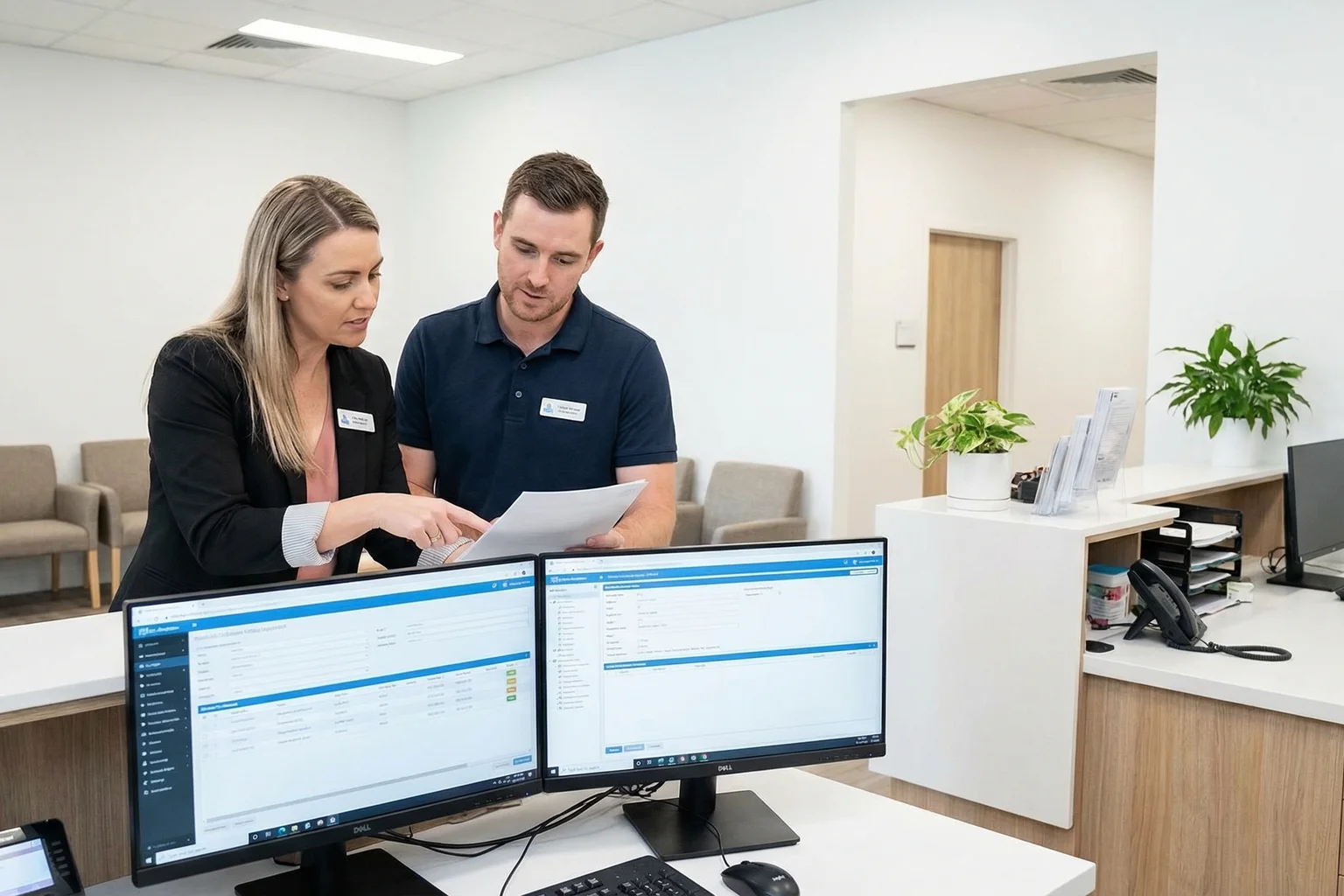
You just hired a front desk coordinator. Smart, motivated, great in the interview. In six months, maybe they’ll be good at the job. Until then, your best staff member spends 15-20 hours per week training them while fielding their constant questions.
Then at month eight, they quit. The cycle repeats.
Medical practice managers know this pattern too well. Admin staff turnover in healthcare runs 30-40% annually. At $15-25K cost per replacement, a single six-person front desk team spends $90-150K per year just replacing people.
But the real cost isn’t the hiring. It’s the training.
The training burden nobody tracks
Most practices estimate 2-3 weeks to onboard a front desk employee. The reality is closer to 3-6 months before a new hire works alone (MedTrainer Healthcare Onboarding Study, 2025). Here’s why:
Week 1-2: Survival mode
- Phone system basics
- Finding things in the EHR
- Basic scheduling templates
- Standard scripts for common questions
Week 3-8: The exception flood
- “Wait, Dr. Chen doesn’t see new patients on Fridays”
- “This patient needs workers comp but I don’t know the forms”
- “Insurance shows out-of-network but they’re in-network somehow”
Month 3-6: Specialty knowledge
- Which providers take which insurance
- Prior auth workflows per payer
- When to escalate vs when to handle
- Practice rules that aren’t written down anywhere
During this entire period, someone else answers their questions. Your best front desk staff member becomes a full-time trainer while trying to do their actual job.
What training really costs medical practices
Let’s calculate the real cost:
Trainer time: 15-20 hours per week x 12 weeks = 180-240 hours Trainer hourly cost: $22/hour (median front desk rate + benefits) Direct training cost: $3,960-5,280 per new hire
New hire reduced output: 6 months at 60% effectiveness vs full output Lost work: 40% x $22/hour x 2,080 hours/year x 0.5 years = $9,152
Errors and rework: Missed appointments, wrong billing info, scheduling mistakes Error cost: $2,000-4,000 per new hire (conservative estimate)
Total training cost per new hire: $15,000-18,500
With 30-40% turnover on a six-person team, that’s 2-3 replacements per year.
Annual training cost: $30,000-55,000
And this assumes training goes smoothly. It often doesn’t.
Why training takes so long (and keeps getting harder)
Three factors make front desk training a growing problem:
1. Complexity keeps rising More insurance plans with different rules. Expanded services needing different workflows. New prior auth requirements every quarter. State telehealth regulations that keep changing.
2. Insider knowledge isn’t documented “Just ask Sarah” doesn’t scale when Sarah is training three people. Policy manuals are 6-18 months out of date. Exception handling lives in people’s heads. Provider preferences change but nobody updates the guide.
3. Patient expectations have shifted Patients expect instant answers. Hold times over 2 minutes trigger complaints. Training period means longer hold times. That means worse patient experience. New staff nervousness shows in their voice. Patients sense it.
The traditional solution: throw money at it
Practices try various approaches. All are expensive:
Higher wages to reduce turnover Paying $18-20/hour instead of $15-17 cuts turnover by maybe 10-15%. It doesn’t remove the training burden when people still leave.
Outsourced answering services Cost: $1,500-3,000/month. They take messages. They don’t schedule, answer questions, or access your EHR. Callback burden falls on your trained staff.
Training software and programs Cost: $2,000-5,000/year. Helps standardize onboarding checklists. Doesn’t reduce the 3-6 month ramp time. Doesn’t free up trainer hours.
Adding extra staff to absorb training Adding an extra person just to cover training periods costs $50-70K annually (salary + benefits). And you still need someone to train them.
None of these solutions remove the core problem. Someone has to know how your practice works. Teaching that knowledge takes months.
How AI removes training bottlenecks
Voice AI for medical practices flips the model.
Instead of training the AI on your workflows, the AI analyzes your existing call recordings to mirror your best staff practices.
How it works:
Phase 1: Learning (7-14 days) AI reviews 2-4 weeks of call recordings. It spots common call patterns and how staff resolve them. It maps provider schedules, insurance rules, and when to escalate. It builds a model of “how this practice operates.”
Phase 2: Supervised operation (14-30 days) AI handles routine calls with staff watching. It flags uncertain situations for human review. It refines based on corrections. It escalates edge cases to keep patient experience strong.
Phase 3: Autonomous operation (30+ days) AI resolves 50%+ of inbound calls with no staff help. No hold times. Available 24/7. Consistent quality regardless of staff turnover. Human staff focuses on complex cases only.
The training burden disappears.
When your front desk employee quits, the AI doesn’t forget anything. New hires start with simpler roles. They handle only complex escalations the AI can’t resolve. Training time drops from 3-6 months to 2-3 weeks.
Note: All call recordings are processed under HIPAA-compliant infrastructure with BAA coverage.
Real numbers: Commonwealth Pain & Spine
Commonwealth Pain & Spine deployed Pretty Good AI voice automation to handle appointment scheduling, refills, and records requests across their practice locations.
Results in the first 90 days:
- 50%+ of calls resolved without staff involvement
- Hold times dropped from 2+ hours to under 5 seconds
- 13% of appointments booked after-hours, when no one was available to answer
- Front desk team shifted to patient experience and complex cases
Training impact: They hired two new front desk coordinators during the pilot. Training time dropped from 4-5 months to 3-4 weeks. The new hires didn’t need to master phone workflows because the AI already handled those.
Their practice manager put it simply: “We stopped losing what employees learn every time someone left.”
The economics change completely
Let’s recalculate costs with voice AI:
AI platform cost: $3,000-5,000/month (varies by call volume)
Training cost reduction:
- Before: $30,000-55,000/year in training burden
- After: $8,000-12,000/year (simplified onboarding only)
- Savings: $22,000-43,000/year
Turnover cost reduction: When roles become easier and less stressful, turnover drops. Even a modest 10-15% reduction in turnover saves $15,000-22,500 annually (at $15-25K per replacement x 30% turnover x 10-15% improvement).
Staff productivity gain: Your best employees stop spending 15-20 hours per week training. They handle complex cases and build relationships with patients. That’s 780-1,040 hours per year of senior staff time redirected to high-value work.
Total annual benefit: $60,000-100,000+
Break-even: 30-60 days
What this means for growing practices
The training bottleneck caps practice growth invisibly.
You can’t add providers faster than you can hire and train front desk staff. At 3-6 months training time, expanding to a new location or adding two providers requires planning front desk hiring 6+ months in advance.
Voice AI removes this constraint. Add a provider tomorrow. The AI already knows how to schedule them, verify insurance, answer questions, and route calls right.
This is what makes scaling possible:
- Multi-location expansion without adding front desk staff at the same rate
- New provider ramp-up in weeks instead of months
- Less dependence on star employees who hold all the knowledge
- Easier to predict costs (no surprise training expenses from turnover spikes)
Implementation: what actually happens
Weeks 1-2: Setup Upload 2-4 weeks of call recordings (or start recording). Configure EHR integration for live scheduling access. Set escalation rules (what gets routed to humans). Test with internal staff calls.
Weeks 3-4: Pilot AI handles part of inbound calls (typically 25-50%). Staff monitors and provides corrections. System refines based on real interactions. Metrics tracked: resolution rate, patient satisfaction, escalation volume.
Week 5+: Scale AI percentage increases based on performance. Target 50-70% auto-resolution within 60 days. Staff transitions to complex-case focus. Training burden drops right away for next hire.
No major system changes. No workflow redesign. No staff replacement.
The AI learns how you already work. Then it does that work.
The next hiring cycle looks different
When you hire your next front desk coordinator:
Training checklist (old model):
- Phone system: 40 hours
- EHR basics: 30 hours
- Scheduling workflows: 60 hours
- Insurance verification: 25 hours
- Provider preferences: 40 hours
- Specialty protocols: 50 hours
- Exception handling: 80+ hours
Total: 325+ hours (8 weeks full-time)
Training checklist (with AI):
- EHR for complex cases: 15 hours
- Escalation handling: 20 hours
- Patient relationship skills: 15 hours
- AI handoff protocols: 10 hours
Total: 60 hours (1.5 weeks)
Your new hire spends less time learning scripts. They spend more time learning to be excellent at the 20% of calls that truly need human judgment.
Ready to stop bleeding $60K per year?
If your practice spends more than $40K annually on front desk training and turnover (most multi-provider practices do), voice AI pays for itself in under 60 days.
Every practice thinks their workflows are too unique for automation. Then they watch the AI adapt to controlled substance rules, workers comp protocols, and provider-specific scheduling preferences in under 2 weeks.
Your next hire learns in weeks what used to take months. They succeed faster. They stay longer. And your best staff stops living in training mode.
Schedule a 30-minute demo. We’ll show you exactly what 6 months of training looks like compressed into 2 weeks. Book your demo ->
Stop Paying the Training Tax Every Time Someone Quits
PGA onboards in 30 days and never quits. Every call handled correctly on day one — no 6-month ramp.
Book a Demo →Written by Kevin Henrikson