Practice Operations
Real-Time Insurance Verification for Urgent Care
Urgent care verifies coverage at the door, not days ahead. How AI runs real-time eligibility so registration is not the thing holding up the visit.
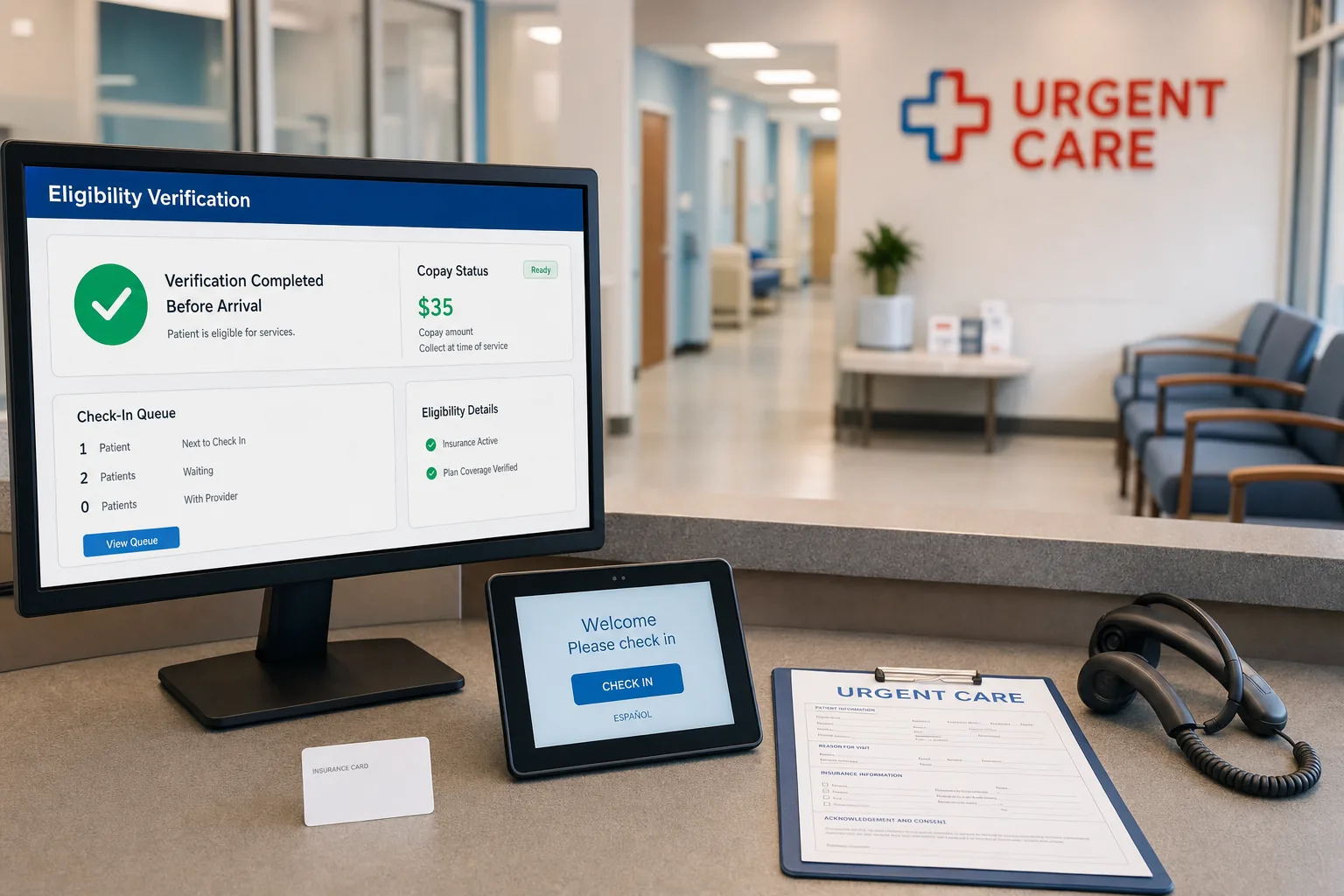
A patient walks into your urgent care center at 11am on a Saturday. They have a sprained ankle. They filled out a paper form in the waiting room. Your front desk staff is now on hold with a payer trying to confirm whether that patient’s insurance is still active, because the card they handed over expired three months ago.
In the meantime, the patient waits. The front desk staff cannot check in the next patient. And your average door-to-provider time ticks upward.
This is the urgent care insurance verification problem. It is not a technology problem in the sense that the technology does not exist to solve it. The technology exists. It is a workflow problem: insurance verification at most urgent care centers still happens at the point of care, with the patient standing at the desk, instead of before the patient arrives.
AI voice agents integrated with athenaOne fix this by moving verification earlier in the patient journey, without requiring patients to do anything they were not already doing.
The urgent care insurance problem is worse than in other settings
Urgent care occupies an unusual position in the insurance verification spectrum. Patients arrive unscheduled. Or they call ahead with two hours’ notice. There is no appointment booked weeks in advance where a staff member has time to run eligibility and call the patient back if something is wrong. The same compressed timeline shapes what you can ask afterwards, which is why a single-question follow-up beats a survey nobody finishes.
A typical urgent care center sees roughly 25 to 40 patients a day, and a busy center can top 50 in peak season (Experity visit data). A meaningful share of those patients have an insurance discrepancy at check-in, a lapsed plan, a changed payer, a dependent who aged off coverage, a copay that is different than the patient expects. Each discrepancy takes 8 to 12 minutes to resolve manually.
On a busy Saturday with 80 patients, that is 12 to 16 discrepancy calls. Some of those are resolvable at the desk. Some require the patient to call their insurer themselves. Some result in the patient declining to provide correct insurance, leaving the center to write off the visit or chase collections.
The front desk staff handling those 12 to 16 calls could be checking in the next three patients in that same window. They are not. They are on hold.
How AI moves verification out of the waiting room
The solution is not faster verification at check-in. It is verification before check-in.
When a patient calls to let your urgent care center know they are coming in, or when they book online, or when they call with a question, the AI voice agent handles insurance intake as part of the intake conversation.
“Before you come in, can I confirm your insurance information? I’ll verify your coverage now so check-in is faster when you arrive.”
Most patients say yes. The AI collects their insurance card details verbally, runs real-time eligibility verification through athenaOne, and updates the patient record before the patient arrives. If there is a discrepancy (the plan is inactive, the copay is different than expected, the patient is listed as secondary instead of primary), the AI flags it and routes an alert to the front desk with the details.
When the patient arrives, the front desk staff can see the verification status in athenaOne before they pick up the clipboard. If the insurance is clean, check-in takes 90 seconds. If there is a flagged issue, the staff already knows what the issue is and how to address it.
What about walk-ins who do not call ahead
Walk-in volume is the constraint that cannot be fully automated. A patient who arrives without calling ahead still requires point-of-care verification.
AI does not eliminate that problem. It reduces it. If 60% of your urgent care volume calls ahead or books online, and you can verify insurance for all of those patients before arrival, you have cut your check-in verification queue by 60% before the day starts. Your staff handles walk-in discrepancies with the bandwidth they used to spend on scheduled patients who called ahead.
For true walk-in volume, the AI’s contribution is speed rather than pre-verification. The AI can retrieve the patient’s existing insurance record from athenaOne instantly if they have been seen before, reducing re-verification to an update check rather than a full intake. For new patients, the AI can begin the intake conversation at the kiosk or via a text link sent to the patient’s phone while they wait, collecting information passively while the patient sits.
The prior authorization overlap
Urgent care prior authorization volume is lower than hospital or specialty care, but it is not zero. Imaging is the primary prior auth trigger in urgent care, CT scans, X-rays for complex fractures, and MRI for soft tissue injuries that might require surgical follow-up.
The authorization workflow for urgent care imaging typically requires a same-day or near-same-day turnaround, which means faxing or calling the payer within a narrow window while the patient is still in the center. AI voice agents integrated with athenaOne handle the administrative layer of this workflow, initiating the auth request, checking status, and routing alerts when authorization is received or denied, without requiring a staff member to track the status manually.
For urgent care directors managing multiple locations, the volume of same-day auth requests across sites can be significant. A centralized AI handling auth tracking across all locations, with status updates logged in athenaOne, reduces the coordination overhead of running a multi-location urgent care operation.
What directors of operations are measuring
Urgent care performance metrics where AI-assisted insurance verification shows up most clearly:
Door-to-provider time. When check-in friction decreases, patients move from arrival to triage faster. The average urgent care center is targeting 20 minutes or less door-to-provider. Manual insurance verification at check-in regularly adds 8 to 15 minutes to that number for patients with discrepancies.
Claim denial rate. Verification errors at check-in are a primary driver of front-end claim denials. A patient seen with incorrect insurance on file creates a denial that requires a rework cycle, calling the patient, getting correct information, resubmitting. Moving verification earlier reduces the input error rate and therefore the denial rate.
Collections per visit. When co-pays and deductibles are confirmed before the patient arrives, collection at point of service increases. Patients who arrive expecting a $30 copay and are told at checkout it is $75 do not always pay it before they leave. Patients who are told in advance tend to arrive prepared.
Key takeaways for urgent care operators
- A meaningful share of urgent care patients have an insurance discrepancy at check-in: each one takes 8 to 12 minutes to resolve manually
- Pre-arrival verification via AI moves the problem out of the waiting room: AI collects and verifies insurance during the pre-visit call or booking flow
- athenahealth-native integration means no reconciliation: verification results write directly to the patient record
- Walk-in volume is managed differently: AI reduces walk-in verification friction through returning patient record retrieval and in-wait intake
- Multi-location operators see compounding benefits: centralized AI configuration means consistent verification protocols across every site
- Claim denial reduction is the financial case: front-end verification errors are the most common source of avoidable claim denials in urgent care
The urgent care competitive pressure
Independent urgent care centers still face convenience competition: health systems are aggressively building urgent care networks, and even as big-box retail health retrenched in 2024 (Walmart Health closed; Walgreens shed roughly half its VillageMD clinics; CVS trimmed MinuteClinics), patient expectations for fast, frictionless visits that those players set have not gone away. The patient experience at check-in, the first thing a patient encounters, is a direct competitive variable.
A center that moves patients from door to provider in 18 minutes because verification happened before arrival is going to earn different reviews than a center where patients wait 35 minutes because front desk staff is on hold with a payer.
AI-assisted insurance verification is not a back-office efficiency play for urgent care. It is a patient experience play that happens to also improve collections and reduce denials.
Sources:
- Urgent Care Association, Urgent Care Industry Data (urgentcareassociation.org/about/urgent-care-data/, accessed 2026)
- Urgent Care Association, 2023 Urgent Care Industry Benchmarking Report
- MGMA, “Front-End Revenue Cycle Benchmarks for Ambulatory Practices”
- AHA Market Scan, “Walgreens, CVS and Walmart Scale Back on Health Care” (Nov 2024)
See how Pretty Good AI handles insurance verification for urgent care centers
Ready to reduce missed calls?
15-minute demo. See how an AI team works inside your athenaOne practice.
Schedule a Demo →Written by Kevin Henrikson