Practice Operations
Urgent Care Scheduling at Peak Call Volume
Urgent care centers face unpredictable demand spikes that break traditional scheduling. AI handles volume surges without proportional headcount increases.
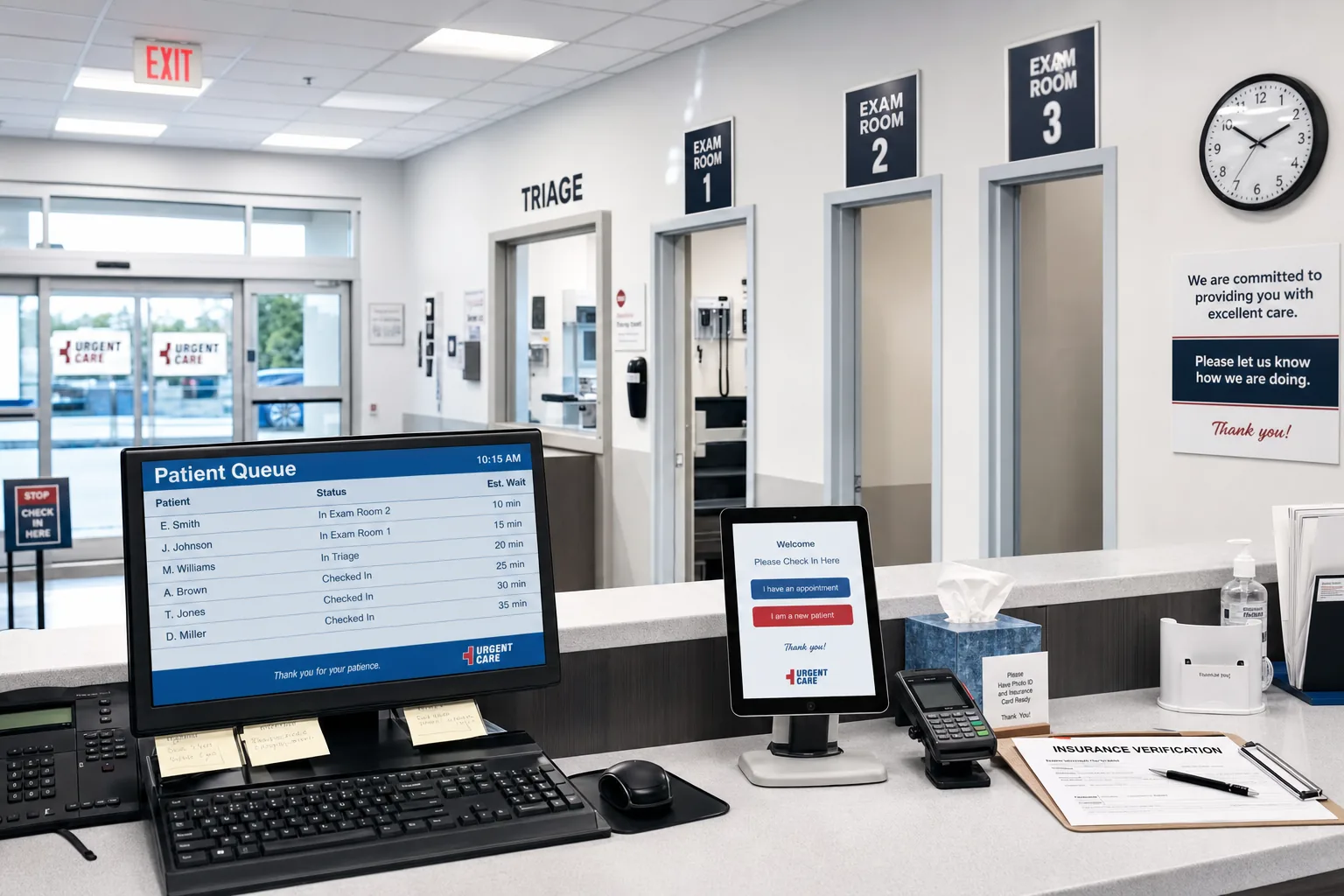
Urgent care scheduling AI solves a problem that appointment-based scheduling systems were never designed to handle: unpredictable walk-in volume on top of a call queue that spikes without warning.
A traditional medical practice schedules by appointment. A patient calls, a staff member books a slot, the day fills predictably. Urgent care does not work that way. Monday morning after a holiday weekend, the phones ring 400 times before noon. A walk-in flu surge hits Thursday with no advance notice. A school in the service area releases a food allergy advisory and forty calls come in before your front desk staff has finished their morning huddle.
The standard response to urgent care volume spikes is simple and expensive: more people answering phones. The problem is that staffing for your peak demand means overstaffing for the other 70% of your operating hours. AI scheduling tools built for urgent care change this calculus by absorbing volume spikes without requiring headcount that sits idle most of the time.
Why urgent care volume is fundamentally different from scheduled practices
Urgent care volume does not follow the patterns that appointment-based scheduling was designed around.
Walk-in patients arrive without notice. Phone volume often reflects acute illness patterns (flu season, local outbreaks, sports injury spikes) that are partially predictable at the seasonal level but not at the daily or hourly level. When your call volume doubles, it rarely doubles evenly. It arrives in bursts. Your front desk staff either answer the phones or help the walk-in patients standing at the desk. They cannot do both at once.
The result is that urgent care centers routinely miss calls during peak periods. A patient who calls and gets a busy signal or a 20-minute hold does not wait; they go to a competitor or arrive as a walk-in in a worse clinical state. Every missed call is a potential lost visit that cost your front desk’s time to not capture.
According to the Urgent Care Association, more than 15,000 urgent care centers operate in the United States, up from about 9,000 in 2016, with continued growth driven by patients seeking care outside of emergency rooms and primary care offices. That growth has intensified competition. When two urgent care centers are within two miles of each other, the one that answers the phone wins the visit.
What urgent care scheduling AI actually does
AI scheduling for urgent care handles the structured, high-volume tasks that consume your front desk staff during peak periods: appointment confirmation, wait time inquiries, insurance verification routing, and follow-up scheduling for patients who were seen and need a return visit.
Wait time and availability queries. The majority of urgent care phone calls during peak hours are patients asking one question: how long is the wait right now? An AI voice agent reads current wait time from the practice management system and answers that question without pulling a staff member off the floor. For centers with online check-in, the AI can also route patients to the queue without a phone interaction.
Follow-up and recall scheduling. Patients who visited for a laceration repair, strep culture, or UTI treatment often need a follow-up appointment or a call to discuss lab results. AI handles outbound follow-up scheduling calls, sends reminders, and logs confirmations, without staff making individual calls during what is already your most congested operational period.
Insurance verification routing. Urgent care centers deal with a different insurance verification challenge than scheduled practices: patients arrive without prior notice, and staff need to verify coverage before the visit starts or before discharge. AI can handle the inbound call from a patient asking whether their insurance is accepted, check coverage in real time, and route exceptions to staff rather than starting the verification process from scratch on every call.
After-hours screening and routing. Patients call urgent care after hours when they are not sure whether their symptom needs an emergency room or can wait until morning. AI voice agents use a symptom screen and red-flag rules provided by the practice: lower-risk calls can receive the next opening and an offer to schedule, while emergency indicators route the caller to 911 or the nearest ER. The agent does not diagnose or decide the clinical outcome; it acts like a front desk that recognizes the route and gets the concern to the right place.
The staffing math
The typical urgent care front desk handles three to five calls per hour at baseline. During a volume spike, call volume can reach fifteen to twenty calls per hour per location. That is a 3-4x surge that most centers cannot absorb without either dropping calls or pulling clinical staff to answer phones.
AI scheduling absorbs the routine call categories (wait times, follow-up scheduling, insurance questions, after-hours routing) without adding headcount. For a center that handles 80 calls per day with 40% falling into routine categories, AI automation means your staff handles 48 calls instead of 80 while maintaining the same service level on patient-facing interactions. During a 300-call spike day, that ratio matters more.
The financial case does not require complex modeling. If a missed call converts to a visit at an average revenue of $180, a center that recovers 10 missed calls per day through AI-assisted call handling recovers $1,800 per day in visits that would otherwise have gone to a competitor. That math compounds across the year. The same intake that captures the visit also decides whether the claim survives, and how peak volume and intake errors break urgent care billing is the back half of the same equation.
What to look for in urgent care AI scheduling tools
Not all AI scheduling tools work with urgent care’s operational model. Before selecting a system, centers should verify a few specific capabilities.
Real-time wait time integration. An AI that reads static data will give patients inaccurate wait times, which creates frustration when they arrive. The system needs to read live queue data from your practice management platform.
Walk-in queue management. Appointment-focused AI tools frequently lack walk-in queue logic. Urgent care needs a system that handles both appointment holders and walk-ins in the same scheduling workflow.
After-hours clinical routing. The system needs practice-owned red-flag rules for symptom screening, which reports get directed to 911 or the ER, which get sent to the on-call team, and which get offered a next-morning appointment. This requires input from your clinical team and is not something you want the vendor deciding unilaterally.
EHR integration. For centers on athenahealth, native integration means the AI reads and writes to the same system your clinical staff uses. Data from the AI interaction, insurance verification status, appointment confirmation, patient-provided symptom summary, should appear in the patient record without manual transcription.
The patient experience side
Urgent care patients have high expectations and low tolerance for friction. They are usually dealing with an acute health concern, often with a sick child or an injury that is distracting them. A phone system that puts them on hold for eight minutes or fails to answer after hours does not just lose a visit, it creates a patient who actively chooses a competitor the next time.
AI voice agents handle these interactions differently than IVR menus. A patient calling to ask about wait times does not want to press 1 for appointments, 2 for billing, 3 for hours. They want to say “how long is the wait right now” and get an answer in under 10 seconds. Conversational AI built for urgent care handles that interaction without menus, without hold times, and without transferring to a staff member for a question that does not require human judgment.
What changes operationally
Urgent care centers that deploy AI scheduling consistently report the same operational shift: staff spend less time on the phone and more time helping patients who are physically present in the center.
That shift matters because urgent care quality is evaluated in person. A patient who is seen quickly, feels heard, and gets clear discharge instructions will return. A patient who waited 20 minutes to get someone on the phone before even arriving is already in a worse mindset when they walk through the door. Reducing the phone friction that happens before the visit changes the patient experience at the point of care, before your clinical team has said a word.
Key takeaways
- Urgent care call volume spikes are unpredictable and cannot be reliably absorbed by staffing for peak demand alone.
- AI scheduling absorbs the high-volume routine call categories, wait times, follow-up scheduling, insurance questions, after-hours routing, without additional headcount.
- Every missed call during a peak period is a potential lost visit at full urgent care revenue. AI reduces that miss rate.
- Real-time wait time integration, walk-in queue management, and EHR integration are required for urgent care AI to function correctly, verify these before selecting a vendor.
- Native athenahealth integration eliminates manual data entry and keeps AI interaction data in the clinical record.
- Patient experience during the phone interaction predicts the in-person visit experience. Lower phone friction produces better clinical encounter conditions.
See how Pretty Good AI handles urgent care scheduling at peak volume
Sources:
- Journal of Urgent Care Medicine. Two AI Trends That Will Change Urgent Care. JUCM, 2025.
Ready to reduce missed calls?
15-minute demo. See how an AI team works inside your athenaOne practice.
Schedule a Demo →Written by Kevin Henrikson