Industry Insights
Why Voice AI Beats Chatbots for Medical Practices
Patients abandon text-based medical chatbots at high rates. Voice AI keeps conversations going. See why practices are switching to voice automation for access.
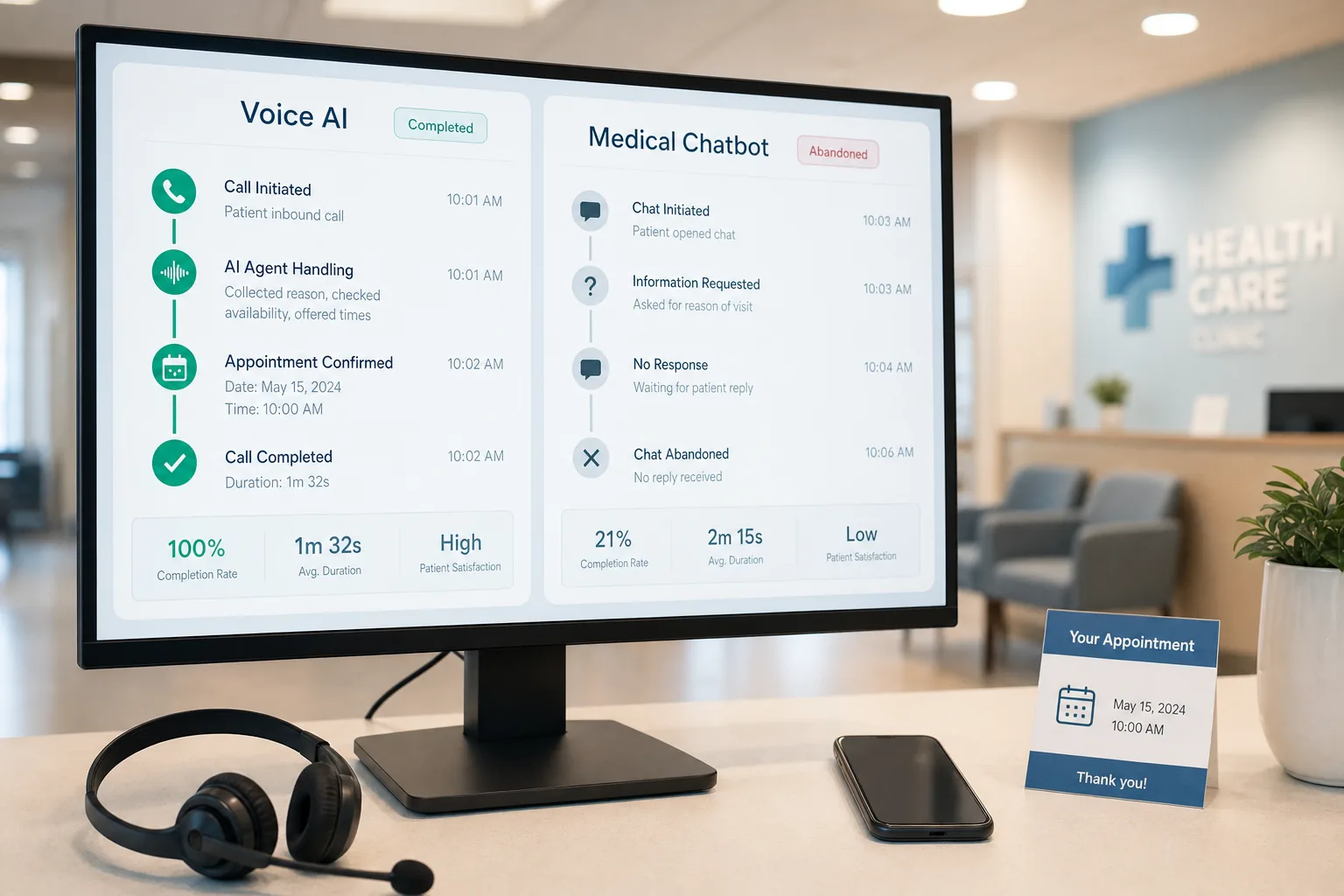
Medical practices are drowning in administrative tasks. Missed calls, scheduling bottlenecks, and staff burnout are pushing clinics to breaking point. Automation promises relief, but which technology actually works?
Chatbots have become the default answer. They’re cheap, easy to deploy, and every vendor is selling them. But here’s what practices are finding: patients hate them, staff don’t trust them, and they create more work than they solve.
Voice AI takes a different approach. Instead of forcing patients to type their way through rigid menus, it handles conversations the way humans do, by speaking. The results are not incrementally better. They represent a different category of outcome.
The chatbot reality check
Chatbots sound compelling in sales demos. Instant responses. 24/7 availability. No staff required. Thousands of practices have deployed them over the past five years. Here’s what they’re reporting:
Low completion rates. A small share of patients who encounter medical chatbots complete their intended task. The rest abandon and call your office anyway, now frustrated.
Accuracy gaps. Chatbots struggle with medical terminology, insurance nuances, and anything outside their script. When they fail, they create rework. Your staff now has to correct misinformation while the patient is annoyed.
Channel friction multiplied. Trace the patient journey: they call your office, hear voicemail, get directed to a website, open a chat window, type their question, wait for a response, get a canned answer, then call back anyway. You haven’t reduced steps, you’ve added them.
Zero empathy in a high-empathy field. Healthcare is personal. Patients are scared, confused, or in pain. A typing interface can’t convey warmth. You’ve replaced human connection with a form submission.
Why voice works differently
Voice AI doesn’t try to replace human conversation. It engages in it. When a patient calls, they hear a natural voice. They speak their request. The AI understands, responds, and takes action. No typing. No menus. No app download.
Patients actually use it
Voice requires no behavior change. Patients call, talk, and it works. Practices can compare completed calls and transfers against their existing phone baseline. The interface is already familiar: it’s called a phone call. What the call has to establish changes when there is no insurer in the middle, which is how intake expectations get set when a patient is paying directly.
It handles real conversations
Modern voice AI manages context, interruptions, and multi-turn conversations. A patient can say, “I need to reschedule Thursday, and also check if you take Blue Shield,” and get both answers in one call.
Chatbots require separate workflows for each task. Voice AI handles requests the way your front desk does, by listening and responding naturally.
It works where patients already are
Your phone doesn’t stop ringing. Patients will call. Voice AI answers those calls and resolves them end-to-end, including transfers to staff when needed. No channel switching. No apps. No friction.
Chatbots require patients to move from phone to web to app. Every channel switch creates dropout. Voice AI eliminates those transitions entirely.
Direct EHR integration
Voice AI platforms built for healthcare connect directly to systems like athenaOne. When a patient schedules an appointment, verifies insurance, or requests a prescription refill, the AI reads from and writes to your EHR in real-time, just like your staff would.
Most chatbots sit on your website with no backend connection. They collect information your team manually processes later. That’s not automation. That’s an extra data entry step.
Healthcare-grade voice AI also comes with HIPAA-compliant Business Associate Agreements. Many chatbot vendors don’t offer BAAs at all.
It sounds human
This isn’t robotic text-to-speech. Modern voice AI uses neural voice models that convey warmth and adapt tone to context. Patients often don’t realize they’re speaking with AI until it connects them to a staff member.
Chatbots feel mechanical because they’re text boxes. Voice AI feels natural because it uses the most human interface we have.
The business-case math
Chatbots can look simpler upfront. That’s the pitch. But the total cost of ownership tells a different story.
Chatbot TCO:
- Lower apparent entry cost
- High abandonment, poorly designed chatbots lose most patients before the task is done
- Staff time fixing failed interactions
- Missed appointments from incomplete bookings
- Patient frustration driving churn
- Zero impact on missed calls
Voice AI TCO:
- Technology assessment depends on workflow scope and volume
- High completion rate on live deployments, far above what text chatbots achieve
- Direct EHR integration (no manual rework)
- Handles missed calls and gives practices a way to measure recovered access
- Measurable improvement in patient satisfaction
- Documented reduction in staff burnout
Practices should evaluate ROI from measured recovered access, staff time, and completed workflows. Chatbots rarely solve the core problem when a patient’s phone call still goes unanswered.
Results speak louder than features
Practices that deploy chatbots often keep them as a checkbox (“We have AI!”) but continue hiring more front desk staff. The technology doesn’t reduce workload, it adds another channel to manage.
Practices using voice AI can track:
- Missed calls before and after implementation
- Routine administrative call volume over comparable periods
- Staff time redeployed from phone triage to care coordination
- Patient satisfaction through post-call surveys and other defined measures
The core difference: chatbots ask patients to change their behavior. Voice AI meets them where they are.
Staff augmentation, not replacement
A common concern: “Will AI replace my front desk team?”
No. Voice AI handles the repetitive, high-volume calls, appointment scheduling, prescription refills, insurance verification. Your staff handles complex cases, patient education, and situations requiring judgment or empathy.
The result? Your team stops being glorified phone operators and starts doing the work they were hired for. Burnout drops. Retention improves. Job satisfaction goes up.
When chatbots make sense (rarely in healthcare)
Chatbots work well for:
- Simple FAQ lookup (“What are your hours?”)
- E-commerce product browsing
- Low-stakes transactions where dropout doesn’t matter
They struggle with:
- Complex scheduling that requires insurance verification
- Empathetic interactions with anxious or frustrated patients
- Multi-step workflows requiring live EHR access
- Anything where failure means lost revenue or patient churn
If your goal is to check an innovation box, deploy a chatbot. If your goal is to reduce missed calls, improve patient access, and free your staff from phone burnout, deploy voice AI.
The choice is clear
Your patients are calling right now. Some are hearing voicemail. Some are hanging up. Some are booking with your competitor who answered.
Chatbots won’t fix that. They add a web channel to manage while your phone still goes unanswered.
Voice AI solves the actual problem. It answers the phone. It handles the conversation. It completes the task. Your patient is served, your staff is freed up, and you didn’t lose revenue.
That’s a different operating model, not a marginal improvement.
Ready to hear the difference? Book a 15-minute demo where we’ll show you voice AI handling a live call to a practice, scheduling an appointment, verifying insurance, and transferring to staff. No slides. Just results.
See How It Works in Your Practice
A 15-minute live demo shows voice AI handling a real patient call, scheduling, insurance verification, and EHR lookup. No slides, no pitch deck.
Book a 15-Minute Demo →Written by Kevin Henrikson