Industry Insights
Why Medical Practices Miss Patient Calls
Practices miss patient calls at predictable hours, not at random. How to measure the gap, find the hours that leak, and decide whether voice AI closes it.
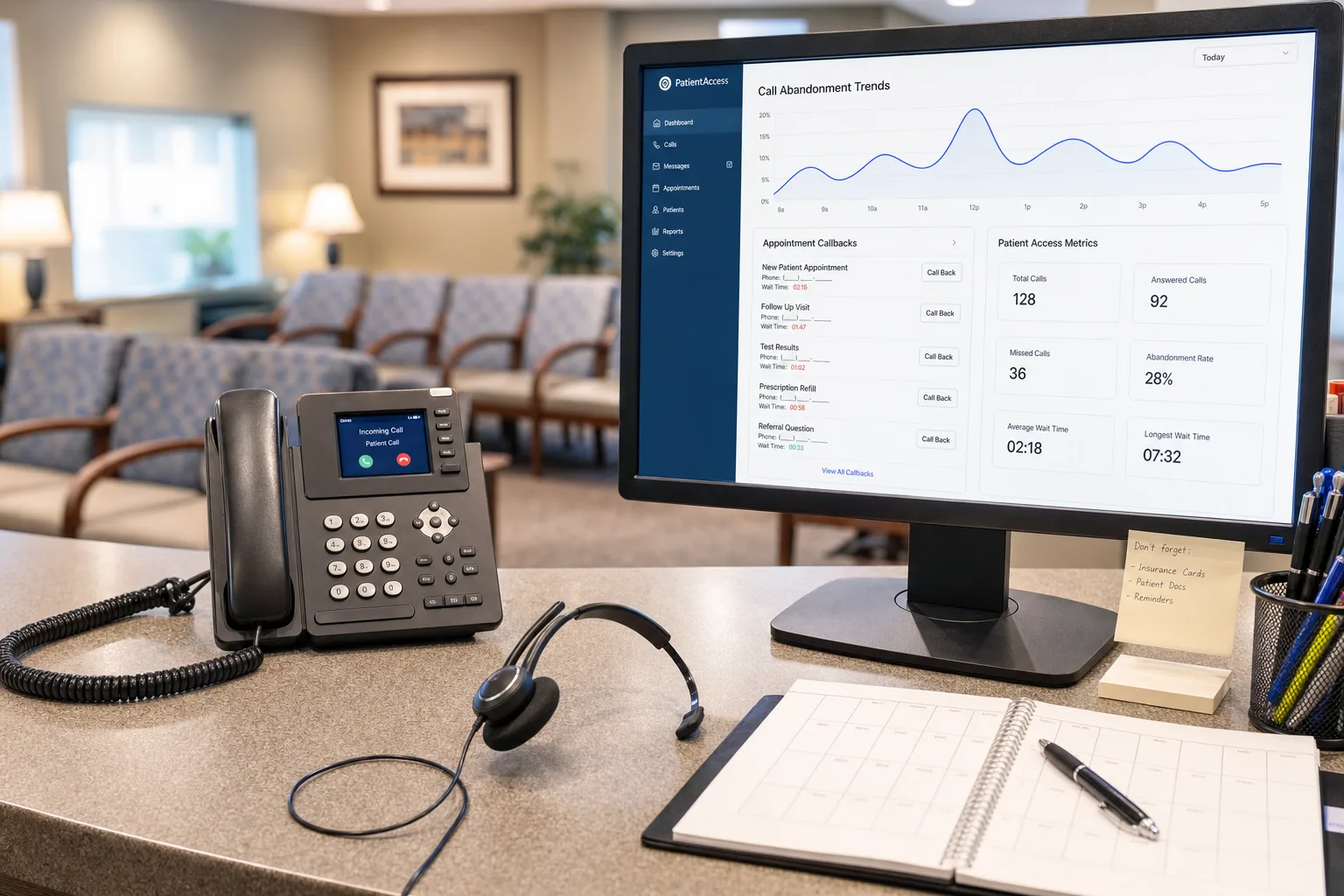
Medical practices miss patient calls for two reasons, and only one of them is staffing.
The first is timing. Calls do not arrive evenly. They stack into a few predictable windows, and the front desk is busiest with in-person work during exactly those windows.
The second is call length. The calls that consume the most staff time are the ones with payer rules or scheduling rules underneath them. In a March 10, 2026 MGMA Stat poll of 294 practice leaders, the most time-consuming phone tasks were eligibility and prior authorization at 45% and scheduling at 31%, with intake at 9%, prescription refills at 6%, and everything else at 9%. Three quarters of the burden sits in two categories, both of which require somebody to look something up in the practice management system while the patient waits.
That combination is what produces a miss rate. A short call that arrives in a quiet hour gets answered. A long call that arrives in a busy hour becomes hold time, and hold time becomes an abandoned call.
Which means the fix is not a general instruction to answer the phone faster. It is a specific one: find the hours that leak, find the call types that take the longest, and decide which of those you can complete without a person.
The hours that leak are the same everywhere
Pull a week of call detail records from your phone system and the shape is consistent across specialties.
Monday between 8am and 10am. The weekend’s voicemail, the weekend’s symptoms, and the week’s rescheduling all arrive at once, into a front desk that is also checking in the day’s first patients.
The lunch hour. Coverage drops by half or more while call volume does not. Practices often see their highest abandonment rate here, and it is rarely on anyone’s dashboard because the daily average smooths it out.
The first thirty minutes after close. Patients call when they leave work. Nobody is there.
The two days after any provider schedule change. A provider goes out, a template gets rebuilt, and every affected patient calls in the same 48 hours. This is the spike nobody staffs for because it does not repeat on a weekly cycle, and it runs on the same roster data that decides whether a night call reaches the right surgeon.
None of those four are a performance problem. They are a capacity mismatch, and staffing to the peak means overstaffing every other hour of the week.
How to measure the gap before you buy anything
Most practices do not know their real miss rate, because the number they quote is an average and the damage happens in the tails.
It is also worth being honest about how much of this the patient portal has absorbed, which is less than most vendor decks suggest. An MGMA Stat poll on digital self-scheduling found 71% of practices have fewer than one in four patients self-scheduling, 21% are between a quarter and a half, 5% are between half and three quarters, and only 3% are above three quarters. For the large majority of practices, the phone is still the front door, and the calls that remain are disproportionately the complicated ones.
Here is the pull that actually tells you something. Four numbers, one week, by hour:
- Offered calls by hour of day and day of week. Not daily totals. The hourly curve is the whole point.
- Abandonment rate by that same hour. Where the two curves diverge is your leak.
- Average time to answer in your three worst hours. Compare it to your best three. The gap is what a patient experiences as “they never pick up.”
- Voicemails left versus voicemails returned same day. This is usually the most uncomfortable number in the set.
Then do one thing your phone system cannot do for you: take the busiest hour and classify fifty calls by what the caller actually wanted. Scheduling, eligibility, a refill request, a records request, a billing question, a referral. You now know which of your leaks are worth automating and which are worth rerouting.
If you want the full version of this as a standing report rather than a one-off exercise, the front-office scorecard lays out the metric set and the review cadence.
Why the usual fixes stall
Every practice administrator has already tried the obvious things.
Hiring. Front-office roles turn over faster than almost any other seat in the practice. MGMA’s 2023 Practice Operations data report put front-office turnover at 40% in 2022, against 33% for clinical support and business operations support staff. The problem is not only the cost of the hire, it is that the training clock restarts before the last hire reached full speed, and phone competence is the slowest competence to build.
Phone trees. A menu moves the wait rather than removing it. It also pushes the hardest callers, the ones who do not fit a menu option, into the longest path.
Voicemail with a callback queue. This converts a missed call into a task, which is progress, but the task lands in the same understaffed queue that could not take the call. Callbacks slip, and a patient who has already been unable to reach you once is not inclined to wait.
Outsourced phone coverage. Somebody picks up, which helps the abandonment number. But a team outside your practice cannot see your provider templates, your appointment types, or your eligibility responses, so the call ends in a message rather than a booked visit. You have moved the work, not finished it.
The pattern across all four is the same. Each one addresses the greeting. None of them addresses the reason the call was long.
The hard part is the slot, not the greeting
This is where most discussion of missed calls goes wrong, and it is the part that matters if you run on athenaOne.
The MGMA poll is specific about why scheduling calls consume so much time: appointment openings are limited for complex visit types, specific providers, and procedure slots, which forces back-and-forth and phone tag. Practices with online scheduling still field the calls, because the exceptions are what people call about. A genuinely new patient cannot find the right opening. A visit type needs a companion visit booked with it. A provider’s availability has a rule attached that is not visible on the web scheduler.
Anyone who has configured athenaOne scheduling knows the texture of this:
- Generic template slots. Practices build schedules out of “Any 15” and “Any 30” slot types, and a search for a specific appointment type will return a generic slot. Whether that generic slot is genuinely eligible for this appointment type, for this provider, in this department, is the central ambiguity in the whole workflow. A fifteen-minute opening is not usable for a forty-five-minute service, and nothing in the slot’s name says so.
- Minimum lead time that differs by patient status. A practice may need three or four business days before a new patient can be offered a slot, so forms are complete before the visit, while an established patient can book the next business day. Two rules, one calendar.
- Linked visits. Some appointment types can only be booked if a companion type can be booked too. Offering one without the other creates a cancellation later.
- Appointment-type catalogs that change without warning. They get consolidated, retired, and folded together by whoever maintains them, and every downstream rule has to be re-mapped.
Every one of those is a reason a call takes six minutes instead of ninety seconds. None of them is solved by answering faster.
What actually closes the gap
The practices that fix this stop trying to scale people to phone volume and start automating the call types that can be completed end to end.
The word that matters there is completed. A call that ends with a booked appointment written back into athenaOne is closed. A call that ends with a message for the front desk is a task you still owe. The difference between those two outcomes is not voice quality, and it is not the script. It is how deeply the system is integrated with the record.
Pretty Good AI holds production access to 820+ athenaOne APIs, which is why a call can resolve rather than deflect. On an inbound scheduling call that means reading the provider’s template and slot types, resolving whether a generic slot is eligible for the requested appointment type in that department, checking the patient’s status and the lead-time rule that applies to it, running eligibility, booking against real availability, and writing the appointment back into athenaOne with the reason for visit attached. Across customers, about 60% of calls are handled start to finish at the largest deployments, and that share is a function of how much of the record the system can read and write, not of how natural the voice sounds. That relationship between integration depth and completion rate is the single most useful thing to grade a vendor on.
We answer on voice and on secure two-way text, on the same athenaOne integration, so a patient who starts on the phone and finishes by text is one conversation rather than two.
The rest of the leak closes through work that never needed a phone call at all. Outbound confirmation and recall outreach removes inbound volume before it arrives. Waitlist backfill on cancellations turns a gap into a booked visit without anybody dialing. Order and tickler outreach works the list that usually waits for a slow week.
Customer-reported results. Your numbers will vary by workflow, staffing, seasonality and call mix.
What it looks like when the rules change under you
Automation of this kind is not set-and-forget, and any vendor who tells you otherwise has not run one.
A dermatology practice consolidated its appointment-type catalog. Cosmetic types, two biopsy durations, cryotherapy, and the generic procedure type were all retired and folded into a single follow-up type. The surviving type was fifteen minutes, so a forty-five-minute service no longer had anywhere to go. The practice still wanted the reason for visit to carry the specific service name on the booked appointment.
The change arrived without notice. Our engineer’s note back to the practice was blunt about wanting a heads-up next time, and the remap took a deliberate decision from the practice: keep the retired types internally, map them onto fifteen and thirty-minute equivalents, and carry the service name through as reason for visit.
That is the real shape of this work. The rule changed, the system flagged the conflict instead of silently booking wrong, and a human on each side agreed the new mapping. Calls that hit an unmapped type in the meantime routed to staff with the context attached rather than guessing.
Ask any vendor you are evaluating what happens on the day your appointment types change. The answer tells you more than the demo does.
Where this does not help
Two boundaries worth being clear about.
Clinical decisions stay with your care team. We handle the administrative call: booking it, verifying coverage, collecting what is needed, chasing the paperwork, and routing to the right person. Anything that requires clinical judgment goes to a clinician, with the context already gathered. Results calls are the sharpest version of that line, and where the automation stops on results notification is worth reading before you scope one.
A rule nobody can articulate cannot be automated. If two experienced schedulers handle the same request differently and neither can say why, that workflow needs a decision from the practice before any system can run it. This comes up in scoping more often than people expect, and finding it is a useful outcome even when the answer is not yet.
What to measure ninety days in
Go back to the same four numbers you pulled at the start, by hour, and add three.
- Abandonment rate in your three worst hours, against the baseline for those specific hours.
- Share of calls completed without staff involvement, which is the number that determines whether capacity actually came back.
- Same-day voicemail return rate, which should be approaching irrelevant if the queue is draining.
If the daily average improved but the worst hours did not, the leak is still there and the average is hiding it.
The bottom line
Missed calls are not a discipline problem and they are not a volume problem. They are a mismatch between when calls arrive, how long the hard ones take, and how many people are on the desk in that hour.
Measure the hourly curve. Classify what the callers want. Automate the call types that can be finished inside athenaOne, and route the rest to a person with the work already half done.
Your phones are ringing right now. The question is not whether somebody picks up. It is whether the call ends finished.
See how AI voice agents work at practices like yours.
Real demo, real human, no pressure.
Book a 15-Minute Demo → →Written by Kevin Henrikson